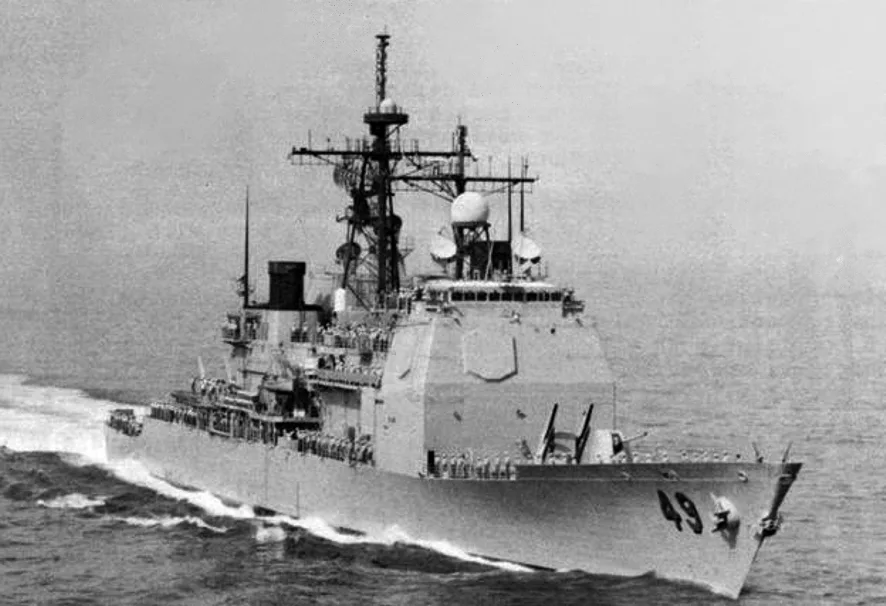
USS Vincennes fired two missiles at a climbing Iran Air Airbus inside airway A-59. The US military investigation found errors in identification and altitude reporting.
Original photograph, no crop or retouching. Responsive WebP copies resized without cropping.
Geographic context
Bandar Abbas departure
Reported crash position east of Hengham Island
Dubai destination
Approximate geographic markers for the departure airport, the report's crash coordinates and the destination airport. The aircraft was cleared along A-59; the markers do not trace its recorded radar path. Basemap: Natural Earth, public domain.Read supporting evidence
Iran Air Flight 655 left Bandar Abbas for Dubai and climbed within its assigned airway. Vincennes, already fighting Iranian small boats, classified the aircraft as an F-14. Captain William C. Rogers III ordered missiles fired after receiving reports that it was closing and descending. The DoD investigation found a continuous climb in the recorded data and identified errors in the information passed to him.
Read the full incident Follow what happened, from the flight to the investigation findings.
What investigators concluded
The DoD investigation found that Vincennes engaged an aircraft its captain believed threatened his ships. It judged his decision prudent on the information he received and found no negligent or culpable conduct by US naval personnel. It also found that AEGIS worked as designed, the Airbus remained in its airway, and inaccurate identification and descending-altitude reports reached the command team.
1,706 words / about 8 minutes to read. Based on the investigation records cited below.
A scheduled flight above a naval engagement
On 3 July 1988, Iran Air Flight 655 departed Bandar Abbas for Dubai while US warships and Iranian small boats were fighting in the Strait of Hormuz. The Airbus climbed along its cleared route. Approximately seven minutes after takeoff, two missiles fired by USS Vincennes intercepted it at about 13,500 feet. The aircraft fell into the sea east of Hengham Island. The US Department of Defense investigation recorded about 290 people from six nations aboard, while acknowledging that a passenger manifest and list of deceased had not been supplied.
The investigation was led by Rear Admiral William M. Fogarty under orders from US Central Command. It examined the conduct of US naval forces, including the decision aboard Vincennes to fire. Fogarty submitted his report on 28 July 1988. General George B. Crist endorsed it with modifications on 5 August, Admiral William J. Crowe added a second endorsement on 18 August, and the Secretary of Defense approved the findings and recommendations as modified on 19 August. These were the conclusions of a US military investigation into its own forces.
The report described heightened air and naval activity during the preceding three days. Iraqi strikes against Iranian oil facilities and shipping had been followed by increased Iranian attacks on shipping. Iranian F-14 fighters had recently moved to Bandar Abbas, a joint military and civilian airfield. US forces had received warnings of possible Iranian activity over the Fourth of July weekend. Those warnings and the presence of fighters formed part of the background against which Vincennes evaluated the aircraft.
Early on 3 July, USS Elmer Montgomery reported Iranian small boats approaching a merchant vessel and challenging shipping. Vincennes was directed north to investigate. Its helicopter, Ocean Lord 25, was sent to observe the boats and reported being fired upon at about 06:15. Vincennes and Montgomery closed the area at high speed. When two boats turned toward them, the movement was interpreted as hostile intent. Vincennes requested permission to engage and opened fire at about 06:43.
That engagement continued during Flight 655's takeoff and climb. A round that could not be fired caused a foul bore in the forward gun. Vincennes maneuvered to bring the after gun to bear, including a full rudder turn at 30 knots. The report found that the gun problem, maneuvering and continuing surface action increased tension in the combat information center and restricted the attention the captain could give to the aircraft.
The report identified the airliner as an Airbus A-300B2-202 delivered on 30 April 1982. It had standard civilian identification equipment. Bandar Abbas tower instructed Flight 655 to select Mode III code 6760 before departure and read that code correctly. Takeoff was from runway 21 at 06:47, corresponding to 10:17 local time in the report. The planned departure had been 06:20. Its clearance was to Dubai via airway A-59 at flight level 140, or 14,000 feet.
A-59 was 20 nautical miles wide between Bandar Abbas and the DARAX reporting point, extending ten miles either side of its centerline. Flight 655 remained inside that corridor. At about 06:54 the pilot reported passing MOBET and leaving 12,000 feet. The reconstructed profile placed the aircraft climbing through about 13,500 feet at interception, on a course near 210 degrees and traveling about 383 knots. It was a little over three miles west of the airway centerline.
Vincennes detected the aircraft shortly after takeoff, at about 47 nautical miles. It became track 4131. USS Sides also tracked it. Subsequent analysis of Vincennes' recordings showed steadily increasing radar altitude and increasing altitude in the aircraft's Mode C replies. The only identification mode associated with Flight 655 in the system data was Mode III 6760. Testimony from Sides corroborated that code and the climb.
Inside Vincennes, the aircraft was initially handled as an unknown contact assumed to be an enemy under the ship's guidance. A momentary Mode II code 1100 readout was then associated with the track. Operators connected that military code with an Iranian F-14. By about 06:50, the large screen display carried an F-14 label. Crist's endorsement emphasized that the identification supervisor had supplied a positive identification and that the aircraft had been entered into the system as an F-14.
The investigation traced the code association to the remote control indicator used for identification interrogations. Its read gate could remain near Bandar Abbas even as the selected aircraft track moved toward the ship. Fogarty considered a response from a military aircraft at the airfield a possible source, aided by atmospheric conditions that extended radio propagation. The exact source could not be verified. The Airbus itself maintained Mode III 6760 throughout the flight.
The possibility of a commercial aircraft was raised aboard Vincennes. One officer reported seeing the track rise through about 8,000 to 9,000 feet and said it might be commercial traffic; the captain acknowledged the report by raising his hand. The large screens showed the airway as a single line, slightly west of the actual centerline. Altitude was available on individual console readouts, while the large screens could not display it in real time.
Vincennes transmitted challenges on the military and international air distress frequencies. At about 06:51, it told the task force commander that an Iranian F-14 was closing and that it intended to engage at 20 nautical miles unless the aircraft turned away. The commander concurred and required warnings before firing. When the aircraft reached 20 miles, Rogers withheld missile fire and ordered fire control radar illumination. Flight 655 continued its climb.
The report counted five Vincennes warnings on the military distress frequency and four on international air distress, with Sides also transmitting a warning. Other units heard the transmissions. The investigation found that the warning formats could leave a pilot uncertain about which aircraft was being addressed. It considered it probable that Flight 655's pilot was occupied with takeoff, climb and communications with approach control and Tehran Center and was not monitoring international air distress.
The airliner made no reported reply and did not turn away. The investigation found that it was impossible to know whether an aircraft had heard a warning unless it replied or changed course. It also identified limited VHF radio capacity aboard US surface ships as an obstacle to monitoring distress and communicating with civilian air traffic agencies simultaneously. The task force commander lacked a usable real time data link for independently checking Vincennes' reports.
As the distance fell to roughly 15 nautical miles, reports of decreasing altitude began reaching the command team. The recorded aircraft profile continued upward. At the beginning of 06:54, the system placed Flight 655 about 12 nautical miles away at 12,370 feet and about 380 knots. Several operators later recalled substantially lower altitudes and a descent. The investigation documented the conflict between those recollections, the reports passed internally and the recorded data.
Rogers relied on his principal air warfare adviser while continuing to manage the small boat action. Crist concluded that the adviser accepted reports of descent without confirming them on the console directly in front of him. The endorsement described how changes in the combat information center organization had weakened an independent check on incoming air information. The adviser was carrying responsibilities for force air warfare, the ship's air warfare and radio reporting.
Rogers turned his firing key at approximately 06:54:05. Two SM-2 Block II missiles left their launchers at approximately 06:54:22 and intercepted Flight 655 about 21 seconds later, roughly eight nautical miles from Vincennes. The aircraft then descended rapidly. The report placed its fall about 6.5 miles east of Hengham Island, at 26 degrees 37.75 minutes north and 56 degrees 01 minute east. Iranian helicopters were at the wreckage area by 07:50; the report also described boats and a hovercraft in the search effort.
Fogarty found that AEGIS had functioned as designed and that the recorded data were valid. The aircraft had followed a normal commercial flight profile within its airway and had climbed continuously until interception. The investigation found an incorrect association of the Mode II readout, inaccurate reports of descent and imperfect recollections of identification codes. It also found that a Link 11 track crossover had not occurred.
Drawing on advice from Navy medical specialists, the report considered stress, task fixation and unconscious distortion of information possible major influences. It described scenario fulfillment: incoming information could be interpreted to fit an already accepted picture of an Iranian F-14 approaching to attack. The investigation could not fully reconcile the claimed descent with the recorded climb. Crist considered the final erroneous altitude assessment potentially pivotal. Crowe regarded its precise influence on the firing decision as uncertain.
The approved report nevertheless judged Rogers' decision prudent given the information reaching him, the limited time and his belief that his ships faced a threat. It found no negligent or culpable conduct by US naval personnel and judged the engagement consistent with the rules of engagement on the information presented. Fogarty also assigned Iran a share of responsibility for exposing a civilian flight to the nearby hostilities. Crowe's endorsement assigned Iran principal responsibility. These judgments accompanied the investigation's findings of errors aboard Vincennes.
The recommendations addressed personnel, ship organization, displays and training. Fogarty called for further work on stress in modern warship command systems, strengthening the anti-air warfare coordinator position and relieving the principal air warfare adviser of radio telephone duties. He recommended an altitude option for the large screen displays and training that placed simulated commercial traffic near hostile targets. Crist added human performance evaluation under overload. Crowe called for more formal target designation, better circuit discipline and confirmation of important reports as a firing decision approached.
The endorsements changed parts of the original recommendations. Crist disapproved the recommendation for no disciplinary or administrative action and referred to further action in his endorsement; that paragraph is redacted in the release. He also disapproved a proposed diplomatic warning to Iran and an alternative voice warning format. The Secretary of Defense approved the package as modified.
The investigation lacked the aircraft recorder and other evidence sought from Iran. Classified source material and redactions limited the released record. The ICAO Council fact-finding report C-WP/8708 was not obtained. The source of the momentary military code remained unverified. The investigation could not fully reconcile the reported descent with the recorded climb.
Reports of descent reinforce the threat assessment
The captain received reports of decreasing altitude as the airliner continued climbing. Crist found that a direct console check by the principal adviser could have revealed the climb.
The DoD investigation found that Rogers believed the aircraft threatened his ships. Vincennes launched two SM-2 missiles and the aircraft was intercepted at about 13,500 feet.
Vincennes reported an inbound Iranian F-14 and its intention to engage at 20 nautical miles unless it turned away. The task force commander required warnings first.
Two SM-2 Block II missiles left Vincennes. The report places interception about 21 seconds later at 13,500 feet and eight nautical miles from the ship.
Why did operators associate a military transponder code with Flight 655?
The DoD investigation found that the identification operator associated a Mode II readout with Flight 655 while the interrogation read gate remained near Bandar Abbas. It considered a military aircraft on the ground a possible source of that signal. Flight 655 transmitted Mode III 6760 throughout its flight.
Could the captain see live altitude on the large screen display?
The large screen displays could show position, course, speed and identification, but could not display altitude in real time. Altitude was available on console character readouts. The investigation recommended adding an altitude display option.
What did the investigation recommend about combat stress?
Fogarty recommended research into stress in sophisticated warship command systems, including whether personnel selection could use psychological profiles. The first endorsement added a proposal to test human performance under overload in battle simulations.
The investigation considered a military aircraft at Bandar Abbas a possible source of the Mode II readout. Crist stated that the source could not be verified.
The report could not reconcile the reported descent satisfactorily with the recorded climb. It considered stress and task fixation possible influences. The endorsements differed in their assessment of how much the erroneous altitude reports affected the firing decision.
Actions and recommendations are described at the dates of the cited records. A recommendation is not proof of implementation.
Stress research and simulation
Fogarty recommended further study of stress in sophisticated command systems. Crist added a proposal to assess human effectiveness during peak overload in battle simulations.
The report recommended strengthening the anti-air warfare coordinator position and removing radio telephone duties from the principal air warfare adviser. Crowe called for formal target designation and confirmation of significant reports.
The Secretary of Defense approved the investigation as modified by the endorsements on 19 August 1988. Crist had disapproved the original recommendation against disciplinary or administrative action; his referenced action paragraph is redacted in the release.
Matching dossiers for Concurrent surface engagement: No other dossier in this collection.
Read alongside
These comparisons connect specific research topics. Shared circumstances do not establish identical causes. Evidence from both investigations is provided below.
Both investigations examined how attention and team information affected command decisions. The DoD report considered stress and task fixation possible influences on the Vincennes assessment. The NTSB found that United 173's captain became preoccupied with a landing gear problem and failed to manage the diminishing fuel supply. United 173 involved fuel exhaustion during an extended approach delay; Iran Air 655 involved a naval missile engagement.
Explore the records below for additional context. They open on the publisher's site and are not all included in our report search. Source reuse terms apply.
Defense Technical Information Center identifier for the DoD investigation.
Sources and transparency
US military investigation approved by the Secretary of Defense on 19 August 1988.
Source limitations
The US Department of Defense investigated the actions of its own naval forces. The ICAO Council fact-finding report C-WP/8708 was not obtained. The released DoD text contains redactions and may omit classified parts. Investigators lacked the aircraft recorder, a verified passenger manifest and a list of deceased.
Formal Investigation into the Circumstances Surrounding the Downing of Iran Air Flight 655 on 3 July 1988
US Department of Defense Final investigation, Rear Admiral Fogarty letter of 28 July 1988, with endorsements and Secretary of Defense approval of 19 August 1988
Official report PDF, hosted by documents.theblackvault.com
US government work, public domain in the United States. The host cover is excluded from the government-work licence basis. US federal government work under 17 USC 105.
Kevin Murphy writes the incident accounts on AirlineIncidents.com, out of a long interest in aviation safety and the lessons each investigation leaves behind.
Prepared by
AirlineIncidents editorial desk
Report citation check
Independent expert review
Not completed
Citation checks compare supporting text with the indexed report pages. They do not constitute independent expert review. How these pages are prepared.
Revision history
: Published sourced incident account, timeline, photographs and investigation findings.