Original photograph downloaded at the supplied dimensions. Responsive WebP copies resized without cropping.
Geographic context
Dubai International Airport, departure
Mumbai FIR, broad regional marker
Brisbane International Airport, destination
The burst occurred after entry into Mumbai FIR at FL310. The summary gives no exact coordinates. The FIR marker is a broad regional reference; the airport markers show the departure and destination. Basemap: Natural Earth, public domain.Read supporting evidence
About 75 minutes into the Dubai to Brisbane flight, wheel 17 lost its pressure and both crews heard a bang. The pilots carried out the suspected tyre-damage procedure, found no other system abnormality and continued. Inspection in Brisbane revealed a burst tyre and a fractured belly fairing panel.
Read the full incident Follow what happened, from the flight to the investigation findings.
What investigators concluded
The AAIS attributed the burst to a manufacturing defect in the NC2 carcass ply. A liberated tyre chunk struck the fairing. Investigators accepted the structural assessment that the fairing damage did not impair aircraft performance.
1,510 words / about 7 minutes to read. Based on the investigation records cited below.
A bang after departure from Dubai
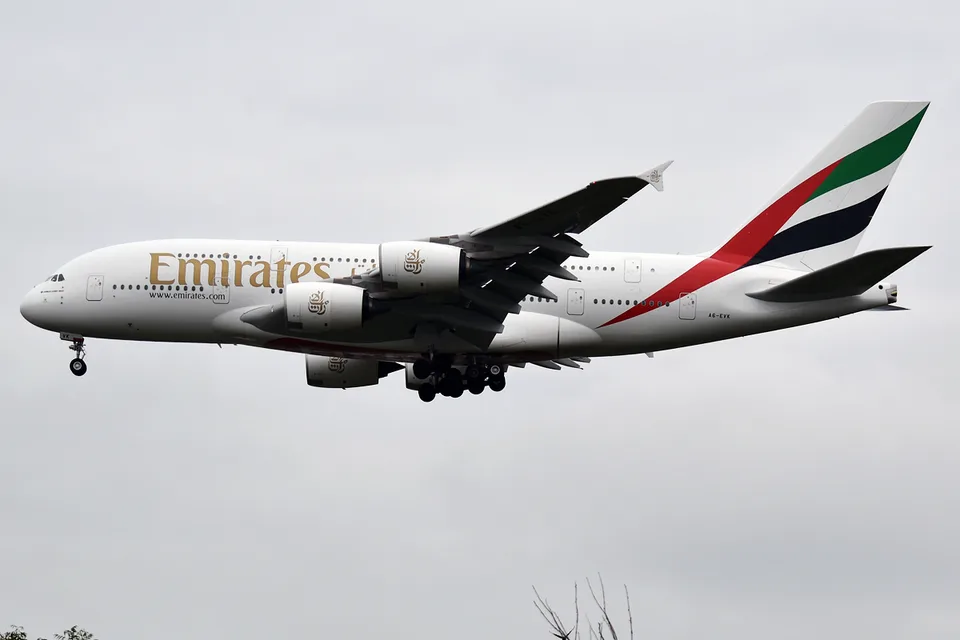
Emirates A6-EVK was carrying 501 passengers, four flight crew and 24 cabin crew from Dubai to Brisbane under callsign UAE94G. The flight crew described the briefing, preparations, pushback, taxi and takeoff as normal. The aircraft had been released to service, and investigators found that it had been certificated, equipped and maintained in accordance with the applicable UAE regulations. No defect or malfunction contributing to the incident had been detected before departure.
About one hour and 15 minutes after takeoff, after the aircraft entered Mumbai flight information region, both the flight and cabin crews heard a bang. The A380 was cruising at flight level 310. The electronic centralized aircraft monitor, or ECAM, displayed WHEEL TIRE PRESS LO, and the wheel display showed zero pressure for body landing gear wheel 17. Pressure indications for the other tyres remained normal.
The pilots carried out the ECAM actions and consulted the flight crew operations manual. They activated the procedure for suspected landing gear wheel tyre damage. Its cautions included care during taxiing and an effect on landing distance. They also checked the system display pages for other abnormalities. The checks showed no additional system problem.
The operator's Maintenance Control Center contacted the pilots to confirm the warning. Once the crew confirmed it, maintenance control suggested inspecting the wheels at Brisbane and arranging for a maintenance technician to meet the aircraft. The crew considered continuing, returning to Dubai and landing at the nearest airport.
According to their statements, a return to Dubai would have required dumping about 100 tons of fuel to meet the maximum landing weight. They also considered the disruption that could follow if the A380 stopped on an active runway for an inspection. They expected a diversion to Mumbai to present similar issues. Their assessment included the landing weight expected at Brisbane and the absence of other ECAM system-malfunction indications.
The pilots planned to retain the option of diverting to an airport close to the route if aircraft performance deteriorated. They decided to continue to Brisbane. The fractured belly fairing was hidden from the flight and cabin crews by its location. The pilots therefore had no visual indication of that damage when they assessed the options.
The AAIS found that the crew followed the manual procedures for suspected tyre damage. Investigators could not determine whether continuing to Brisbane was the most appropriate alternative. Their analysis also recorded that the bang associated with the fairing fracture had not been included in the crew's risk assessment.
On approach, the crew extended the landing gear at 3,000 feet above the ground, earlier than normal. They said the extra height would give them time to cancel the approach or go around if the gear failed to extend. The aircraft landed smoothly on Brisbane's runway 19L. The pilots stopped on the runway for a visual inspection before continuing to the gate. No injuries were reported among the 529 people on board.
The inspection confirmed that the tyre on wheel assembly 17 had burst and the belly fairing had been damaged. The other wheels were undamaged. A tyre chunk had struck access panel 197ET, part of the upper belly fairing. The panel extended between fuselage frames 67 and 72 and was secured with 110 screws and washers. The observed damage lay between frames 69 and 72. The liberated panel was never found, and a review of maintenance records showed no previous damage or repair to it.
Airbus examined the damage and assessed aircraft airworthiness. Its analysis identified a 75 mm crack in a rear bracket associated with the panel. Panel 197ET was an aerodynamic fairing classed as Category C structure. The AAIS agreed with the conclusion that loss of part of the panel had not impaired aircraft performance.
The manufacturer's particular risk analysis addressed debris released close to structures and systems. It considered tread shedding, flailing tread and wheel-rim release with the gear extended, as well as tyre bursts, flailing tread and rim release with the gear retracted. Airbus concluded that its A380 wheel and tyre failure analysis covered this event.
Wheel 17 was an unbraked wheel at the rear of the body landing gear. It used a radial tyre of size 1400 x 530 R23. The assembly included wheel serial number B1116 and Michelin tyre serial number 0056B149, part number M16004. The tyre had accumulated 171 cycles since new and since installation. It was a new tyre with no retreads, and its release certificate carried a date of 12 March 2020.
The wheel history placed the assembly on A6-EVK at position 17 on 27 January 2022. The aircraft itself had accumulated 6,412 hours and 38 minutes of flight and 917 cycles by the incident. Its last 3A maintenance check had been completed on 12 May 2022. The investigation found the aircraft airworthy at dispatch. The damaged tyre was sent to its manufacturer for visual examination and further laboratory analysis.
The tyre contained four carcass plies that shared the load created by inflation pressure. In the bead region, two turned up around the bead while the other two passed down between the bead core and rim. The manufacturer examined the burst area and found an unexpected local change in the angle of the NC2 carcass cords. Away from that area, the cord orientation was consistent with the expected value and no cord damage was observed.
The angle variation also increased the spacing between NC2 textile cords. Measurements in the affected area gave 32 mm across ten cords, compared with 20 mm across ten cords in an unaffected area. X-ray tomography showed that, close to the burst, the gap between NC2 cords was twice the gap between NC1 cords. Comparative measurements were also made on the side opposite the rupture.
Visual examination also found frayed cords from plies NC3 and NC4. The manufacturer attributed that fraying to tyre rolling after the burst. Beneath the bead core, missing down-ply cords showed that those plies had been pulled away during the rupture. Investigators also examined separation between the bead-flange rubber and the outermost casing ply. They considered heat or stress from the internal NC2 structure a possible explanation for that separation.
Examination with an electron microscope compared the broken aramid and nylon fibres with laboratory samples and the manufacturer's experience. The aramid fibres showed compression failure, while the nylon fibres showed tension failure. The investigators described alternating tension and compression in the hybrid material, consistent with the fatigue failure observed in the NC2 casing at the burst. These examinations linked the rupture to a local defect within the tyre construction.
The manufacturer found similarities with a tyre examined after a previous burst in 2017. Its root-cause work described a sequence during the laying of the NC2 carcass material. The feed reel emptied, and the remaining uncured material fell from the reel and stuck to the machine frame. The machine operator continued to rotate the assembly drum, stretching and distorting the trapped material.
That movement changed the local ply angle and the spacing of the textile cords. The machine operator failed to notice the distortion and continued building the casing. Once the tyre had been completed, the local defect could no longer be detected by the industrial non-destructive inspection controls described in the report. The manufacturer considered a similar convergence of factors likely for the tyre fitted to A6-EVK.
The AAIS determined that the burst resulted from a manufacturing defect. The local variation in NC2 ply angle and cord spacing left the tyre unable to withstand the difference between the internal inflation-gas pressure and the surrounding atmospheric pressure. It burst, releasing a chunk that struck and fractured the fairing panel beside the wheel well.
Manufacturing safeguards and the completed investigation
After the earlier burst, the manufacturer had identified casing ply supports and an updated working method as safeguards. The support consisted of an elastic fabric band stretched between fasteners at the NC2 laying station. Its purpose was to keep the end of the material reel from falling onto the building drum. The AAIS found that corrective actions had been implemented but their effectiveness had not been evaluated. It concluded that the production quality process required a machine modification that would stop the roll before its material ran out.
Michelin reported restoring the casing ply supports to working order on 5 July 2022 and strengthening the daily manufacturing control plan from that date. From 11 July, each M16004 tyre was released only after a check that the support remained installed and in good condition. Michelin also launched a process-evolution study, with prototype assessment planned by the end of 2022 and deployment across the affected machines planned during the first quarter of 2023. The AAIS judged the actions adequate and issued no further safety recommendation.
Both flight recorders were downloaded and analysed at the Abu Dhabi Flight Recorder Laboratory. The CVR recording of the incident had been overwritten because the remaining flight to Brisbane exceeded its two-hour capacity. The AAIS issued its completed investigation as a Summary Report on 16 July 2024, with its scope limited to the events leading to the occurrence and no detailed analysis of non-contributing factors.
Continued drum rotation altered the ply angle and textile-cord spacing. The completed casing passed through controls that could no longer detect the local defect.
The crew found no other system abnormality, considered the fuel dump and runway disruption involved in returning, calculated an acceptable landing weight at Brisbane, and kept diversion options available. Investigators could not determine whether continuing was the most appropriate alternative.
The AAIS found a manufacturing defect that changed the local NC2 carcass ply angle and cord spacing. The weakened tyre could no longer withstand the difference between its internal inflation pressure and ambient pressure.
Was the bang captured on the cockpit voice recorder?
The event recording was overwritten during the remaining flight to Brisbane. The CVR retained only the last two hours. Both recorders were downloaded and analysed in Abu Dhabi.
The GCAA issued a published Summary Report on 16 July 2024. It contains the completed investigation findings and manufacturer actions, but omits a complete recorder chronology, a CVR transcript, the full tyre teardown and structural-analysis reports, and exact coordinates of the burst.
The flight history gives 30 June 2022 and the cover gives 1 July 2022. The local-time parenthesis gives 2023. The cover identifies an A380-842, while the aircraft-information paragraph describes an A380-861. Crew flying roles differ between the history and findings, and the YBBN footnote conflicts with the named Brisbane destination.
The report records completed support and control-plan changes in July 2022. It describes the prototype assessment and wider machine deployment as planned phases.
A reinforced daily control plan began on 5 July 2022. From 11 July, M16004 tyre release included checking that the casing ply support was fitted and in good condition.
Michelin launched a process-evolution study covering prototype assessment and deployment to the affected production machines. The AAIS accepted the actions and made no further safety recommendation.
Matching dossiers for Debris impact on aerodynamic fairing: No other dossier in this collection.
Safety findingEarlier safeguards had not removed the hazard
Corrective actions following a previous burst had been implemented, but their effectiveness had not been evaluated. The AAIS called for a production-machine change to stop the roll before it ended.
Matching dossiers for Earlier safeguards had not removed the hazard: No other dossier in this collection.
Read alongside
These comparisons connect specific research topics. Shared circumstances do not establish identical causes. Evidence from both investigations is provided below.
Both investigations examined A380 damage from liberated debris and defects introduced during manufacture. On A6-EVK, a tyre chunk fractured an aerodynamic fairing and aircraft performance remained unimpaired. On Qantas 32, turbine-disc debris damaged the wing and systems; a fragment severed a wiring loom between the lower fuselage and body fairing, disabling redundancy for systems already affected by wing damage.
Explore the records below for additional context. They open on the publisher's site and are not all included in our report search. Source reuse terms apply.
Published investigation findings, tyre examination, crew decision analysis and Michelin manufacturing actions.
Sources and transparency
30 October 2026
Source limitations
The GCAA issued a published Summary Report on 16 July 2024. It contains the completed investigation findings and manufacturer actions, but omits a complete recorder chronology, a CVR transcript, the full tyre teardown and structural-analysis reports, and exact coordinates of the burst.
Aircraft Belly Structural Fairing Fracture due to Tire Burst During Flight, A6-EVK
UAE General Civil Aviation Authority, Air Accident Investigation Sector Final investigation publication: Serious Incident Summary Report AIFN/0006/2022, issued 16 July 2024
Kevin Murphy writes the incident accounts on AirlineIncidents.com, out of a long interest in aviation safety and the lessons each investigation leaves behind.
Prepared by
AirlineIncidents editorial desk
Report citation check
Independent expert review
Not completed
Citation checks compare supporting text with the indexed report pages. They do not constitute independent expert review. How these pages are prepared.
Revision history
: GCAA published its completed findings and safety actions in a Summary Report on 16 July 2024.