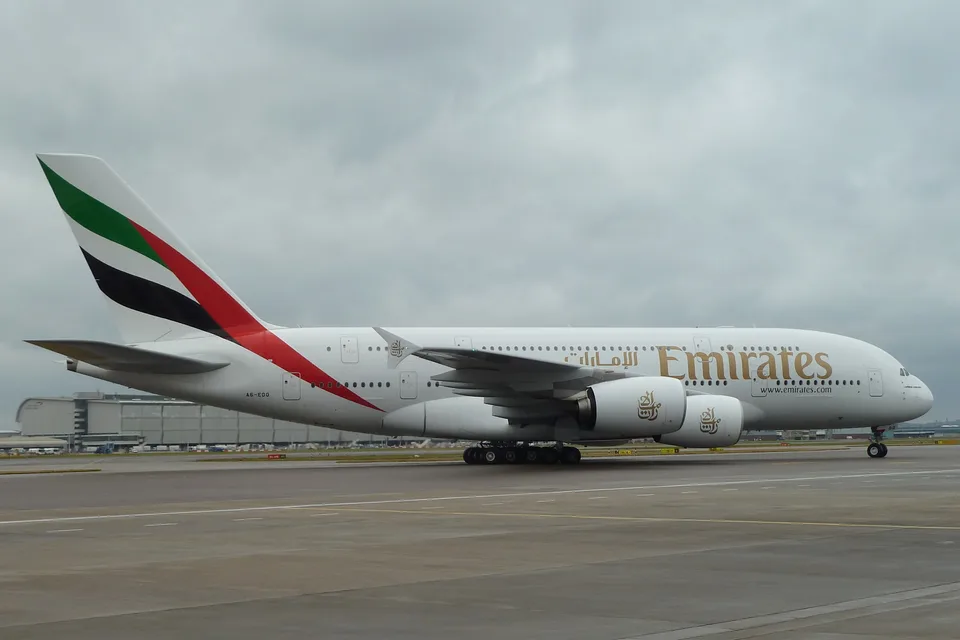
An Emirates A380 landed at Dubai with its left wing landing gear still stowed after damaged wires disabled both emergency unlock channels. All 372 occupants escaped injury.
Original photograph. Responsive WebP copies resized without cropping.
Geographic context
London Heathrow, departure
Dubai International, landing
Flight EK002 departed London Heathrow and landed at Dubai International. Airport markers use approximate airport reference positions. Basemap: Natural Earth, public domain.Read supporting evidence
During cruise from London, temperature warnings led the crew to isolate the green hydraulic system. They then used emergency gravity extension for the landing gear. The left wing gear stayed in its bay because fatigue damage had broken the command wires for both independent unlock channels. The aircraft landed safely at Dubai and was towed to a stand, where passengers disembarked in controlled groups.
Read the full incident Follow what happened, from the flight to the investigation findings.
What investigators concluded
The GCAA final report, issued on 14 June 2017, attributed the failed extension to flexure endurance fatigue in both emergency unlock actuator command wire channels. Aerodynamic movement acted on inadequately supported wiring looms during gear operation. The investigation identified no further contributing factors and recommended wiring improvements, emergency monitoring and safer towing procedures.
From a hydraulic warning to a landing with one gear stowed
1,544 words / about 8 minutes to read. Based on the investigation records cited below.
A warning during the London to Dubai flight
Emirates flight EK002 left London Heathrow for Dubai at 1405 UTC on 9 November 2016. The Airbus A380-861, registered A6-EDQ, carried 345 passengers, two flight crewmembers and 25 cabin crewmembers. Its departure and initial cruise were uneventful. The commander was flying and the copilot was monitoring. Both pilots were qualified for the flight, and the investigation found that they had been well rested.
About three hours and 20 minutes into the flight, the electronic centralized aircraft monitoring system indicated that the green hydraulic system temperature had risen above its normal operating range. A further message indicated an overheat. Following the flight crew operating manual, the pilots isolated the green hydraulic system and began preparing for the limitations that would affect the rest of the flight.
The A380 had two independent hydraulic systems, green and yellow. The green system normally supplied the nose and wing landing gear extension mechanisms, nose wheel steering and wing gear brakes, among other services. With that system isolated, the nose and wing landing gear had to be lowered through the emergency gravity extension system. The loss also slowed flap extension and increased landing distance because half the ground spoilers would be unavailable.
The pilots discussed the hydraulic problem with Emirates maintenance control. The commander asked whether the isolated system could be restored to extend the landing gear, and was advised that restoration was impossible in flight. He requested a long approach at Dubai and towing support after landing. Air traffic control provided a 20 mile final approach and assigned a stand near the expected runway exit. The senior cabin crewmember was briefed about the hydraulic problem and the anticipated tow.
Fuel consumption was a particular concern. The operating manual allowed for an increase of up to 10 percent after loss of the green system if outer ailerons deflected upwards. Once all the landing gear was extended, consumption could increase by as much as 100 percent. The emergency extension system left the gear doors open, and the isolated green system prevented retraction. A go-around would therefore leave the aircraft flying with the extended gear and its additional drag.
An initial calculation gave expected landing fuel below 7,000 kg, including a required reserve of 4,600 kg. The pilots discussed declaring a minimum fuel state if necessary and sought to avoid a hold. A revised calculation, accounting for lower consumption in descent, gave more than 10,000 kg at landing. About an hour before arrival, the crew had established the sequence for configuring the aircraft for approach, landing and subsequent movement on the ground.
At about 4,000 feet, approximately eight minutes before landing, the pilots selected the landing gear down. The A380 had a nose gear, two body gear assemblies and two wing gear assemblies. Gravity extension used electrically powered emergency unlock actuators to release the uplocks, allowing the gear to fall into position. Two dedicated control modules provided independent electrical channels for the emergency release.
The indications showed the other landing gear down and locked, but the left wing gear failed to reach that state. Its doors were open. The crew declared an emergency approximately four minutes before touchdown and advised that the aircraft would need a tow from the runway. The operating manual contained a procedure for landing with one abnormal wing or body gear, including manual braking and avoidance of the autobrake system.
The commander elected to continue. The investigation found that the fuel remaining and the increase in consumption with the gear extended were the deciding considerations. Its analysis said that, as the new gear problem emerged late in the approach, the time available to obtain and process further information was diminishing and the commander focused on his earlier decision to land. The findings recorded 13,300 kg of fuel on approach when the emergency was declared.
The A380 landed uneventfully at 2022 UTC with 12,600 kg of fuel. It came to a stop beside taxiway K6. The pilots felt a slight lean to the left during the landing roll and decided to remain on the runway. Smoke was seen near the landing gear brakes, but the fire commander established that there was no fire. The commander reported that the brake temperatures were within limits.
Ground staff approached with a tug. The commander assumed that the person arranging an inspection was an Emirates maintenance engineer. In fact, no company engineer had been dispatched to the runway. Emirates network control had arranged support for the earlier hydraulic problem but had not learned of the emergency declared on the air traffic control frequency shortly before landing. Its engineer was waiting at the stand to troubleshoot the hydraulic defect.
The aircraft was towed slowly via K6 to stand F20 with its passengers aboard. No landing gear safety pins had been fitted. The investigation found unclear communication and confirmation bias: the commander believed a company engineer was managing the tow, while the ground personnel believed they were carrying out his request. The investigation found that nobody competent was in charge of assessing whether the aircraft was safe to move.
Dubai Airports recovery procedures called for a team involving airside operations, the airline engineer, a tug operator and a headset mechanic. The engineer was responsible for establishing whether the aircraft could safely be towed. Emirates engineering procedures also required a walk around inspection and fitting landing gear safety pins before towing, with a technical logbook entry controlling their fitment. That procedure did not cover recovery with passengers and cargo aboard. The headset mechanic and tug operator said they followed the airside controller's instructions.
At the stand, engineers confirmed that the left wing gear was still fully retracted. Fuel was transferred from the left wing tank to the right to level the aircraft before passengers disembarked in controlled groups through the forward left main deck door. All 372 occupants escaped injury. The aircraft, property and environment were undamaged. The investigation found no operational pressure on the ground crew to clear the runway.
Airbus supplied a technical adaptation document with instructions and limitations for moving the empty aircraft to a maintenance hangar. Troubleshooting began the next day with AAIS investigators present. Initial visual checks revealed no damage. With the aircraft raised on jacks and the weight on wheels systems reset, the left wing gear extended successfully. More detailed inspections then found broken wires in the harnesses feeding both emergency unlock channels.
Examination of the left wing wiring identified fractures in the three command wires of each channel. Deformation of the wire strands indicated repeated mechanical loading, and investigators found evidence of arcing between broken ends. Tomographic examination confirmed flexure endurance fatigue. The final report attributed the failed release to fatigue damage in the two independent command wire channels, caused by aerodynamic effects on inadequately secured wiring looms during gear operation.
Both free fall control modules passed tests in the hangar and at the vendor facility. The uplock worked satisfactorily after the wires were repaired, although results of additional vendor tests were unavailable when the report was issued. Investigators also found similar damage on the right wing gear channel B wires. The damaged left wing wires were repaired, the uplock assembly and control modules were replaced, and a subsequent gravity extension test succeeded.
The green hydraulic temperature sensor was separately examined in France. Tests found a failed sensing element that produced unreliable values and indications. Some resistance measurements were absent, while measurements below ambient temperature were higher than expected and produced readings above actual system temperatures. The investigation thus documented the sensor defect alongside the wiring damage that prevented emergency extension.
The aircraft had passed an operational emergency extension test on 20 July 2015. The maintenance programme called for free fall tests every 24 months or 3,000 flight hours, whichever came first, including an electrical wiring check and a functional extension test. After the incident, Airbus issued Alert Operator Transmission A32R009-16 on 22 November 2016. It recommended a gravity extension test within one month and inspection of all 24 emergency unlock actuator positions, followed by another extension test, within two months. Initial responses from 75 aircraft inspections identified 37 aircraft with damaged wires.
The final inspection results recorded wire damage on 73 aircraft out of 195 inspections. Relevant damage affected the left and right wing gear unlock systems and appeared unrelated to aircraft age or loom length. Airbus flight tests used cameras to observe the mechanisms and wiring during gear movement. They confirmed aerodynamic movement at the wing gear positions, with minimal or no movement at the body and nose gear positions.
On 26 December 2016, the AAIS issued two prompt recommendations to EASA covering mandatory fleet inspections, investigation of the fatigue mechanism and a design improvement. Airbus subsequently published service bulletin A380-92-8103 and production modification 77381 on 5 May 2017. The final report identified no additional contributing factors to the gear extension failure.
The final report, issued on 14 June 2017, also addressed recovery procedures. The Airbus recovery manual excluded occupied aircraft and the maintenance manual prohibited towing with passengers aboard. Emirates procedures did not cover recovery in these conditions. Recommendations to Emirates called for safe towing instructions and improved monitoring of declared emergencies. Recommendations to Airbus called for consistent flight manual guidance about anticipated towing and detailed instructions for pilots, engineers and ground staff handling similar recoveries.
Follow the main stages, then open the evidence beneath each step.
1
Temperature warnings prompted isolation
The crew isolated the green hydraulic system after temperature and overheat warnings, following the operating manual. Testing later found an unreliable temperature sensor.
Emergency extension depended on electrical release
Gravity extension used two independent electrical channels to power the emergency unlock actuators. Green hydraulic isolation prevented normal extension of the nose and wing gear.
The aircraft was towed with passengers aboard, without landing gear safety pins or an engineer supervising at the runway. The investigation recommended clearer towing and emergency monitoring procedures.
The left wing landing gear remained in its bay. Fuel was transferred from left to right to level the aircraft, and passengers left in controlled groups through the forward left main deck door.
Why did the left wing landing gear stay retracted?
Fatigue damage affected all six command wires near the two emergency unlock actuator connectors. Both independent command channels failed to release the left wing gear.
The commander considered the fuel remaining and the increased consumption after gravity extension, which prevented gear retraction. An initial estimate was below 7,000 kg at landing; a second exceeded 10,000 kg. The aircraft landed with 12,600 kg.
The aircraft was towed with passengers aboard and its landing gear unsecured. The commander believed an Emirates maintenance engineer was supervising, while the ground team understood it was following his request. The investigation found gaps in the applicable towing procedures.
The left wing uplock operated satisfactorily after the wiring repair. The final report said results from its additional vendor testing were unavailable at publication.
Actions and recommendations are described at the dates of the cited records. A recommendation is not proof of implementation.
Airbus requested fleet tests and inspections
The 22 November 2016 transmission recommended gravity extension tests and inspection of emergency unlock wiring. The final inspection results identified wire damage on 73 aircraft out of 195 inspections.
Prompt recommendations addressed the wiring design
On 26 December 2016 the AAIS recommended that EASA require fleet inspections and ensure Airbus investigated the fatigue and developed a design improvement.
Final recommendations covered the occupied aircraft tow
The AAIS recommended that Emirates issue towing instructions and improve network control monitoring of emergencies. It recommended consistent Airbus flight manual guidance and detailed recovery instructions for similar conditions.
Matching dossiers for Emergency unlock wiring fatigue: No other dossier in this collection.
CircumstanceGreen hydraulic system isolated
The overheat indication required isolation of the green system and use of emergency landing gear extension. Testing subsequently identified a failed sensing element giving unreliable indications.
Matching dossiers for Green hydraulic system isolated: No other dossier in this collection.
Safety findingRecovery coordination shortcomings
Unclear communication and the commander's assumption that an engineer was present led to towing without a safety assessment. The operating and recovery manuals lacked instructions for the occupied aircraft in this condition.
Matching dossiers for Recovery coordination shortcomings: No other dossier in this collection.
RiskWider fleet exposure
Inspection results recorded wiring damage on 73 of 195 aircraft inspections. The investigation considered emergency extension failure a potentially serious occurrence.
Matching dossiers for Wider fleet exposure: No other dossier in this collection.
Read alongside
These comparisons connect specific research topics. Shared circumstances do not establish identical causes. Evidence from both investigations is provided below.
Both crews dealt with a landing gear problem while considering the fuel available for landing. Emirates A6-EDQ continued to Dubai and landed with 12,600 kg remaining. United Airlines 173 delayed near Portland for about an hour and exhausted its fuel. The NTSB attributed that accident to the captain's fuel monitoring and response while preoccupied with the gear problem; the GCAA attributed A6-EDQ's failed gear extension to fatigue damage in the unlock command wires.
Explore the records below for additional context. They open on the publisher's site and are not all included in our report search. Source reuse terms apply.
The investigation includes the flight sequence, recorder summaries, wiring and sensor examinations, fleet findings and safety recommendations.
Sources and transparency
30 October 2026
Source limitations
The left wing uplock assembly operated satisfactorily after wire repair. Its further vendor test results were unavailable when the final report was issued.
Failure of the Left Wing Landing Gear to Extend: Emirates A6-EDQ
UAE GCAA Air Accident Investigation Sector Final Report AIFN/0015/2016, issued 14 June 2017
Kevin Murphy writes the incident accounts on AirlineIncidents.com, out of a long interest in aviation safety and the lessons each investigation leaves behind.
Prepared by
AirlineIncidents editorial desk
Report citation check
Independent expert review
Not completed
Citation checks compare supporting text with the indexed report pages. They do not constitute independent expert review. How these pages are prepared.
Revision history
: Final investigation completed. GCAA AAIS Final Report AIFN/0015/2016 was issued on 14 June 2017.