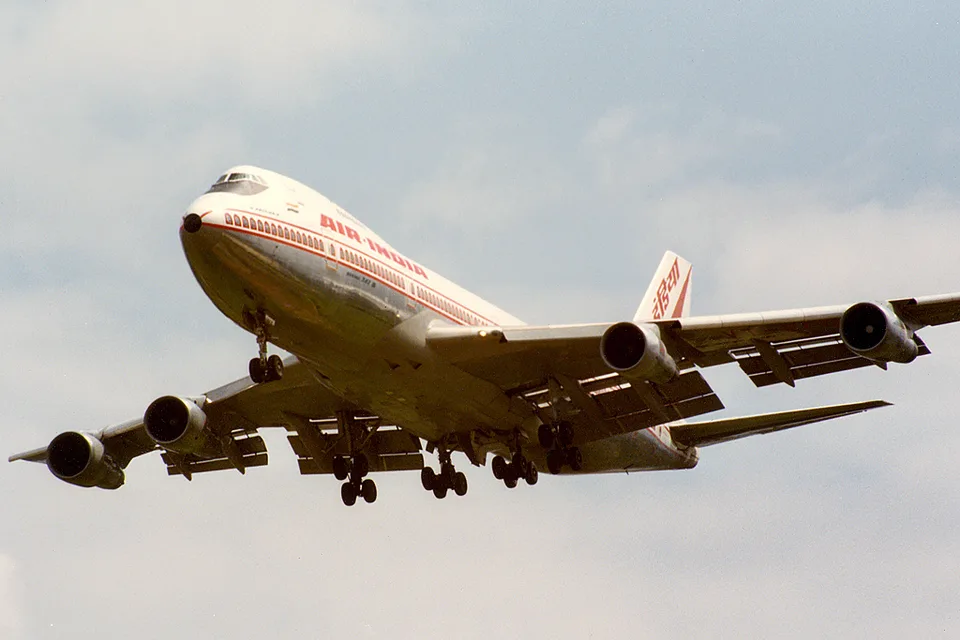
No cropping or colour changes. Responsive WebP copies resized without cropping.
Geographic context
Montreal Mirabel departure
Accident site in the Atlantic
London Heathrow destination
Flight 182 was travelling from Montreal Mirabel to London Heathrow before continuing to Delhi and Bombay. The accident position given by the court is 51 degrees 3.6 minutes N, 12 degrees 49 minutes W. Basemap: Natural Earth, public domain.Read supporting evidence
Air India Flight 182 was cruising at 31,000 feet from Montreal towards London when a sudden event cut off its recorders and transponder. The aircraft broke up in flight and fell into the Atlantic. The Kirpal court found that a bomb exploded in the forward cargo hold.
Read the full incident Follow what happened, from the flight to the investigation findings.
What investigators concluded
The Kirpal court attributed the crash to a bomb in the forward cargo hold. It drew on structural and metallurgical evidence, the loss of electrical systems and the linked movements of unaccompanied baggage.
1,576 words / about 8 minutes to read. Based on the investigation records cited below.
A scheduled flight across the Atlantic
Air India Flight 182 left Montreal's Mirabel Airport at 0218 GMT on 23 June 1985, bound for London, Delhi and Bombay. The Boeing 747-237B, registered VT-EFO and named Kanishka, carried 307 passengers and 22 crew members. About five hours into the Atlantic crossing, while cruising at 31,000 feet, it disappeared from Shannon's radar. The aircraft fell into the sea off Ireland. Everyone on board died.
The aircraft had reached Toronto from Frankfurt on the previous day as Flight 181. Its passengers and baggage were unloaded for Canadian customs and immigration checks. A new crew took over for the journey to London: Captain H.S. Narendra, co-pilot Captain S.S. Bhinder, flight engineer D.D. Dumasia and 19 cabin crew members. Air India had acquired the aircraft in June 1978. By the accident it had accumulated 23,634 hours and 49 minutes of flight and 7,525 cycles.
The completed Indian court investigation, led by Justice B.N. Kirpal, issued its conclusions and recommendations on 26 February 1986. The Canadian Aviation Safety Board prepared a separate submission to assist that inquiry. Investigators examined the flight recorders, Shannon's radio recordings, recovered bodies, floating wreckage and aircraft structure lying on the seabed.
The baggage investigation led back to reservations made in Vancouver on 19 June. A caller arranged two journeys connecting with Air India services. After changes to the bookings and a cash purchase of the tickets, one itinerary was in the name M. Singh, travelling from Vancouver to Toronto on CP Air Flight 060 and then towards Delhi on Air India. The second was in the name L. Singh, travelling from Vancouver to Tokyo and connecting with Air India Flight 301 to Bangkok.
At Vancouver on 22 June, the person checking in for CP Air Flight 060 insisted that his suitcase be tagged through to Delhi. He was still wait-listed beyond Toronto. The agent initially explained that the bag could not be interlined without a confirmed onward booking, then accepted it as the queue grew. Records showed one checked bag and an assigned seat, 10B. Investigators established that the person using the name M. Singh did not board CP Air Flight 060. The person using L. Singh's booking also checked a bag and failed to board his flight to Tokyo.
At Toronto, a driver responsible for moving bags between terminals remembered collecting a CP Air suitcase from Vancouver for transfer to Air India. The Canadian investigators deduced that it followed the usual handling route onto Flight 181/182 because it had not appeared as found luggage. The court also examined the driver's description of the suitcase and its CP Air tag.
The security system had two separate weaknesses. Staff used a numbered control sheet to check passengers aboard, but checked baggage was not numbered or correlated with those passengers. Consequently, the unaccompanied interline suitcase could pass through the loading system. The Canadian submission found that matching passengers with baggage at Toronto would have detected it.
The X-ray machine used for checked baggage also broke down during loading. The court recorded that an Air India security officer directed staff to use a hand-held PD-4 explosives detector for the remaining bags. About 60 to 70 bags were checked and cleared with it. The bags were not opened for physical inspection. The Canadian submission questioned the detector's effectiveness, especially with plastic explosives, and could not determine whether the Vancouver suitcase had been screened before or after the X-ray failure.
Air India had requested additional security because of the assessed threat to its flights. The Canadian submission described extra police coverage and an airline security officer supervising Toronto and Mirabel. It also found that a significant number of screening staff had missed the required initial or refresher passenger inspection training.
The aircraft was also carrying a spare engine on an external fifth pod, with associated components loaded as cargo. Loading difficulties delayed its departure from Toronto. During the stop at Mirabel, a technician attended to a projecting latch handle on the spare engine's fan cowl and applied high-speed tape. The flight engineer accepted the work.
Sixty-five passengers destined for Montreal left the aircraft, together with three Air India staff members who had travelled from Toronto for work at Mirabel. The remaining 202 passengers stayed aboard, and another 105 joined. The court established the final total of 307 passengers, including six infants. Three suitcases singled out during screening at Mirabel were held back; subsequent examination found no explosive items in them.
After departure, the flight proceeded normally across the Atlantic. The cockpit voice transcript records position reports, the clearance towards London and conversation about arrival paperwork. At 0709:58 the crew acknowledged Shannon's instruction to select transponder code 2005. The final conversation concerned customs seals for the aircraft's arrival. The court found no emergency before the sudden event at about 0714 GMT.
A loud sound reached the cockpit area microphone immediately before the voice recording ended. The flight data recording stopped at essentially the same time, and Shannon lost the aircraft's transponder signal. The Canadian submission described the event as sudden and without warning. Its examination of the flight data found no abnormal variation before the recordings ceased.
Experts in Canada, Britain and India analysed the short sounds on the voice recorder and Shannon's air traffic control tape. They differed over the interpretation of the initial noise and its source. The British analysis favoured sudden decompression of undetermined origin from the acoustic evidence. The Indian analysis related the sound's rise time to an event farther from the cockpit. The Canadian submission recorded those differences.
The court considered the loss of electrical supplies alongside the physical evidence. Power for both recorders originated in the main equipment centre immediately ahead of the forward cargo hold. The transponder was also in that forward equipment area. The court concluded that an explosion in the forward hold could damage the electrical distribution and account for all three systems ceasing to function together. The recorders had been installed near the rear pressure bulkhead.
Shannon alerted the marine rescue organisation, and ships and aircraft converged on the area. The merchant ship Laurentian Forest reported wreckage and uninflated life rafts at 0918 GMT. It reported bodies in the water soon afterwards. Irish naval vessels, helicopters, lifeboats and other ships took part in the search. Eventually 131 bodies were recovered, representing less than half of those aboard.
Much of the evidence lay about 6,700 feet below the sea. Acoustic beacons helped search vessels locate the recorders. A remotely operated submersible from Leon Thevenin found the cockpit voice recorder on 9 July; it reached the ship's deck the next morning. The digital flight data recorder was recovered on 11 July. Both were kept in water during their initial handling and transfer to Bombay.
A detailed survey photographed and filmed the wreckage on the seabed. The Canadian submission described a trail extending approximately 6.5 nautical miles. The forward fuselage and wings were concentrated in one area, while the rear structure spread along a broader east to west trail. Investigators used those patterns, structural examinations and the medical evidence to reconstruct the breakup before water impact.
Recovered floor panels had separated upwards from their supports, and seats showed loading from below. Several parts of the right wing and tail had been struck in flight by objects from farther forward. The court connected this damage with rupture and ejection of material from the forward part of the aircraft. The Canadian investigation concluded that both cargo compartments ruptured before impact and that the section behind the wings separated in flight.
Metallurgical work concentrated on damaged skin and structure from the forward cargo area, including items identified as targets 362/396 and 399. Investigators examined punctures, curled metal, tiny fragments and microscopic changes. The Indian laboratory findings attributed features in these items to shock waves and fragments from an explosion inside the forward hold. The explosive's chemical composition was unidentified, and no part of its detonator or timing mechanism was recovered.
The court concluded that a bomb exploded in the forward cargo hold. It also identified a connection with the suitcase explosion at Narita Airport earlier that morning. The linked Vancouver bookings, the two unaccompanied bags and the Narita blast led it to find a strong probability that the suitcase sent towards Flight 182 contained a similar device. The Canadian submission also favoured a forward cargo explosion, while judging its evidence inconclusive. It found no evidence that an earlier structural failure initiated the accident.
The court's recommendations addressed the whole transfer chain. It called for confirmed onward reservations before baggage was interlined, matching transferred bags to the passengers boarding the next aircraft, and removal of baggage when its passenger failed to board. It also urged governments to notify connecting airlines of particular threats so that precautions could begin at the first point where baggage entered the system.
The court questioned reliance on the PD-4 and recommended effective backup equipment or procedures when screening equipment failed. It asked manufacturers to protect sensitive aircraft systems from explosive damage and called for studies into separating the avionics bay and emergency oxygen systems from cargo areas.
Recorder recommendations included alternative power sources and a voice recording lasting for the entire flight. The court also proposed separate oxygen sources for the pilot and co-pilot. The Canadian submission recorded security measures already directed by Transport Canada on 23 and 29 June 1985, including wider inspection of checked baggage and screening at the first departure point for baggage transferred within Canada to Air India.
The court found a bomb explosion in the forward cargo hold and connected the simultaneous loss of recorders and transponder to damage around the main equipment centre.
A simplified reading of the investigation findings. The sequence does not replace the full report or imply that every contributing factor is shown.
Sequence of events
Times are Greenwich Mean Time unless a date or local time is specified. The accident occurred at about 0714 GMT on 23 June 1985. Expand an event to see its evidence.
22 June 1985Unaccompanied baggage leaves Vancouver
A suitcase checked in under the name M. Singh travelled on CP Air Flight 060 for transfer to Air India. The person using that booking did not board.
The Kirpal court concluded that a bomb exploded in the forward cargo hold. Its findings drew on the damaged structure, recorder power loss and baggage evidence.
How did an unaccompanied suitcase pass through Toronto?
Toronto staff numbered passengers but did not number checked baggage or match bags with passengers. The Canadian submission found that this allowed the unaccompanied suitcase from CP Air Flight 060 to continue onto Air India Flight 181/182.
The chemical composition of the explosive remained unidentified. Investigators recovered no part of the explosive device, detonator or timing mechanism.
The Canadian submission could not determine whether the Vancouver suitcase passed through screening before or after the X-ray failure, or which cargo compartment held it.
Actions and recommendations are described at the dates of the cited records. A recommendation is not proof of implementation.
Canadian security directions in June 1985
On 23 June, Transport Canada directed checked baggage inspection and other added measures for international departures except flights to the continental United States. On 29 June it directed screening at the first departure point for baggage and cargo interlined within Canada to Air India.
The court recommended matching transferred baggage with passengers before loading, confirmed onward reservations for interlining and removal of bags when passengers failed to board.
The court called for studies into separating essential avionics and oxygen systems from cargo areas, alternative recorder power sources and voice recording for the entire flight.
Matching dossiers for Breakup in flight: No other dossier in this collection.
Read alongside
These comparisons connect specific research topics. Shared circumstances do not establish identical causes. Evidence from both investigations is provided below.
Both investigations located an explosion in the forward cargo hold of a Boeing 747. The Kirpal court linked the Air India event with electrical disruption and damaged forward structure. The AAIB found that an explosive device in a baggage container on the left side of Pan Am 103's forward hold caused its disintegration.
Explore the records below for additional context. They open on the publisher's site and are not all included in our report search. Source reuse terms apply.
Kevin Murphy writes the incident accounts on AirlineIncidents.com, out of a long interest in aviation safety and the lessons each investigation leaves behind.
Prepared by
AirlineIncidents editorial desk
Report citation check
Independent expert review
Not completed
Citation checks compare supporting text with the indexed report pages. They do not constitute independent expert review. How these pages are prepared.
Revision history
: Court findings dated 26 February 1986, with the Canadian Aviation Safety Board submission.