LEVEL 3 Final report

Based on the investigation authority's final report.

Date
Show source
Occurrence
Uncontained engine failure
Location
Over southwestern Greenland, near the search area about 100 km northwest of Narsarsuaq
Show source
Operator
Air France
Show source
Aircraft
Airbus A380-861, four Engine Alliance GP7270 engines
Show source
Registration
F-HPJE
Show source
Route
Paris Charles-de-Gaulle to Los Angeles; diverted to Goose Bay
Show source
Air France AF066, A380-861 F-HPJE, Greenland, 30 September 20171.5.9 Choice of alternate airfield | Printed page 22 | PDF page 22Find this passage in evidence search
People aboard
521: 497 passengers and 24 crew
Show source
Fatalities
0
Show source
Survivors
521, all aboard
Show source
Topics
Uncontained engine failure, Cold dwell fatigue, Engine design and certification, Degraded engine-out performance, High-energy debris trajectory

This photograph is cropped for the banner. See the full photograph, credit, licence and what it shows.

Photographs and geographic context

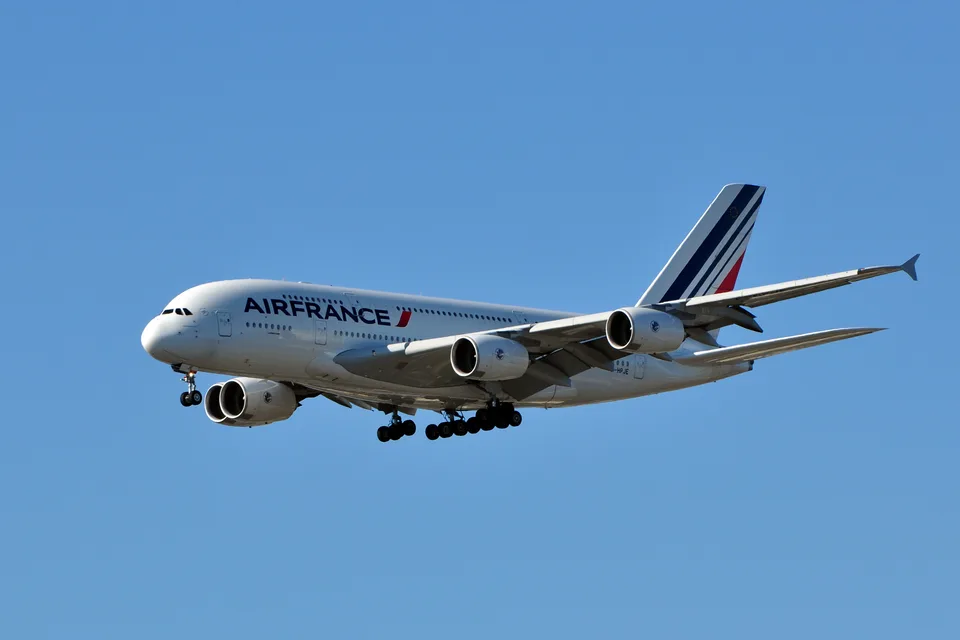
Air France Airbus A380 F-HPJE approaching Washington Dulles with landing gear extended.

F-HPJE on approach to Washington Dulles in November 2011.

Photo: Joe Ravi, CC BY-SA 3.0

Image info

The accident aircraft, photographed on 6 November 2011, before the engine failure over Greenland.

Image source

Original photograph unchanged. Responsive WebP copies resized without cropping.

Geographic context

Geographical orientation for Air France 66Engine failure over southwestern Greenland; Diversion landing at Goose Bay. Approximate geographic markers for the failure area and diversion airport. The BEA places the debris search area about 100 km northwest of Narsarsuaq and charts the diversion to Goose Bay.12NORTH UP / SCHEMATIC / NOT A RECORDED FLIGHT TRACK
  1. Engine failure over southwestern Greenland
  2. Diversion landing at Goose Bay
Approximate geographic markers for the failure area and diversion airport. The BEA places the debris search area about 100 km northwest of Narsarsuaq and charts the diversion to Goose Bay. Basemap: Natural Earth, public domain.
Read supporting evidence
Air France AF066, A380-861 F-HPJE, Greenland, 30 September 20171.1 History of the flight, Figure 2 | Printed page 14 | PDF page 14Find this passage in evidence search

What happened

At 13:49 UTC, during a climb from FL370 toward FL380 over Greenland, the fan hub of engine No 4 fractured. Fan fragments, the inlet and engine casing separated. The crew shut down the engine, descended to FL270 and diverted to Goose Bay, landing at 15:42. No one was injured.

Read the full incident Follow what happened, from the flight to the investigation findings.

What investigators concluded

The BEA found that cold dwell fatigue initiated a subsurface crack in a macro-zone in the titanium fan hub. The hub failed after 3,534 cycles. The engine design and certification had not taken this failure mechanism in Ti-6-4 into account. The BEA identified gaps in knowledge, certification guidance and macro-zone detection, together with the increased risk associated with larger titanium forgings.

Evidence behind this explanation
Air France AF066, A380-861 F-HPJE, Greenland, 30 September 20171.16.5 Examination of hub fragment found during phase III | Printed page 51 | PDF page 51Find this passage in evidence search

The fan failure over Greenland

1,536 words / about 7 minutes to read. Based on the investigation records cited below.

A scheduled flight across the Atlantic

Air France flight AF066 left Paris Charles-de-Gaulle at 09:50 UTC on 30 September 2017 for Los Angeles. The Airbus A380-861, registered F-HPJE, carried 497 passengers and 24 crew. Its flight crew consisted of a captain and two first officers, who divided the rest periods for the long flight. The aircraft had four Engine Alliance GP7270 engines and had entered Air France service in 2011. It initially cruised at FL330, then climbed in stages, reaching FL370 at 11:14.

As the aircraft crossed Greenland, the captain was monitoring and one first officer was flying. The other first officer was resting. At 13:48 the crew asked Gander Oceanic for clearance to climb to FL380. The controller approved the request and asked them to report reaching that level. Engine low-pressure rotor speed increased as the climb began. A minute later, the right outer engine suffered an uncontained failure.

Sources for this section

The fan separates

The titanium fan hub in engine No 4 broke into at least three pieces. Its central conical fragment remained attached to the low-pressure shaft. Two other large fragments flew outward, one upward and one downward. Their interaction with the engine casing and inlet tore those structures away. Debris struck the wing, pylon, control surfaces and horizontal stabilizer. The surrounding airframe sustained relatively slight damage, and no debris entered the cabin. The pressure shell remained intact.

The aircraft yawed three degrees to the right in three seconds, with airframe vibrations recorded for about four seconds. An engine stall message appeared on the ECAM, followed by an engine failure indication. The captain took control and engaged his autopilot. He moved the affected thrust lever to idle. The engine shut down automatically, and the first officer operated the engine master and fire pushbuttons. The available recordings showed no warning before the fan separation.

Sources for this section

Finding a level the aircraft could hold

The pilots could not see engine No 4 from the cockpit, and the camera on the fin did not show it. A cabin crew member brought forward a passenger's smartphone photograph. The resting first officer returned to help, then went to the upper deck to inspect the damage and take more photographs. He also saw damage to the leading edge slats and small vibrations in the flaps. The crew used Air France's FOR-DEC decision method to assess the failure and the diversion.

During the first minute and a half, airspeed fell from 277 to 258 knots while the aircraft remained at FL370. The flight management system calculated an engine-out maximum level of FL346. The captain began descending, but the A380 could not hold the anticipated level and selected speed. He continued through several lower levels. Each new descent interrupted the ECAM actions. After reaching FL290 with the three remaining engines at maximum continuous thrust, he selected FL270 to reduce the demands on them. Speed stabilized at 279 knots.

Sources for this section

The diversion to Goose Bay

Gander Oceanic detected the deviation from the cleared vertical profile through datalink information and asked whether there was a problem. Another aircraft relayed the A380's Mayday, and the crew also sent a Mayday through the datalink. Direct voice contact resumed a few minutes later. The aircraft was outside radar coverage during the descent. No nearby traffic was reported and there were no obstacles along the planned route.

The crew and Air France operations considered Kangerlussuaq, Iqaluit and Goose Bay. Kangerlussuaq was closer, but the pilots were unfamiliar with its available approach and were concerned about surrounding mountains and reduced aircraft performance. Runway length also mattered if the flaps became stuck retracted. Iqaluit had adverse weather. They selected Goose Bay, whose runway 08/26 was 3,368 metres long. At 15:42 the A380 landed on runway 26 after an RNAV GNSS approach. Airport crews collected debris from the runway during the prolonged taxi to the stand.

Sources for this section
Air France AF066, A380-861 F-HPJE, Greenland, 30 September 20171.5.9 Choice of alternate airfield | Printed page 22 | PDF page 22Find this passage in evidence search
Air France AF066, A380-861 F-HPJE, Greenland, 30 September 20172.6.1 Information available to crew when there is severe damage | Printed page 70 | PDF page 70Find this passage in evidence search
Air France AF066, A380-861 F-HPJE, Greenland, 30 September 20171.5.9 Choice of alternate airfield | Printed page 22 | PDF page 22Find this passage in evidence search

Passengers and the flight recordings

All 521 occupants survived without injury. There was no emergency evacuation. Goose Bay's immigration, passenger handling and accommodation capacity was insufficient for everyone aboard the A380. Some passengers entered the terminal, and meals were served on the aircraft. The captain met passengers in groups of 50 to explain the situation. The last passenger left at 08:10 UTC on 1 October, and Air France arranged onward travel to Los Angeles.

The extended ground phase also affected the cockpit voice recording. It held about two hours and four minutes of sound. By the time it stopped, the engine failure had been overwritten. The captain had anticipated preserving the recording, but the first officer encountered an incorrect circuit breaker location in the aircraft documents and difficulties accessing the avionics bay. Recording stopped automatically five minutes after the final engine shutdown. The flight data recorder, aircraft computer records, radio recordings and crew statements supplied other evidence about the sudden failure and subsequent flight.

Sources for this section

Searching the Greenland ice sheet

The flight data located the failure over Greenland. Denmark delegated the investigation to the BEA, which organized work with the Canadian and American authorities and the manufacturers. The debris search area lay on ice about 100 kilometres northwest of Narsarsuaq. Helicopter flights in October 2017 recovered around 30 pieces, including fan blade and inlet fragments. The missing fan hub remained essential to determining the fracture process, but snowfall ended visual searches.

An airborne radar campaign and a ground search followed in 2018. Investigators encountered background noise, limited radar penetration and a vast search area. The hub fragments were still missing at the end of June. Refined processing of the airborne radar data later identified a promising target. For the next expedition, a Danish university group modified an electromagnetic detector to locate titanium several metres below the snow. A strong signal near a crevasse led to excavation. The recovered hub fragment was handed to the BEA in July 2019, 21 months after the accident.

Sources for this section
Air France AF066, A380-861 F-HPJE, Greenland, 30 September 20171.16.4 Searches in Greenland, Phase III | Printed page 46 | PDF page 46Find this passage in evidence search

A crack below the blade slot

Examination under BEA supervision traced the crack to slot No 10, about 14 centimetres behind the hub's front face and 1.4 millimetres below the slot bottom. The crack began in a macro-zone, a region of metal grains with a strong common crystallographic orientation. Metallurgical work established cold dwell fatigue. The material met the applicable requirements for the titanium alloy, and investigators found no associated material quality or manufacturing anomaly. The recovered fracture surfaces also ruled out maintenance damage as the origin.

The crack progressed for approximately 1,650 cycles before the hub failed at 3,534 cycles. Its predicted minimum life had been 15,000 cycles. Much of the early crack growth occurred below the surface, where the scheduled maintenance inspections available at the time could not have detected it. Earlier inspections of other engines had found surface damage that made a maintenance-related failure appear plausible. Recovery of the actual fracture origin changed that assessment and established the subsurface fatigue mechanism.

Microscope examination showed both fatigue striations and faceted regions on the fracture surface. Investigators estimated 1,652 striations and identified a transition associated with the crack reaching the surface after about 773 cycles. They found a micro-textured region about 1.75 millimetres wide and 1.63 millimetres deep at the origin. A polished cross-section allowed the laboratory to map the grain orientations. This map closely matched the faceted fracture region, linking the crack to a concentration of similarly oriented grains. The crack eventually extended about 19.7 millimetres before becoming unstable. These examinations connected the microscopic origin beneath the blade slot with the eventual separation of the much larger fan hub fragments.

Sources for this section
Air France AF066, A380-861 F-HPJE, Greenland, 30 September 20171.16.5 Examination of hub fragment found during phase III | Printed page 47 | PDF page 47Find this passage in evidence search
Air France AF066, A380-861 F-HPJE, Greenland, 30 September 20171.16.5 Examination of hub fragment found during phase III | Printed page 51 | PDF page 51Find this passage in evidence search
Air France AF066, A380-861 F-HPJE, Greenland, 30 September 20171.16.5 Examination of hub fragment found during phase III | Printed page 48 | PDF page 48Find this passage in evidence search
Air France AF066, A380-861 F-HPJE, Greenland, 30 September 20171.16.5 Examination of hub fragment found during phase III | Printed page 49 | PDF page 49Find this passage in evidence search
Air France AF066, A380-861 F-HPJE, Greenland, 30 September 20171.16.5 Examination of hub fragment found during phase III | Printed page 50 | PDF page 50Find this passage in evidence search
Air France AF066, A380-861 F-HPJE, Greenland, 30 September 20172.3 Damages during maintenance operations | Printed page 65 | PDF page 65Find this passage in evidence search

Cold dwell fatigue and aircraft performance

Dwell fatigue combines cyclic loading with a period during which stress is held. Titanium can undergo creep at ambient temperatures, and the arrangement of its grains affects susceptibility to this process. At the time of the GP7200's certification, the scientific community, industry and certification authorities generally considered Ti-6-4 insensitive to cold dwell fatigue. Tests after the accident showed that longer dwell times could reduce life significantly. The BEA found that the large, strongly aligned macro-zone and the duration of stress in service probably contributed to crack initiation.

The investigation also explained the unexpected descent. The calculated engine-out ceiling assumed a windmilling failed engine. The seized rotor and extensive engine damage produced additional drag, lowering the sustainable level. Operational documents gave the crew no means of estimating the performance loss from such severe damage. The BEA considered their step down descent the only effective means available to find the actual stabilization level. It found their use of the greendot speed appropriate and described FOR-DEC as effective in managing the occurrence.

Sources for this section
Air France AF066, A380-861 F-HPJE, Greenland, 30 September 20171.18.4 Cold dwell fatigue phenomenon | Printed page 60 | PDF page 60Find this passage in evidence search
Air France AF066, A380-861 F-HPJE, Greenland, 30 September 20172.4.3 Knowledge of cold dwell fatigue | Printed page 67 | PDF page 67Find this passage in evidence search
Air France AF066, A380-861 F-HPJE, Greenland, 30 September 20172.6.1 Information available to crew when there is severe damage | Printed page 69 | PDF page 69Find this passage in evidence search
Air France AF066, A380-861 F-HPJE, Greenland, 30 September 20172.6.1 Information available to crew when there is severe damage | Printed page 70 | PDF page 70Find this passage in evidence search
Air France AF066, A380-861 F-HPJE, Greenland, 30 September 20172.6.4 Method for processing onboard incidents | Printed page 71 | PDF page 71Find this passage in evidence search
Air France AF066, A380-861 F-HPJE, Greenland, 30 September 20172.4.3 Knowledge of cold dwell fatigue | Printed page 67 | PDF page 67Find this passage in evidence search
Air France AF066, A380-861 F-HPJE, Greenland, 30 September 20172.6.1 Information available to crew when there is severe damage | Printed page 70 | PDF page 70Find this passage in evidence search

Inspections, design changes and recommendations

After the accident, the manufacturer issued inspection instructions adopted by the FAA and EASA. As the failure mechanism became known, a November 2019 service bulletin added periodic ultrasonic inspections to eddy current checks, with inspections every 330 cycles. A more elastic fan blade lock ring eased removal and installation and reduced the risk of maintenance damage; deployment began on 25 November 2019. The report recorded that no crack had been detected by 10 March 2020. Air France had also revised its recorder preservation procedures and aircraft information on 4 January 2018.

The BEA's final report identified insufficient knowledge of cold dwell fatigue in Ti-6-4, absent certification instructions for the phenomenon and macro-zones, limits in non-destructive detection, and the increased risk of large macro-zones in bigger forgings as possible contributing factors. Four recommendations addressed EASA and the FAA. They called for control of the risk through design, manufacturing and production checks, and for review of affected titanium rotor parts with suitable in-service inspections where required.

Sources for this section
Air France AF066, A380-861 F-HPJE, Greenland, 30 September 20174.4 Inspections since examination of engine No 4 fan hub | Printed page 76 | PDF page 76Find this passage in evidence search
Air France AF066, A380-861 F-HPJE, Greenland, 30 September 20174.3 Design of a new fan blade lock ring | Printed page 76 | PDF page 76Find this passage in evidence search
Air France AF066, A380-861 F-HPJE, Greenland, 30 September 20174.2 Inspection of GP7270 fan hubs just after accident | Printed page 76 | PDF page 76Find this passage in evidence search
Air France AF066, A380-861 F-HPJE, Greenland, 30 September 20174.1 Preservation of flight recorders | Printed page 75 | PDF page 75Find this passage in evidence search
Air France AF066, A380-861 F-HPJE, Greenland, 30 September 20175.1 Titanium rotor-grade critical parts | Printed page 79 | PDF page 79Find this passage in evidence search
Air France AF066, A380-861 F-HPJE, Greenland, 30 September 20174.4 Inspections since examination of engine No 4 fan hub | Printed page 76 | PDF page 76Find this passage in evidence search

Return to the short summary / Source status and limitations

How the sequence developed

Follow the main stages, then open the evidence beneath each step.

  1. Subsurface fatigue begins

    Cold dwell fatigue initiated a crack in a macro-zone below the bottom of a fan blade slot.

    Read supporting evidence
    Air France AF066, A380-861 F-HPJE, Greenland, 30 September 20171.16.5 Examination of hub fragment found during phase III | Printed page 51 | PDF page 51Find this passage in evidence search
    Air France AF066, A380-861 F-HPJE, Greenland, 30 September 20171.16.5 Examination of hub fragment found during phase III | Printed page 47 | PDF page 47Find this passage in evidence search
  2. The hub fractures

    After 3,534 cycles, the fan hub broke into at least three parts and two large fragments escaped upward and downward.

    Read supporting evidence
  3. Engine structure separates

    The liberated rotor fragments destroyed the engine casing and separated the inlet. Debris struck nearby aircraft structure.

    Read supporting evidence
  4. Drag reduces the ceiling

    The damaged engine generated additional drag. The aircraft stabilized at FL270, around 7,000 feet below the FMS engine-out indication.

    Read supporting evidence
    Air France AF066, A380-861 F-HPJE, Greenland, 30 September 20172.6.1 Information available to crew when there is severe damage | Printed page 69 | PDF page 69Find this passage in evidence search
  5. The crew diverts and lands

    The crew selected Goose Bay with Air France operations and landed on runway 26 without further difficulty.

    Read supporting evidence
    Air France AF066, A380-861 F-HPJE, Greenland, 30 September 20171.5.9 Choice of alternate airfield | Printed page 22 | PDF page 22Find this passage in evidence search

A simplified reading of the investigation findings. The sequence does not replace the full report or imply that every contributing factor is shown.

Sequence of events

Flight times are UTC. Greenland and Goose Bay local time was three hours behind UTC on the day of the accident. Expand an event to see its evidence.

  1. 09:50 UTCDeparture from Paris

    Flight AF066 departed Paris Charles-de-Gaulle for Los Angeles with 497 passengers and 24 crew.

  2. 13:48 UTCClimb requested

    The crew requested and received clearance to climb from FL370 to FL380.

  3. 13:49 UTCFan hub fractures

    The right outer engine fan hub broke into at least three parts. Two large fragments were ejected and the engine inlet and casing separated.

  4. Immediately after the failureCrew shuts down engine No 4

    The captain took control. The engine shut down automatically, and the first officer operated the engine master and fire pushbuttons.

  5. Descent after the failurePerformance below the calculated ceiling

    The crew descended in steps, eventually stabilizing at FL270. Engine damage had substantially increased drag.

    Air France AF066, A380-861 F-HPJE, Greenland, 30 September 20172.6.1 Information available to crew when there is severe damage | Printed page 69 | PDF page 69Find this passage in evidence search
  6. 15:42 UTCLanding at Goose Bay

    The A380 landed on runway 26. Taxiing was interrupted while airport services collected debris from the runway.

  7. 1 October 2017, 08:10 UTCLast passenger leaves

    Limited passenger handling and accommodation capacity prolonged the stay aboard. The last passenger left the aircraft the following morning.

  8. July 2019Recovered hub fragment examined

    A fragment recovered from the Greenland ice sheet reached the BEA. Examination established a subsurface crack and cold dwell fatigue.

    Air France AF066, A380-861 F-HPJE, Greenland, 30 September 20171.16.4 Searches in Greenland, Phase III | Printed page 46 | PDF page 46Find this passage in evidence search
    Air France AF066, A380-861 F-HPJE, Greenland, 30 September 20171.16.5 Examination of hub fragment found during phase III | Printed page 47 | PDF page 47Find this passage in evidence search
    Air France AF066, A380-861 F-HPJE, Greenland, 30 September 20171.16.5 Examination of hub fragment found during phase III | Printed page 51 | PDF page 51Find this passage in evidence search
  9. September 2020Final investigation report

    The BEA issued its final report and recommendations to EASA and the FAA on titanium rotor parts and cold dwell fatigue.

    Air France AF066, A380-861 F-HPJE, Greenland, 30 September 20175.1 Titanium rotor-grade critical parts | Printed page 79 | PDF page 79Find this passage in evidence search
    Air France AF066, A380-861 F-HPJE, Greenland, 30 September 20175.1 Titanium rotor-grade critical parts | Printed page 79 | PDF page 79Find this passage in evidence search

Search the report evidence

Search extracted report prose, with original page references. Short results link to the full document.

Questions readers ask

Why did the titanium fan hub crack?

Cold dwell fatigue initiated a crack in a large, strongly aligned grain region below a blade slot. Tests after the accident showed that holding the stress for longer could significantly reduce the part's life.

Air France AF066, A380-861 F-HPJE, Greenland, 30 September 20172.4.3 Knowledge of cold dwell fatigue | Printed page 67 | PDF page 67Find this passage in evidence search
Air France AF066, A380-861 F-HPJE, Greenland, 30 September 20171.16.5 Examination of hub fragment found during phase III | Printed page 51 | PDF page 51Find this passage in evidence search
Air France AF066, A380-861 F-HPJE, Greenland, 30 September 20171.16.5 Examination of hub fragment found during phase III | Printed page 47 | PDF page 47Find this passage in evidence search
Why did the A380 descend to FL270?

Damage to engine No 4 created additional drag. The crew used a step down descent to find a level at which the aircraft could maintain speed, eventually stabilizing at FL270.

Air France AF066, A380-861 F-HPJE, Greenland, 30 September 20172.6.1 Information available to crew when there is severe damage | Printed page 70 | PDF page 70Find this passage in evidence search
Air France AF066, A380-861 F-HPJE, Greenland, 30 September 20172.6.1 Information available to crew when there is severe damage | Printed page 69 | PDF page 69Find this passage in evidence search
How was the missing fan hub fragment found?

Investigators refined airborne radar results and used a modified electromagnetic detector on the ice sheet. A strong detection near a crevasse led to excavation, and the fragment was handed to the BEA in July 2019.

Air France AF066, A380-861 F-HPJE, Greenland, 30 September 20171.16.4 Searches in Greenland, Phase III | Printed page 46 | PDF page 46Find this passage in evidence search

What the evidence can and cannot establish

No recording of the initial cockpit sounds

The engine failure had been overwritten on the two-hour cockpit voice recorder. Other recorded data confirmed the sudden failure and showed no preceding warning.

Read supporting evidence

Titanium grain detection limits

At the time of the final report, reliable non-destructive methods for detecting macro-zones in production were unavailable. The BEA identified this limitation among the factors that may have contributed.

Read supporting evidence
Air France AF066, A380-861 F-HPJE, Greenland, 30 September 20172.5.2 Detection of macro-zones in production | Printed page 69 | PDF page 69Find this passage in evidence search

Debris direction

The upward and downward ejection of the two large hub fragments was random. The BEA found that lateral ejection might have caused catastrophic damage to aircraft structure or flight controls.

Read supporting evidence

Safety follow-up

Actions and recommendations are described at the dates of the cited records. A recommendation is not proof of implementation.

Fan hub inspections and lock ring changes

The November 2019 instructions introduced periodic ultrasonic inspections alongside eddy current inspections. A redesigned lock ring entered deployment on 25 November 2019. The report recorded no detected cracks as of 10 March 2020.

Read supporting evidence
Air France AF066, A380-861 F-HPJE, Greenland, 30 September 20174.4 Inspections since examination of engine No 4 fan hub | Printed page 76 | PDF page 76Find this passage in evidence search
Air France AF066, A380-861 F-HPJE, Greenland, 30 September 20174.3 Design of a new fan blade lock ring | Printed page 76 | PDF page 76Find this passage in evidence search
Air France AF066, A380-861 F-HPJE, Greenland, 30 September 20174.2 Inspection of GP7270 fan hubs just after accident | Printed page 76 | PDF page 76Find this passage in evidence search

Four recommendations in the final report

FRAN 2020-006 and 007 asked EASA and the FAA to control cold dwell fatigue risk through design and manufacturing criteria. FRAN 2020-008 and 009 called for review of affected titanium rotor parts and adapted in-service crack inspection programmes where appropriate.

Read supporting evidence
Air France AF066, A380-861 F-HPJE, Greenland, 30 September 20175.1 Titanium rotor-grade critical parts | Printed page 79 | PDF page 79Find this passage in evidence search

Classifications, with reasons

These labels organise the evidence. They are not a ranking of causes. A shared label means a shared research topic, not an identical mechanism.

EventUncontained engine failure

The fan hub fractured and high-energy pieces escaped through the engine casing, separating the inlet and striking adjacent aircraft structure.

Failure mechanismCold dwell fatigue

A crack began below a blade slot in an unusually large and intense macro-zone. Sustained stress during cyclic loading reduced fatigue life.

Air France AF066, A380-861 F-HPJE, Greenland, 30 September 20171.16.5 Examination of hub fragment found during phase III | Printed page 51 | PDF page 51Find this passage in evidence search
Air France AF066, A380-861 F-HPJE, Greenland, 30 September 20171.16.5 Examination of hub fragment found during phase III | Printed page 47 | PDF page 47Find this passage in evidence search
Air France AF066, A380-861 F-HPJE, Greenland, 30 September 20171.18.4 Cold dwell fatigue phenomenon | Printed page 60 | PDF page 60Find this passage in evidence search
Air France AF066, A380-861 F-HPJE, Greenland, 30 September 20172.4.3 Knowledge of cold dwell fatigue | Printed page 67 | PDF page 67Find this passage in evidence search
Contributing factorsEngine design and certification

The BEA identified insufficient knowledge of cold dwell fatigue in Ti-6-4, absent certification guidance and limits in macro-zone detection.

Air France AF066, A380-861 F-HPJE, Greenland, 30 September 20172.5.2 Detection of macro-zones in production | Printed page 69 | PDF page 69Find this passage in evidence search
Operational circumstanceDegraded engine-out performance

Additional drag from the damaged engine reduced the aircraft's sustainable flight level by about 7,000 feet relative to the FMS indication.

Air France AF066, A380-861 F-HPJE, Greenland, 30 September 20172.6.1 Information available to crew when there is severe damage | Printed page 69 | PDF page 69Find this passage in evidence search
RiskHigh-energy debris trajectory

The two large fragments were ejected upward and downward. The BEA found that lateral ejection could have damaged the airframe or flight control systems with catastrophic consequences.

Read alongside

These comparisons connect specific research topics. Shared circumstances do not establish identical causes. Evidence from both investigations is provided below.

United Airlines Flight 232

Both Air France 66 and United Airlines 232 involved an uncontained fan rotor failure and high-energy debris. In the United accident, a fatigue crack grew from a metallurgical defect and the debris disabled all three hydraulic systems. On F-HPJE, cold dwell fatigue began below a blade slot in a macro-zone; the aircraft sustained limited surrounding structural damage and remained controllable.

Read supporting evidence
Air France AF066, A380-861 F-HPJE, Greenland, 30 September 20171.16.5 Examination of hub fragment found during phase III | Printed page 51 | PDF page 51Find this passage in evidence search
NTSB final reportExecutive summary | Printed page v | PDF page 6Find this passage in evidence search
NTSB final report3.2 Probable Cause | Printed page 102 | PDF page 108Find this passage in evidence search

Further investigation records

Explore the records below for additional context. They open on the publisher's site and are not all included in our report search. Source reuse terms apply.

Sources and transparency

The BEA completed its investigation and issued its final report in September 2020.

Source limitations

The English report is a BEA courtesy translation. The French original is the reference text. The initial engine failure had been overwritten on the cockpit voice recorder by the time recording stopped.

Air France AF066, A380-861 F-HPJE, Greenland, 30 September 2017

BEA
Final report BEA2017-0568.en, September 2020. Official English courtesy translation.

Official report PDF, hosted by bea.aero

Open source document

85 PDF pages.

BEA safety investigation report. Copyright in source material remains with its rights holders. Short passages identify the supporting evidence.

United Airlines Flight 232, McDonnell Douglas DC-10-10, Sioux Gateway Airport, Sioux City, Iowa, July 19, 1989

National Transportation Safety Board
NTSB/AAR-90/06, report date 1 November 1990

Official report PDF, hosted by ntsb.gov

Open source document

129 PDF pages.

Brief attributed excerpts for source-based commentary. Full report, photographs and third-party material are not republished. Source terms.

Read the extraction, classification and review methodology.

Suggest a correction to this dossier

Editorial record

Kevin Murphy writes the incident accounts on AirlineIncidents.com, out of a long interest in aviation safety and the lessons each investigation leaves behind.

Prepared by
AirlineIncidents editorial desk
Report citation check
Independent expert review
Not completed

Citation checks compare supporting text with the indexed report pages. They do not constitute independent expert review. How these pages are prepared.

Revision history

: BEA final report, September 2020: cold dwell fatigue findings and four recommendations to EASA and the FAA.
Source-based corrections are reviewed before changes appear here. Suggest a correction to this dossier.

Cite or link to this page

Quoting this account or linking to it? Please use the page address below, and credit the investigation report it is built from.

Credit line

AirlineIncidents.com. Air France Flight 66 accident account. Published 15 October 2026. https://airlineincidents.com/incidents/air-france-66-2017/

HTML link

<a href="https://airlineincidents.com/incidents/air-france-66-2017/">Air France Flight 66 accident account (AirlineIncidents.com)</a>

Select a box to copy it. Spotted something wrong? Send a correction.