LEVEL 2 Preliminary findings

Based on the investigation authority's preliminary or interim information. Causes not yet determined.

Date
Occurrence
Engine and pylon separation
Location
Runway 17R departure, Louisville Muhammad Ali International
Sources for this section

DCA26MA024 preliminary report: Event and takeoff clearanceNational Transportation Safety Board / preliminary / PDF page 1 (preliminary report)

DCA26MA024 preliminary report: Separation and initial impactsNational Transportation Safety Board / preliminary / PDF page 2 (preliminary report)

Operator
UPS Airlines
Sources for this section

DCA26MA024 preliminary report: Event and takeoff clearanceNational Transportation Safety Board / preliminary / PDF page 1 (preliminary report)

Aircraft
McDonnell Douglas MD-11F
Sources for this section

DCA26MA024 preliminary report: Event and takeoff clearanceNational Transportation Safety Board / preliminary / PDF page 1 (preliminary report)

Registration
N259UP
Sources for this section

DCA26MA024 preliminary report: Event and takeoff clearanceNational Transportation Safety Board / preliminary / PDF page 1 (preliminary report)

Route
Louisville to Honolulu
Sources for this section

DCA26MA024 preliminary report: Event and takeoff clearanceNational Transportation Safety Board / preliminary / PDF page 1 (preliminary report)

People aboard
Its crew consisted of a captain, first officer and relief officer. There were no passengers.
Sources for this section

DCA26MA024 preliminary report: Event and takeoff clearanceNational Transportation Safety Board / preliminary / PDF page 1 (preliminary report)

Fatalities
15 including the later ground death; NTSB main tables list 14; 3 crew; no onboard survivors; 12 including a victim who died 51 days later
Sources for this section

DCA26MA024 investigative update: Event, separation and later death footnoteNational Transportation Safety Board / preliminary / PDF page 1 (investigative update)

DCA26MA024 preliminary report: Event and takeoff clearanceNational Transportation Safety Board / preliminary / PDF page 1 (preliminary report)

Investigating authority
NTSB DCA26MA024, ongoing
Sources for this section

NTSB DCA26MA024 investigation overviewNational Transportation Safety Board / preliminary / Status Ongoing; links to preliminary report, investigative update and hearing

Closing remarks at UPS investigative hearingNational Transportation Safety Board / preliminary / 20 May 2026; analysis and final report still ahead

Topics
Takeoff

Photographic evidence

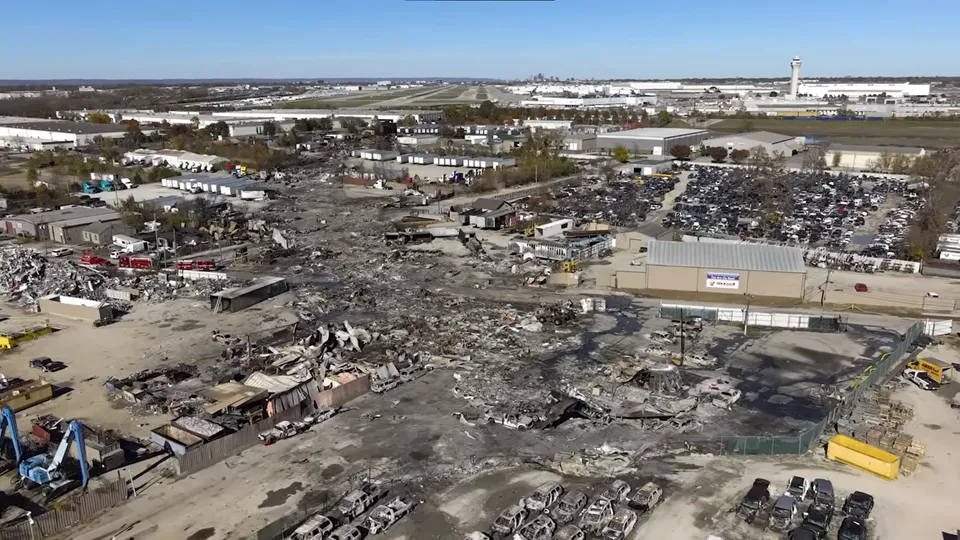
Aerial view of the UPS Flight 2976 crash site in Louisville.

The Flight 2976 crash site in Louisville, 7 November 2025.

Photo: National Transportation Safety Board, Public domain, NTSB staff work

Image info

Still from NTSB aerial footage. Courtesy: National Transportation Safety Board.

Actual crash site still from official NTSB B-roll. Commons PD-USGov NTSB, no third-party credit. Prefer this over airport CCTV stills where airport authorship could require separate permission.

Image source / Original agency release

Resized and WebP recompressed without cropping or content alteration. Banner and homepage use a display crop; the full photograph below is uncropped.

The banner uses a display crop. This photograph is shown uncropped here. It does not by itself establish the cause.

What happened

UPS Flight 2976 was taking off from Louisville for Honolulu on 4 November 2025 when its left engine and pylon separated from the wing. Fire developed around the damaged wing attachment. The MD-11 F rose only briefly, struck a warehouse and continued into nearby buildings and yards. All three crew members died. Twelve people on the ground also died, including one who succumbed to injuries 51 days later. The NTSB documented fatigue cracking in the engine attachment and bearing components and held a public hearing in May 2026. Its final analysis and probable cause have not yet been issued.

Read the full incident

Investigation status

Airport video records the left engine and pylon separating shortly after rotation. Preliminary laboratory work identified fatigue cracks in aft-mount lugs and the spherical bearing race. These are established observations, but the NTSB has not yet adopted a final explanation of the failure sequence, maintenance implications or aircraft performance.

Sources for this section

NTSB DCA26MA024 investigation overviewNational Transportation Safety Board / preliminary / Status Ongoing; links to preliminary report, investigative update and hearing

DCA26MA024 preliminary report: Event and takeoff clearanceNational Transportation Safety Board / preliminary / PDF page 1 (preliminary report)

DCA26MA024 preliminary report: Separation and initial impactsNational Transportation Safety Board / preliminary / PDF page 2 (preliminary report)

DCA26MA024 preliminary report: Wreckage pathNational Transportation Safety Board / preliminary / PDF page 3 (preliminary report)

DCA26MA024 preliminary report: Witnesses and crewNational Transportation Safety Board / preliminary / PDF page 4 (preliminary report)

DCA26MA024 preliminary report: Recorders and attachment designNational Transportation Safety Board / preliminary / PDF page 5 (preliminary report)

DCA26MA024 preliminary report: Pylon attachmentNational Transportation Safety Board / preliminary / PDF page 6 (preliminary report)

DCA26MA024 preliminary report: Recovered mount and bearingNational Transportation Safety Board / preliminary / PDF page 7 (preliminary report)

DCA26MA024 preliminary report: Recovered componentsNational Transportation Safety Board / preliminary / PDF page 8 (preliminary report)

DCA26MA024 preliminary report: Laboratory examinationNational Transportation Safety Board / preliminary / PDF page 9 (preliminary report)

DCA26MA024 preliminary report: Maintenance and initial safety actionsNational Transportation Safety Board / preliminary / PDF page 10 (preliminary report)

DCA26MA024 preliminary report: Further airworthiness actionNational Transportation Safety Board / preliminary / PDF page 11 (preliminary report)

DCA26MA024 preliminary report: Injury classificationNational Transportation Safety Board / preliminary / PDF page 12 (preliminary report)

DCA26MA024 investigative update: Event, separation and later death footnoteNational Transportation Safety Board / preliminary / PDF page 1 (investigative update)

DCA26MA024 investigative update: Bearing-race fatigue examinationNational Transportation Safety Board / preliminary / PDF page 2 (investigative update)

DCA26MA024 investigative update: Bearing fracture illustrationNational Transportation Safety Board / preliminary / PDF page 3 (investigative update)

DCA26MA024 investigative update: 2011 service letterNational Transportation Safety Board / preliminary / PDF page 4 (investigative update)

DCA26MA024 investigative update: Maintenance review and flight dataNational Transportation Safety Board / preliminary / PDF page 5 (investigative update)

UPS Flight 2976 investigative hearing, May 19-20, 2026National Transportation Safety Board / preliminary / Official event page: past hearing and factual purpose

Closing remarks at UPS investigative hearingNational Transportation Safety Board / preliminary / 20 May 2026; analysis and final report still ahead

When is the UPS Airlines Flight 2976 final report due?

No final report has been published yet. NTSB (United States) is leading the investigation. It has been 11 months since the accident. Under ICAO Annex 13, a final report or an interim statement is due by each anniversary of the accident. The next anniversary is 4 November 2026.

Published so far: preliminary report, investigation update.

See all pending air accident final reports

The full incident

1,513 words / about 7 minutes to read. The account is limited to the detail supported by the published evidence; missing sequences are not reconstructed.

A cargo departure from Louisville

UPS Flight 2976 was scheduled to carry cargo from Louisville Muhammad Ali International Airport to Daniel K. Inouye International Airport in Honolulu on 4 November 2025. The aircraft was N259UP, an MD-11 F with three GE CF-6 engines. Its crew consisted of a captain, first officer and relief officer. There were no passengers.

The first officer was flying and the captain was monitoring. All three held airline transport pilot certificates and MD-11 type ratings. The preliminary report recorded about 8,613 total flight hours for the captain, 9,200 for the first officer and 15,250 for the relief officer. Their MD-11 experience varied, but this was a crew with substantial flying experience across its three members.

The aircraft had accumulated approximately 92,992 flight hours and 21,043 cycles. These figures describe its service history; they do not, by themselves, establish that it was unsafe or explain the accident. The NTSB's investigation focused on the condition and history of specific structural components and on how the aircraft performed after their failure.

Sources for this section

DCA26MA024 preliminary report: Event and takeoff clearanceNational Transportation Safety Board / preliminary / PDF page 1 (preliminary report)

DCA26MA024 preliminary report: Witnesses and crewNational Transportation Safety Board / preliminary / PDF page 4 (preliminary report)

DCA26MA024 preliminary report: Recorders and attachment designNational Transportation Safety Board / preliminary / PDF page 5 (preliminary report)

DCA26MA024 preliminary report: Maintenance and initial safety actionsNational Transportation Safety Board / preliminary / PDF page 10 (preliminary report)

Takeoff and separation

The tower cleared Flight 2976 to take off from runway 17R at about 17:11 eastern standard time. The crew acknowledged. The taxi and early takeoff roll appeared uneventful. Flight data began recording the accident flight at about 17:07 and placed the start of the takeoff roll at approximately 17:12.

Airport surveillance video then captured a major failure shortly after rotation, when the aircraft's nose rose for takeoff. The left engine and its pylon separated from the wing. Fire ignited on the detached engine as it passed above the fuselage and fell to the ground. A separate fire developed near the left pylon's wing attachment and remained visible as the airplane continued.

An engine pylon is the structure connecting a wing-mounted engine to the wing. Losing the engine together with that structure is different from an engine stopping while remaining securely attached. The observed separation left damage and fire at the attachment area. The precise consequences for thrust, airflow, control and the airplane's ability to climb are questions for the detailed performance analysis.

Sources for this section

DCA26MA024 preliminary report: Event and takeoff clearanceNational Transportation Safety Board / preliminary / PDF page 1 (preliminary report)

DCA26MA024 preliminary report: Separation and initial impactsNational Transportation Safety Board / preliminary / PDF page 2 (preliminary report)

DCA26MA024 preliminary report: Recorders and attachment designNational Transportation Safety Board / preliminary / PDF page 5 (preliminary report)

DCA26MA024 investigative update: Event, separation and later death footnoteNational Transportation Safety Board / preliminary / PDF page 1 (investigative update)

Too low to clear the buildings

The airplane initially became airborne but did not climb normally. Its flight recorder's radio-altitude data showed no climb above approximately 30 feet over the surface beneath it. The preliminary report also recorded a differing last ADS-B altitude indication. Those figures came from different systems and reference conditions, so they should not be silently treated as interchangeable measurements.

The MD-11 cleared a blast fence beyond runway 17R. Its left main landing gear then struck the roof of a UPS Supply Chain Solutions warehouse at the airport's southern edge. It continued into a storage yard and two more buildings, including a petroleum recycling facility. Most of the airplane was consumed by fire.

The wreckage spread approximately 3,000 feet south-southeast from the warehouse. The consequences extended into places where people were working or visiting on the ground. A tower witness described an abnormal climb, and another saw the airplane stop climbing, lose altitude and roll slightly left. These are observations that the investigators compare with recorded data and physical evidence.

Sources for this section

DCA26MA024 preliminary report: Separation and initial impactsNational Transportation Safety Board / preliminary / PDF page 2 (preliminary report)

DCA26MA024 preliminary report: Wreckage pathNational Transportation Safety Board / preliminary / PDF page 3 (preliminary report)

DCA26MA024 preliminary report: Witnesses and crewNational Transportation Safety Board / preliminary / PDF page 4 (preliminary report)

The people affected

All three crew members died. Eleven people on the ground were initially recorded as fatally injured, and 23 other ground occupants were injured. The preliminary tables divided the latter group into two serious and 21 minor injuries. A victim who had been seriously injured died 51 days after the accident.

That later death is acknowledged directly in a footnote to the NTSB's investigative update. Counting it produces 15 deaths altogether: the three crew and twelve people on the ground. The update's main casualty text still gives 14 fatalities. This account states both the overall toll and the difference in the investigation's published classification, rather than hiding the additional death or changing the official table.

The airplane carried cargo rather than passengers, but that did not limit the human loss to its crew. The crash path passed through occupied ground facilities and produced a major fire. The total should therefore always distinguish deaths aboard the aircraft from those outside it. No one aboard survived.

Sources for this section

DCA26MA024 preliminary report: Event and takeoff clearanceNational Transportation Safety Board / preliminary / PDF page 1 (preliminary report)

DCA26MA024 preliminary report: Injury classificationNational Transportation Safety Board / preliminary / PDF page 12 (preliminary report)

DCA26MA024 investigative update: Event, separation and later death footnoteNational Transportation Safety Board / preliminary / PDF page 1 (investigative update)

Recovering the attachment components

The NTSB recovered the flight data and cockpit voice recorders and read them at its Washington laboratory. The voice recorder held about two hours and four minutes including the accident flight. The data recorder held around 63 hours across 24 flights and roughly 450 recorded parameters. Specialist groups examined the structure, engines, maintenance, operations, materials and performance.

Investigators found the left engine, pylon, mount components and engine fragments on or beside runway 17R. Portions of the left aft mount had fractured and separated. Other pieces, including the wing clevis, spherical bearing and attachment hardware, were recovered with part of the left wing at the crash site. The separated engine and pylon were therefore physical evidence as well as objects visible in the surveillance footage.

The left pylon aft mount consists of two fittings with lugs around a spherical bearing. The wing clevis connects through this assembly. In simpler terms, these parts form a joint that transfers loads between the engine-supporting structure and the wing. Examining them helps distinguish pre-existing cracking from damage caused when the assembly tore apart or struck the ground.

Sources for this section

DCA26MA024 preliminary report: Recorders and attachment designNational Transportation Safety Board / preliminary / PDF page 5 (preliminary report)

DCA26MA024 preliminary report: Pylon attachmentNational Transportation Safety Board / preliminary / PDF page 6 (preliminary report)

DCA26MA024 preliminary report: Recovered mount and bearingNational Transportation Safety Board / preliminary / PDF page 7 (preliminary report)

DCA26MA024 preliminary report: Recovered componentsNational Transportation Safety Board / preliminary / PDF page 8 (preliminary report)

Fatigue cracking and the bearing race

The preliminary laboratory examination found fatigue cracking in parts of the aft-mount lugs as well as areas of overstress failure. Some fracture surfaces showed both kinds of damage; one showed overstress without fatigue. This distinction matters because fatigue can grow under repeated loading before a final failure, while overstress describes material breaking under a load beyond its capacity.

The subsequent investigative update described the spherical bearing race, the outer component surrounding the bearing's ball. It had split into forward and aft portions. Investigators found fatigue cracking around the circumference at the edge of an internal design recess groove. They described fatigue across approximately 75 percent of the fracture surface, with the remaining portion consistent with overstress.

These findings are strong evidence about the components' condition, but they are not yet an adopted probable cause. The NTSB must determine how the component failures progressed, how they relate to the mount and pylon separation, and what inspection, maintenance or design factors contributed. A description of fatigue does not establish when a detectable crack first existed or who should have detected it.

Sources for this section

DCA26MA024 preliminary report: Laboratory examinationNational Transportation Safety Board / preliminary / PDF page 9 (preliminary report)

DCA26MA024 investigative update: Bearing-race fatigue examinationNational Transportation Safety Board / preliminary / PDF page 2 (investigative update)

DCA26MA024 investigative update: Bearing fracture illustrationNational Transportation Safety Board / preliminary / PDF page 3 (investigative update)

The earlier service letter and inspection history

The bearing design appeared consistent with a part number discussed in a Boeing service letter dated 7 February 2011. That letter described four previous bearing-race failures on three airplanes. The failures had begun at the same internal recess groove. In those cases, split race pieces moved beyond the outer surfaces of the mount lugs, making the problem visually identifiable.

The update reports that Boeing's earlier assessment said those bearing failures would not result in a safety-of-flight condition. The letter discussed inspections for race migration and a revised bearing design without the recess groove. It recommended the newer design when replacing an unserviceable bearing but did not prohibit installing the older part number. Investigators were reviewing how that information entered maintenance documents, the UPS program and correspondence with the FAA.

UPS records showed that general and detailed visual inspections of the aft mount, required at a 72-month interval, had last been completed in October 2021. A lubrication task had been performed in October 2025. More specialized inspections were due at higher cycle counts than the airplane had reached. The preliminary report therefore does not say those cycle-based inspections were overdue. Their thresholds and adequacy are separate issues for analysis.

Sources for this section

DCA26MA024 investigative update: 2011 service letterNational Transportation Safety Board / preliminary / PDF page 4 (investigative update)

DCA26MA024 investigative update: Maintenance review and flight dataNational Transportation Safety Board / preliminary / PDF page 5 (investigative update)

DCA26MA024 preliminary report: Maintenance and initial safety actionsNational Transportation Safety Board / preliminary / PDF page 10 (preliminary report)

Flight data and immediate safety action

The update described nominal engine and aircraft performance until about 17:13:11, when the No. 1 engine data became unreliable. A left-engine fire indication followed. Commands to the two remaining engines increased. Data from the center engine showed some fluctuations, while the right engine's rotor speeds increased and remained steady until shortly before the recording ended.

The airplane's recorded groundspeed was about 184 knots for much of those final seconds. The NTSB said its performance study would examine why altitude did not substantially increase after the left engine and pylon separated and how the loss affected handling. This does not support a definite claim that another engine failed or that a particular pilot action explains the failure to climb.

UPS grounded its MD-11 fleet on 7 November. The FAA issued an emergency airworthiness directive the next day prohibiting further flight until approved inspections and corrective actions. A superseding directive on 14 November included DC-10 aircraft because of their similar design. These actions were precautionary protections taken while the investigation continued, rather than a substitute for the eventual cause determination.

Sources for this section

DCA26MA024 investigative update: Maintenance review and flight dataNational Transportation Safety Board / preliminary / PDF page 5 (investigative update)

DCA26MA024 preliminary report: Maintenance and initial safety actionsNational Transportation Safety Board / preliminary / PDF page 10 (preliminary report)

DCA26MA024 preliminary report: Further airworthiness actionNational Transportation Safety Board / preliminary / PDF page 11 (preliminary report)

A hearing, not a final finding

The NTSB held a public investigative hearing on 19 and 20 May 2026. Its purpose was to gather facts and evidence. At the close, the chair explained that investigators would analyze the record and prepare a final report containing the probable cause and safety recommendations. Those later conclusions would be broader than the hearing's topics.

As of 5 October 2026, the official case remained ongoing. This account uses the preliminary report, the investigative update currently linked by the NTSB and official hearing information. It preserves the observed engine separation and material findings while leaving the unresolved failure sequence, maintenance implications and climb performance to the final analysis.

Sources for this section

UPS Flight 2976 investigative hearing, May 19-20, 2026National Transportation Safety Board / preliminary / Official event page: past hearing and factual purpose

Closing remarks at UPS investigative hearingNational Transportation Safety Board / preliminary / 20 May 2026; analysis and final report still ahead

NTSB DCA26MA024 investigation overviewNational Transportation Safety Board / preliminary / Status Ongoing; links to preliminary report, investigative update and hearing

Return to the short summary

Sequence of events

Times are shown only where the cited source establishes them. Untimed stages are ordered by the documented sequence.

  1. About 17:11 ESTTakeoff clearance

    The crew acknowledged clearance for runway 17R.

    Sources for this section

    DCA26MA024 preliminary report: Event and takeoff clearanceNational Transportation Safety Board / preliminary / PDF page 1 (preliminary report)

  2. About 17:12 ESTTakeoff roll begins

    The recorder and video evidence describe an uneventful roll until rotation.

    Sources for this section

    DCA26MA024 preliminary report: Event and takeoff clearanceNational Transportation Safety Board / preliminary / PDF page 1 (preliminary report)

    DCA26MA024 preliminary report: Recorders and attachment designNational Transportation Safety Board / preliminary / PDF page 5 (preliminary report)

  3. Shortly after rotationLeft engine and pylon separate

    Surveillance video shows the engine assembly leaving the wing and fire developing.

    Sources for this section

    DCA26MA024 preliminary report: Separation and initial impactsNational Transportation Safety Board / preliminary / PDF page 2 (preliminary report)

  4. About 17:13:11 ESTLeft-engine data becomes unreliable

    The update records loss of reliable No. 1 engine parameters, followed by its fire indication and increased commands to the other engines.

    Sources for this section

    DCA26MA024 investigative update: Maintenance review and flight dataNational Transportation Safety Board / preliminary / PDF page 5 (investigative update)

  5. Seconds laterAircraft strikes buildings

    The left main gear struck a warehouse roof. The aircraft continued into a storage yard and other buildings.

    Sources for this section

    DCA26MA024 preliminary report: Separation and initial impactsNational Transportation Safety Board / preliminary / PDF page 2 (preliminary report)

    DCA26MA024 preliminary report: Wreckage pathNational Transportation Safety Board / preliminary / PDF page 3 (preliminary report)

  6. 17:13:30 ESTFlight data ends

    The airplane was destroyed. Three crew and eleven ground victims died within the initial casualty classification; a further ground victim died 51 days later.

    Sources for this section

    DCA26MA024 preliminary report: Recorders and attachment designNational Transportation Safety Board / preliminary / PDF page 5 (preliminary report)

    DCA26MA024 investigative update: Event, separation and later death footnoteNational Transportation Safety Board / preliminary / PDF page 1 (investigative update)

Sequence overview

Documented stages in reading order. This overview does not imply a settled chain of causes.

  1. Takeoff clearance

    The crew acknowledged clearance for runway 17R.

    Sources for this section

    DCA26MA024 preliminary report: Event and takeoff clearanceNational Transportation Safety Board / preliminary / PDF page 1 (preliminary report)

  2. Left-engine data becomes unreliable

    The update records loss of reliable No. 1 engine parameters, followed by its fire indication and increased commands to the other engines.

    Sources for this section

    DCA26MA024 investigative update: Maintenance review and flight dataNational Transportation Safety Board / preliminary / PDF page 5 (investigative update)

  3. Flight data ends

    The airplane was destroyed. Three crew and eleven ground victims died within the initial casualty classification; a further ground victim died 51 days later.

    Sources for this section

    DCA26MA024 preliminary report: Recorders and attachment designNational Transportation Safety Board / preliminary / PDF page 5 (preliminary report)

    DCA26MA024 investigative update: Event, separation and later death footnoteNational Transportation Safety Board / preliminary / PDF page 1 (investigative update)

Geographic context

Geographical orientation for UPS Airlines Flight 2976Louisville (SDF), departure airport; Honolulu (HNL), intended destination. Approximate airport reference positions, for geographic orientation only. Markers do not show the recorded flight track or exact impact position.12NORTH UP / SCHEMATIC / NOT A RECORDED FLIGHT TRACK
  1. Louisville (SDF), departure airport
  2. Honolulu (HNL), intended destination
Approximate airport reference positions, for geographic orientation only. Markers do not show the recorded flight track or exact impact position. Basemap: Natural Earth, public domain.
Sources for this section

NTSB DCA26MA024 investigation overviewNational Transportation Safety Board / preliminary / Status Ongoing; links to preliminary report, investigative update and hearing

DCA26MA024 preliminary report: Event and takeoff clearanceNational Transportation Safety Board / preliminary / PDF page 1 (preliminary report)

DCA26MA024 preliminary report: Separation and initial impactsNational Transportation Safety Board / preliminary / PDF page 2 (preliminary report)

DCA26MA024 preliminary report: Wreckage pathNational Transportation Safety Board / preliminary / PDF page 3 (preliminary report)

DCA26MA024 preliminary report: Witnesses and crewNational Transportation Safety Board / preliminary / PDF page 4 (preliminary report)

DCA26MA024 preliminary report: Recorders and attachment designNational Transportation Safety Board / preliminary / PDF page 5 (preliminary report)

DCA26MA024 preliminary report: Pylon attachmentNational Transportation Safety Board / preliminary / PDF page 6 (preliminary report)

DCA26MA024 preliminary report: Recovered mount and bearingNational Transportation Safety Board / preliminary / PDF page 7 (preliminary report)

DCA26MA024 preliminary report: Recovered componentsNational Transportation Safety Board / preliminary / PDF page 8 (preliminary report)

DCA26MA024 preliminary report: Laboratory examinationNational Transportation Safety Board / preliminary / PDF page 9 (preliminary report)

DCA26MA024 preliminary report: Maintenance and initial safety actionsNational Transportation Safety Board / preliminary / PDF page 10 (preliminary report)

DCA26MA024 preliminary report: Further airworthiness actionNational Transportation Safety Board / preliminary / PDF page 11 (preliminary report)

DCA26MA024 preliminary report: Injury classificationNational Transportation Safety Board / preliminary / PDF page 12 (preliminary report)

DCA26MA024 investigative update: Event, separation and later death footnoteNational Transportation Safety Board / preliminary / PDF page 1 (investigative update)

DCA26MA024 investigative update: Bearing-race fatigue examinationNational Transportation Safety Board / preliminary / PDF page 2 (investigative update)

DCA26MA024 investigative update: Bearing fracture illustrationNational Transportation Safety Board / preliminary / PDF page 3 (investigative update)

DCA26MA024 investigative update: 2011 service letterNational Transportation Safety Board / preliminary / PDF page 4 (investigative update)

DCA26MA024 investigative update: Maintenance review and flight dataNational Transportation Safety Board / preliminary / PDF page 5 (investigative update)

UPS Flight 2976 investigative hearing, May 19-20, 2026National Transportation Safety Board / preliminary / Official event page: past hearing and factual purpose

Closing remarks at UPS investigative hearingNational Transportation Safety Board / preliminary / 20 May 2026; analysis and final report still ahead

Questions readers ask

Why do some NTSB documents show 14 deaths?

The main casualty tables record three crew and eleven ground fatalities. The investigative update also acknowledges that another seriously injured ground victim died 51 days later. Including that person gives 15 deaths overall.

Sources for this section

DCA26MA024 investigative update: Event, separation and later death footnoteNational Transportation Safety Board / preliminary / PDF page 1 (investigative update)

Did the engine simply shut down?

No. Surveillance video shows the left engine and its pylon separating from the wing shortly after takeoff rotation.

Sources for this section

DCA26MA024 preliminary report: Separation and initial impactsNational Transportation Safety Board / preliminary / PDF page 2 (preliminary report)

Has fatigue cracking been confirmed?

Yes, laboratory examinations identified fatigue cracking in aft-mount lugs and the spherical bearing race. The complete causal analysis has not yet been adopted.

Sources for this section

DCA26MA024 preliminary report: Laboratory examinationNational Transportation Safety Board / preliminary / PDF page 9 (preliminary report)

DCA26MA024 investigative update: Bearing-race fatigue examinationNational Transportation Safety Board / preliminary / PDF page 2 (investigative update)

NTSB DCA26MA024 investigation overviewNational Transportation Safety Board / preliminary / Status Ongoing; links to preliminary report, investigative update and hearing

Classifications, with reasons

Flight phaseTakeoff

The recorder and video evidence describe an uneventful roll until rotation.

Sources for this section

DCA26MA024 preliminary report: Event and takeoff clearanceNational Transportation Safety Board / preliminary / PDF page 1 (preliminary report)

DCA26MA024 preliminary report: Recorders and attachment designNational Transportation Safety Board / preliminary / PDF page 5 (preliminary report)

What the evidence can and cannot establish

Safety follow-up

A recommendation does not establish implementation. Actions are described at the dates of the linked records.

Emergency airworthiness action

FAA emergency directives in November 2025 required approved inspections and corrective actions before further flight, with the later directive including DC-10 aircraft.

Sources for this section

DCA26MA024 preliminary report: Maintenance and initial safety actionsNational Transportation Safety Board / preliminary / PDF page 10 (preliminary report)

DCA26MA024 preliminary report: Further airworthiness actionNational Transportation Safety Board / preliminary / PDF page 11 (preliminary report)

May 2026 investigative hearing

The hearing added testimony and exhibits to the factual record. It was not the Board meeting to adopt a final probable-cause report.

Sources for this section

UPS Flight 2976 investigative hearing, May 19-20, 2026National Transportation Safety Board / preliminary / Official event page: past hearing and factual purpose

Closing remarks at UPS investigative hearingNational Transportation Safety Board / preliminary / 20 May 2026; analysis and final report still ahead

Read alongside

Related subjects for further reading. These links do not imply identical causes.

United Airlines Flight 232: Uncontained engine failure and loss of hydraulic control

Qantas Flight 32: Uncontained engine failure

Search the investigation evidence

Search the indexed investigation documents. Their preliminary or final status is shown with the results. Other statements linked below may not be indexed.

Sources and transparency

Source status checked on 5 October 2026. This account has not undergone independent expert review. Official statements, interim documents and final findings are labelled separately.

NTSB DCA26MA024 investigation overview

National Transportation Safety Board / preliminary

Open original source. Specific page references appear with the supporting sections above.

DCA26MA024 preliminary report: Injury classification

National Transportation Safety Board / preliminary

Open original source. Specific page references appear with the supporting sections above.

DCA26MA024 investigative update: Maintenance review and flight data

National Transportation Safety Board / preliminary

Open original source. Specific page references appear with the supporting sections above.

UPS Flight 2976 investigative hearing, May 19-20, 2026

National Transportation Safety Board / preliminary

Open original source. Specific page references appear with the supporting sections above.

Closing remarks at UPS investigative hearing

National Transportation Safety Board / preliminary

Open original source. Specific page references appear with the supporting sections above.

Links open the publisher's original records. Source copyright and reuse terms apply.

Sources and methodology

Editorial record

Kevin Murphy writes the incident accounts on AirlineIncidents.com, out of a long interest in aviation safety and the lessons each investigation leaves behind.

Prepared by AirlineIncidents editorial desk. Published 5 October 2026 from the sources linked above. Later documents may revise earlier factual accounts.
Suggest a source-based correction

Indexed source versions

DCA26MA024, UPS Flight 2976 preliminary report

preliminary investigation report. Retrieved 5 October 2026. 12 PDF pages; 14,408,797 bytes.

File fingerprint (SHA-256). It identifies the exact version of the report this page was checked against.

b936c4b3d9d5a9f8dd9b2f0340db25de3a8a8ad6fbe9f17e401442cd5a8f3053
DCA26MA024, UPS Flight 2976 investigative update

preliminary investigation report. Retrieved 5 October 2026. 6 PDF pages; 1,742,464 bytes.

File fingerprint (SHA-256). It identifies the exact version of the report this page was checked against.

3775c1d6092a75975af16fd873e66cd56f8619185bd8ad3a77985fa8bf40dd6f