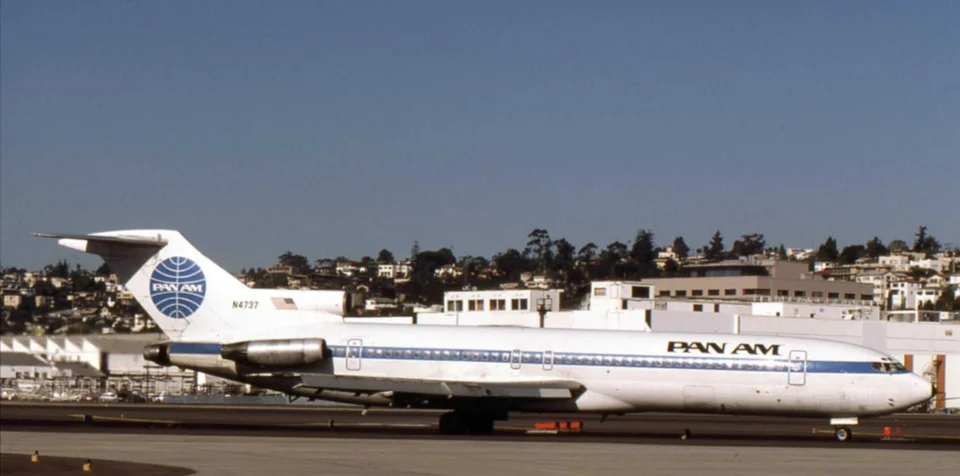
A Boeing 727 encountered a microburst after takeoff from New Orleans and crashed in Kenner. The NTSB found a downdraft and decreasing headwind, with limited wind shear warning capability contributing to the accident.
Resized and converted to WebP for display. The original photograph is also available.
Geographic context
New Orleans International Airport, departure
Kenner accident site
Flight 759 departed eastward from runway 10 for Las Vegas. The crash marker uses the coordinates in the NTSB report; the airport marker is approximate. Basemap: Natural Earth, public domain.Read supporting evidence
Flight 759 lifted off from runway 10 into increasing rain. The headwind diminished and changed to a tailwind while a downdraft acted on the airplane. After a brief climb it descended into trees and houses beyond the runway. All 145 people aboard and eight people on the ground died.
Read the full incident Follow what happened, from the flight to the investigation findings.
What investigators concluded
The NTSB determined that a microburst during liftoff and initial climb imposed a downdraft and decreasing headwind whose effects would have been difficult for the pilot to recognize and counter before tree impact. Limited ground based wind shear detection capability contributed to the accident. The captain's takeoff decision was reasonable given the information available.
Pan Am Flight 759: the departure and investigation
1,529 words / about 7 minutes to read. Based on the investigation records cited below.
Preparing to leave New Orleans
On 9 July 1982, Pan American World Airways Flight 759 was operating a scheduled passenger service from Miami to Las Vegas with a stop at New Orleans. The aircraft was Boeing 727-235 N4737. For the onward flight it carried 137 passengers, seven crewmembers, and a nonrevenue passenger in the cockpit jumpseat. The first officer flew the takeoff, while the captain supervised the departure and made the speed callouts.
The crew prepared for a runway 10 departure. Their takeoff calculation used 15 degrees of flap, a rotation speed of 138 knots indicated airspeed, and a takeoff safety speed of 151 knots. Investigators later recomputed the takeoff weight at 171,139 pounds, within the allowable limits. The airplane's weight required the use of runway 10, so changing the departure direction was unavailable to the captain.
The crew had weather forecasts and the airport information broadcast before leaving the gate. The NTSB found that the forecasts in their flight folders were current and substantially correct. During the taxi, they also reviewed rejected takeoff and fuel dumping procedures. They were preparing to depart in an area of convective weather, with showers developing over the airport and along the intended departure path.
Flight 759 began taxiing at 15:58:48. The first officer requested a wind check, then requested another as conditions changed. At 16:03:33, ground control reported wind from 070 degrees at 17 knots, with gusts to 23 knots. The controller also reported low level wind shear alerts in all quadrants of the airport. Several advisories to other airplanes had been received on Flight 759's radio during the taxi.
The captain responded by directing the first officer to let the airspeed build during takeoff. He also planned to turn off the air conditioning packs, which allowed a higher thrust setting on the two outer engines. The crew planned a slight left turn after liftoff. Investigators concluded that the turn was intended to avoid weather shown to the south of the projected departure track.
At 16:06:24 the tower cleared the aircraft for takeoff. While the crew completed the remaining checklist items, the tower advised another airplane that a heavy Boeing had reported a ten knot wind shear at about 100 feet on final approach. Flight 759 received that transmission too. The NTSB found that the captain knew wind shear alerts had been occurring around the airport and had taken precautions for a possible encounter.
The takeoff roll began at about 16:07:57. Rain was light at first, increased during the ground roll, and became heavier after liftoff. The airplane was accelerating in a headwind. Its captain called the rotation and takeoff safety speeds, and witnesses saw a takeoff and initial climb that appeared normal. The aircraft lifted off at about 16:08:40.
The headwind then diminished and changed to a tailwind as the aircraft crossed the microburst. A downdraft acted on it at the same time. The NTSB estimated a decreasing headwind shear of about 38 knots and a downdraft of seven feet per second at 100 feet above the ground. These wind changes reduced the airplane's lift and climb performance close to the surface.
After its brief climb, Flight 759 began descending. Heavy precipitation obscured visual cues, leaving the pilot dependent on the flight instruments to detect and respond to the changing flight path. The aircraft's flight director supplied ordinary takeoff pitch guidance and was not designed to account for a microburst. At 16:08:57 its ground proximity warning sounded. The airplane was already approaching the tree line beyond the runway.
The initial tree strike occurred at about 16:09:01. Flight 759 hit three trees approximately 2,376 feet beyond the end of runway 10 at about 50 feet above the ground. It then struck another group of trees farther east. Damage to the trees indicated that the airplane had reached level flight or a slight climb at the first impact, but it had insufficient clearance to pass over them.
The airplane continued eastward, rolled farther to the left, and hit trees and houses. It came to rest about 4,610 feet from the runway end. Impact, explosion, and the subsequent fire destroyed the aircraft. Six houses were destroyed and five were substantially damaged. All 145 people aboard died, together with eight people on the ground. Nine other people on the ground sustained serious injuries.
The NTSB found that the impact forces exceeded human tolerances. Examination of the wreckage showed that the landing gear was retracted and that the trailing edge flaps were set for takeoff. The three engines were powered and rotating at impact. Their examination revealed no preimpact malfunction, and the wider investigation found no aircraft failure that had affected the flight's performance.
Investigators recovered both flight recorders. The flight data recorder inscribed altitude, indicated airspeed, magnetic heading, vertical acceleration, and radio microphone keying onto metal foil. Its traces were active and clear, but the small changes in the short flight and the initial contact with trees made timing difficult. The investigators combined recorder evidence with cockpit and controller recordings, aircraft performance calculations, and impact measurements.
The cockpit area recording had severe distortion and background noise. Its erase head was inoperative, allowing older sounds to remain behind the new recording. Loud windshield wiper noise further masked the final minute. Investigators used filtering and repeated listening to decipher the recording, and marked passages where they could not agree on the words.
The meteorological investigation drew on airport sensor information, witness observations, radar returns, and performance studies. The NTSB concluded that a microburst over the airport produced the winds encountered after liftoff. Its analysis linked the loss of headwind and the downdraft to the rapid loss of climb performance. Heavy rain effects on wing aerodynamics were also examined, but the theory still required experimental verification and the Board made no finding based on calculated rain penalties.
New Orleans had a Low Level Wind Shear Alert System. It compared winds from a centerfield sensor with winds at peripheral sensors and alerted when the difference reached a specified threshold. The system measured surface conditions. Winds above the sensors, vertical air movement, and a small microburst between the sensors could escape detection. The shear affecting Flight 759 was detected after the takeoff had begun.
The aircraft also carried an X-band weather radar. Investigators concluded that the captain used it to examine the departure area. Rain between the antenna and a weather cell could weaken the return, reducing the apparent intensity. The NTSB concluded that echoes over and east of the airport did not produce the radar's contour display on Flight 759. Pilots viewing the weather from the eastern side of the airport had stronger returns.
One airport wind sensor, on the west side, had been vandalized and was inoperative. The NTSB found that its absence was not a causal factor in this accident. The Board nevertheless wanted airport coverage deficiencies corrected and sensor locations made available to pilots. It also called for recording sensor output so that wind shear events could be reconstructed and improvements evaluated.
Pan Am's manuals described thunderstorm and wind shear hazards and left the captain responsible for judging the weather and choosing a course of action. The wind shear guidance supplied no quantitative wind speed limits for refusing or delaying takeoff. Investigators found that the captain had enough information to assess the airport weather, and that his decision to depart was reasonable in light of what was available.
The NTSB also assessed the pilot's response after the descent began. Aircraft performance calculations explored the capability to remain above the ground under the reconstructed conditions. The Board considered the time required to recognize instrument changes, understand them, apply control force, and obtain a response from the aircraft. It found that the corrective actions at least equalled the response that could be expected under the prevailing conditions.
The probable cause was the encounter with microburst wind shear during liftoff and initial climb. The resulting downdraft and decreasing headwind imposed effects that the pilot would have had difficulty recognizing and countering before the airplane struck the trees. The NTSB identified the limited capability of ground based wind shear detection technology to give definitive avoidance guidance as a contributing factor.
The NTSB adopted its final report on 21 March 1983. Its recommendations to the FAA addressed airport sensor coverage, pilot access to sensor information, faster distribution of weather advisories, and criteria for delaying departures or approaches into hazardous convective weather. It recommended advanced Doppler weather radar to detect dangerous wind shear in airport terminal areas.
The Board also called for realistic microburst models in simulator training, including encounters during takeoff, approach, and other critical phases of flight. It encouraged enhanced pitch guidance and better use of weather information in operational decisions. These recommendations addressed both avoiding the hazardous encounter and improving the crew's ability to recognize and respond when an encounter occurred.
Another recommendation addressed how controller warnings were expressed. The NTSB wanted the airport system's wind outputs displayed as longitudinal and lateral components relative to the runway centerline. It considered these components more useful to pilots assessing a headwind, tailwind, or crosswind change than separate wind directions and speeds. It also recommended studying whether the available sensor data could support operational limits for aircraft.
A simplified reading of the investigation findings. The sequence does not replace the full report or imply that every contributing factor is shown.
Sequence of events
Times are central daylight time, UTC minus five hours, as used in the NTSB report. The accident occurred at about 16:09. Expand an event to see its evidence.
15:58:48Taxi from the gate
Flight 759 taxied for a departure on runway 10. There were 145 people aboard for the flight to Las Vegas.
The first officer requested another wind check. Ground control reported wind from 070 degrees at 17 knots, gusting to 23 knots, and wind shear alerts in all quadrants. The captain directed an airspeed buildup and a higher thrust setting for takeoff.
The tower advised another aircraft of a reported ten knot wind shear at about 100 feet on final approach. The advisory was received on Flight 759's radio.
Flight 759 struck trees about 2,376 feet beyond the runway at about 50 feet above the ground. It continued eastward into houses and was destroyed by impact and fire.
The NTSB adopted its final report, identifying microburst wind shear as the probable cause and issuing recommendations on detection, weather information and training.
The NTSB judged the takeoff decision reasonable in light of the information available. The captain had checked the departure weather with radar, planned a left turn to avoid weather to the south, and prepared for possible wind shear. Company guidance left the decision to his judgment and supplied no quantitative wind speed limits for refusing a departure.
Why was the dangerous wind shear detected after takeoff began?
The airport system compared surface winds at separated sensors. It could miss a small microburst between sensors and could not detect downdrafts or winds above the sensors. The NTSB found that the shear affecting Flight 759 was detected after its takeoff had begun.
What did the performance calculation show about a possible recovery?
A static calculation showed that a timely pitch increase could theoretically have kept the airplane at 95 feet above the ground. That calculation excluded pilot recognition, perception, and reaction time. The NTSB found that the pilot's corrective response at least equalled what could be expected in the prevailing conditions.
The NTSB could not establish the precise location of the weather echoes as they appeared on Flight 759's radar display. It concluded that rain attenuation could have prevented the stronger returns from contouring.
The aerodynamic effects of heavy rain required further experimental verification. The NTSB regarded numerical calculations of the proposed lift and drag penalties as speculative.
Actions and recommendations are described at the dates of the cited records. A recommendation is not proof of implementation.
Sensor coverage and records
Recommendations A-83-13 to A-83-15 called for correcting airport coverage deficiencies, distributing sensor location and limitation information, and recording sensor outputs.
Recommendations A-83-17 and A-83-18 called for prompt advisory updates and evaluation of weather information as criteria for delaying hazardous approaches and departures.
Recommendations A-83-23 and A-83-25 called for advanced Doppler weather radar and simulator demonstrations of microbursts during takeoff and other critical phases.
Matching dossiers for Aircraft condition: No other dossier in this collection.
Read alongside
These comparisons connect specific research topics. Shared circumstances do not establish identical causes. Evidence from both investigations is provided below.
Both investigations examined departures or arrivals close to convective weather. Pan Am 759 encountered microburst wind shear during initial climb, and the NTSB judged its takeoff decision reasonable with the available information. American Airlines 1420 overran the runway after landing at Little Rock; its probable causes included continuing the approach as severe thunderstorms moved into the airport area and failing to ensure spoiler extension after touchdown.
Explore the records below for additional context. They open on the publisher's site and are not all included in our report search. Source reuse terms apply.
Kevin Murphy writes the incident accounts on AirlineIncidents.com, out of a long interest in aviation safety and the lessons each investigation leaves behind.
Prepared by
AirlineIncidents editorial desk
Report citation check
Independent expert review
Not completed
Citation checks compare supporting text with the indexed report pages. They do not constitute independent expert review. How these pages are prepared.
Revision history
: Final investigation completed; NTSB report adopted 21 March 1983.