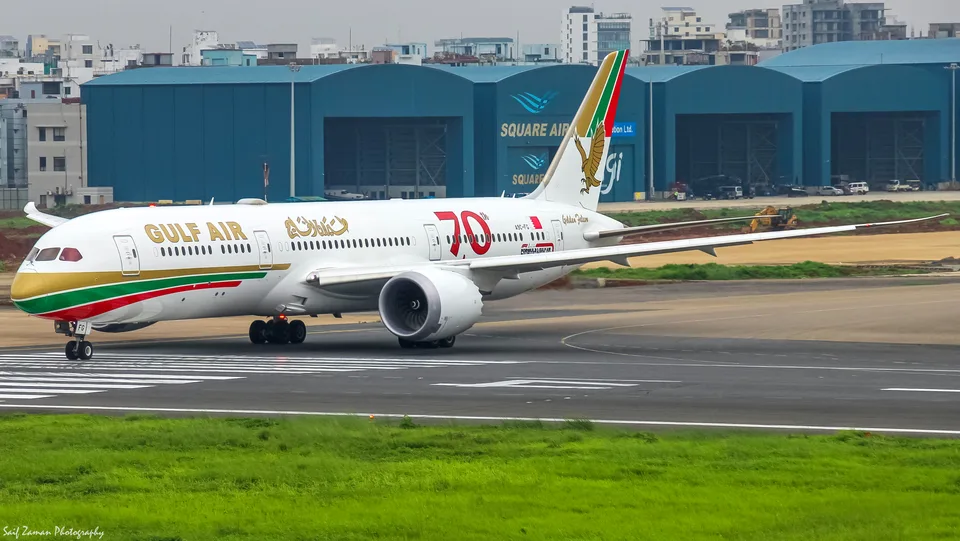
Responsive WebP copies resized without cropping. The original photograph is unchanged.
Geographic context
Bahrain International Airport, departure
Dubai approach area, airport reference
GF504 flew from Bahrain to Dubai. The Dubai marker uses the airport coordinates supplied in the summary; the panel failures occurred in flight during descent. The Bahrain marker gives general airport location. Basemap: Natural Earth, public domain.Read supporting evidence
During descent, A9C-FG's three tuning control panels became inoperative and the crew could not change radio frequencies. The pilots searched their manuals, held while troubleshooting, declared a communication emergency and landed safely at Dubai.
Read the full incident Follow what happened, from the flight to the investigation findings.
What investigators concluded
The AAIS could not determine the technical reason for the panel malfunction. It found that the crew could not locate the applicable reset bulletin, and linked the failed recovery to the missed takeoff briefing check and unfamiliarity with the bulletin location.
GF504 and the three inoperative tuning control panels
1,102 words / about 6 minutes to read. The official report for this event is short, so this account is shorter than most and covers only what the report documents.
Descent toward Dubai
Gulf Air flight GF504 left Bahrain for Dubai on 10 March 2023 with 193 people aboard its Boeing 787-9, A9C-FG. The occupants were 183 passengers, two pilots and eight cabin crew. The commander flew the aircraft and the copilot monitored the flight. The flight data recorder placed takeoff from runway 30R at 17:28:58 UTC. The aircraft climbed to flight level 250 before beginning its descent toward Dubai at about 17:54.
During the descent, the left, centre and right tuning control panels became inoperative. The crew received engine indicating and crew alerting system messages concerning the transponder, weather radar and traffic collision avoidance system. They could no longer change radio frequencies through the panels. The pilots began the quick reference handbook procedures while continuing their arrival into United Arab Emirates airspace.
The crew still had radio contact with Dubai Approach. The flight history describes communication on a standby frequency of 119.3 MHz, and the analysis records a report of the panel failure to the controller at 17:54:10. At 17:56:23, Dubai Approach cleared the aircraft toward VUTEB and authorised descent to 13,000 feet. The flight subsequently held while the crew worked on the problem and awaited further approach clearance.
The copilot searched the quick reference handbook and the electronic Flight Crew Operations Manual on the company iPad in the electronic flight bag. He was looking for a tuning control panel reset procedure or a flight crew operations bulletin covering the malfunction. He could not locate the relevant information. The two pilots did not discuss the applicable bulletin during their attempts to resolve the failures.
The commander described several unsuccessful attempts to reset and restore the panels. The investigation also found that the communication difficulties prevented the pilots from contacting the company Maintenance Control Center for assistance. The crew therefore continued troubleshooting with the manuals available in the cockpit and coordinated the arrival with Dubai air traffic control.
Dubai Approach asked the crew to declare a radio communication emergency so that landing clearance and standby emergency services could be arranged. At 18:22:15, the pilots made the emergency declaration and continued the descent for landing. Approach and Tower coordinated the aircraft altitude and landing clearance. The aircraft landed safely on runway 12L at 18:35:33, vacated at exit Mike 7 Alpha at 18:36:15, and taxied to stand Charlie 41. The fire commander cancelled the full emergency at 18:42.
The summary records no damage to the aircraft, property or environment. Maintenance personnel reset the panels and performed a ground test. The panels functioned, the alert messages cleared and the aircraft returned to service. The technical records had shown no deferred defects relevant to the occurrence before departure.
Gulf Air already had a Boeing bulletin addressing inoperative tuning control panels, uncommanded VHF frequency transfers or changes, and uncommanded transponder code changes. Bulletin GUL-38 R1 was dated 28 December 2021 and remained in effect. It described previous events in which two or three panels became inoperative and displayed a system-unavailable message.
The bulletin explained that the affected functions continued operating with their previous selections, but that all three panels being inoperative prevented control until at least one panel was reset. Its list included VHF and HF radios, satellite communications, the cabin interphone, ground proximity warning, weather radar, TCAS and transponder, alternate navigation, and the alerting and transponder control panel.
For three inoperative panels, the published recovery procedure called for all three to be selected off and only the right panel to be selected on. The bulletin also required the crew to confirm the desired system selections after a reset, including radio frequency and transponder code. For one or two failed panels it described a different reset sequence, with a panel that failed again left off for the rest of the flight.
The copilot said he could not recall where to find the bulletin. The takeoff briefing guide required a review of the applicable bulletins and notices. Investigators concluded that reviewing the existing bulletin and following its reset procedure would have restored normal communication. They linked the unsuccessful recovery to the missed briefing check and difficulty locating the information in the electronic manual.
The AAIS could not determine the technical reason for the malfunction of the three panels. Its findings established that both pilots were licensed, qualified, rested and fit for the flight, and that the aircraft was certificated, equipped and maintained to Bahrain requirements. The aircraft was airworthy when released for departure, with no deferred or reported defects identified as contributing to the occurrence.
The weather at Dubai included ten kilometres visibility and a wind from 310 degrees at seven knots at 18:00 UTC. Investigators excluded weather as a contributory factor. Their findings credited Dubai Approach and Tower with providing the information needed for the safe landing and recorded the activation and subsequent cancellation of the airport emergency response.
Flight data were downloaded in Bahrain and analysed at the Abu Dhabi Flight Recorder Laboratory. The incident cockpit voice recording was overwritten during the aircraft return to Bahrain because the recorder stored a maximum of two hours of cockpit audio.
The summary contains conflicting operational details. Its flight history and crew-performance analysis describe communication on 119.3 MHz, while its bulletin discussion identifies a previously selected 121.5 MHz frequency. The flight history describes the transponder as inoperative and radar monitoring unavailable; the bulletin discussion says ATC continued receiving transponder information and that IDENT failed. It also gives different times for the hold. These details remain unresolved in the published summary.
Bahrain authorities informed the AAIS that Gulf Air had introduced safety measures. The bulletin became a green flag item during the type rating course, and a Flight Crew Operations Notice informed all pilots about new or revised bulletins. The letter also stated that bulletin review was outside the system knowledge validation during licence and operator proficiency checks.
The AAIS considered those measures adequate and issued recommendation SR14/2024 to Gulf Air. It called for better checking of flight crew operations bulletins and NOTAM supplements during the takeoff briefing, adherence to that briefing procedure, and use of the appropriate procedures during flight. The AAIS said its safety recommendation tracking system would assess the recommendation implementation and the effectiveness of the operator actions.
The GCAA published its completed investigation as a serious incident summary report on 13 March 2025, after stakeholder consultation. The investigation scope covered the events leading to the occurrence and excluded in-depth analysis of non-contributing factors. The publication contains findings, causes, safety actions and a recommendation. It provides no component examination results explaining the initiating malfunction, no cockpit voice transcript, no raw flight data tables and no detailed air traffic control transcript.
Bulletin GUL-38 R1 directed the crew to select all three panels off and then select only the right panel on. System selections, including frequency and transponder code, were to be checked after a reset.
Was an incident cockpit voice recording available?
The incident recording was overwritten when the aircraft returned to Bahrain. The recorder had a maximum cockpit audio capacity of two hours. Flight data were downloaded and analysed.
Conflicting frequency, surveillance and hold details
The flight history and crew-performance sections give 119.3 MHz; the bulletin discussion gives 121.5 MHz. The history describes transponder and radar monitoring loss, while the bulletin discussion reports continuing transponder reception and a failed IDENT switch. Holding times also differ between sections.
The published document is a summary report. It contains no component examination results explaining the malfunction, cockpit voice transcript, raw flight data tables or detailed ATC transcript. The investigation excluded in-depth analysis of non-contributing factors. The incident cockpit audio had been overwritten during the return flight.
The AAIS recommended better bulletin and NOTAM supplement checks during the takeoff briefing and adherence to the applicable procedures. It planned to track implementation and the effectiveness of the operator actions.
Matching dossiers for Bulletin access and briefing procedures: No other dossier in this collection.
Read alongside
These comparisons connect specific research topics. Shared circumstances do not establish identical causes. Evidence from both investigations is provided below.
Both flights involved several affected systems and crews working through abnormal procedures before a safe landing. In G-ONEE, the AAIB traced the electrical bus losses to water in generator control units. In A9C-FG, the AAIS left the initiating technical cause undetermined and identified difficulty locating the reset bulletin.
Explore the records below for additional context. They open on the publisher's site and are not all included in our report search. Source reuse terms apply.
The completed investigation summary, including flight history, findings, causes, safety actions and recommendation SR14/2024.
Sources and transparency
GCAA completed the investigation and issued its summary report on 13 March 2025.
Source limitations
The published document is a summary report. It contains no component examination results explaining the malfunction, cockpit voice transcript, raw flight data tables or detailed ATC transcript. The investigation excluded in-depth analysis of non-contributing factors.
Communication Failure: Gulf Air Boeing 787-9 A9C-FG
UAE GCAA Air Accident Investigation Sector Final investigation summary report AIFN/0004/2023, issued 13 March 2025
Kevin Murphy writes the incident accounts on AirlineIncidents.com, out of a long interest in aviation safety and the lessons each investigation leaves behind.
Prepared by
AirlineIncidents editorial desk
Report citation check
Independent expert review
Not completed
Citation checks compare supporting text with the indexed report pages. They do not constitute independent expert review. How these pages are prepared.
Revision history
: Published sourced incident account, timeline, photographs and investigation findings.