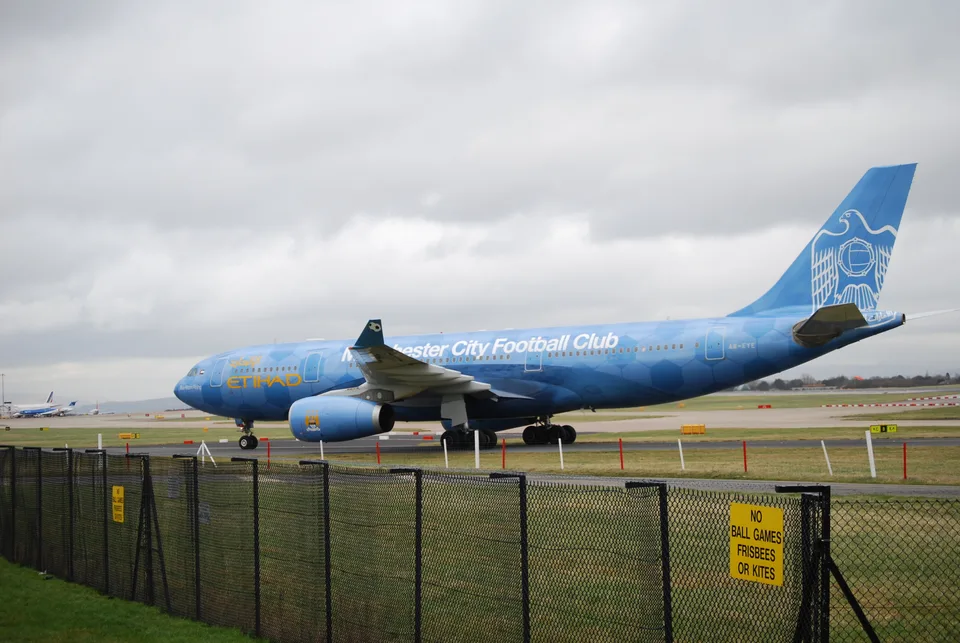
Original photograph downloaded at full size. Responsive WebP copies resized without cropping.
Geographic context
Abu Dhabi International Airport, departure
Dublin International Airport, intended destination
Approximate airport markers for the planned Abu Dhabi to Dublin flight. The attempted takeoff followed the left edge of runway 31L and stopped near taxiway Echo 14. Basemap: Natural Earth, public domain.Read supporting evidence
Etihad flight ETD045 was preparing to depart Abu Dhabi for Dublin with 227 people aboard. After crossing the Echo 15 stop bar in fog, the crew lost external visual cues and followed a white light to the left, believing it marked the runway centerline. The aircraft aligned with the left edge of runway 31L. The captain rejected the takeoff at 86 knots ground speed after hearing repeated thumps. Eleven edge lights were damaged and a nose tire was punctured. Nobody was injured.
Read the full incident Follow what happened, from the flight to the investigation findings.
What investigators concluded
AAIS identified loss of crew situation awareness as the cause of the edge alignment. The root cause of that loss was undetermined. Investigators found missed opportunities to verify position, no follow-me vehicle despite aerodrome procedures, and gaps in visual reference and lighting recording requirements.
1,535 words / about 7 minutes to read. Based on the investigation records cited below.
Fog delays the flight to Dublin
Etihad Airways flight ETD045 was scheduled to leave Abu Dhabi International Airport for Dublin on 30 January 2012. The Airbus A330-243, registered A6-EYE, carried 227 people. The pilots reported for duty at 00:30 for a planned 02:15 departure. They had never flown together before. The copilot was initially assigned to fly the sector, and the weather forecast supplied to the crew indicated 8,000 meters visibility with no fog.
By 01:15, conditions had deteriorated. Fog reduced runway visual range to 200 meters, and the airport entered low visibility operations. Under Etihad's procedures, the captain took over as pilot flying. The crew later confirmed to ground control that their minimum runway visual range for departure was 125 meters. Pushback and engine start were completed at 03:23, after the scheduled departure had been delayed by 68 minutes.
A deadheading company pilot joined the cockpit after pushback and occupied the observer seat. The flight crew had entered discretion time because of the delay. AAIS found that the pilots complied with flight and duty time regulations, were adequately rested, and were qualified and competent for the flight. The investigation identified no contribution from crew or controller fatigue.
At 03:31, ground control cleared the aircraft along Echo 9 and Echo to the Echo 15 CAT III holding point. The captain taxied at an average of seven knots during this phase. No follow-me vehicle was offered or requested. Aerodrome procedures required a vehicle in the prevailing visibility, although requesting one was not an Etihad crew requirement. Tower subsequently reported runway visual ranges of 175 meters for the first third of runway 31L, 200 for the middle third and 175 for the last third.
The crew reported the stop bar in sight at 03:43:32 and received clearance to line up and wait. The red stop bar remained illuminated, so the crew queried whether they could cross it. The controller said he was trying to switch it off and asked the crew to confirm its status. At 03:44:08, they confirmed that the green lights leading toward the runway were on.
The stop bar was linked to 90 meters of green taxiway centerline lighting ahead of it. Those green lights went off when the red stop bar was on and illuminated when it was switched off. Green taxiway lights were spaced 7.5 meters apart and led toward the runway centerline. Runway centerline lights were spaced 15 meters apart, while the elevated runway edge lights were spaced 60 meters apart.
After crossing the stop bar, the aircraft continued straight before beginning its turn. At 03:44:25, the captain called for the remaining before takeoff checklist. Seven seconds later, he interrupted it and said he could not see. AAIS calculated that the aircraft had traveled approximately 70 meters beyond the stop bar. Investigators considered that he was most likely referring to the green lead-in lights and other nearby lights, and had lost the external visual cues needed for positioning.
The captain asked the copilot to request that tower switch on the runway lights. At almost the same time, tower issued takeoff clearance. The copilot read back the clearance but did not transmit the lighting request. The captain did not repeat it. He continued taxiing, turned left and steered toward a visible white light. Investigators considered that both operating pilots probably believed this light marked the runway centerline.
The copilot questioned the spacing of the lights during the turn. The captain said he could see only two. The aircraft stopped at 03:45:07, aligned with the left edge lights. The pilots resumed and completed the before takeoff checklist. Neither the aircraft position nor the runway lighting was explicitly confirmed before departure, and those checks were absent from the operator's procedures.
AAIS found that the crew accepted information that fitted their belief that they were on the centerline. Neither of the other pilots in the cockpit effectively challenged the position. The investigation also noted that a localizer deviation had been observed before takeoff. The captain thought his physical position could be influencing that indication, and the localizer symbol was not used to verify alignment. Etihad did not then require its use as a takeoff aid.
At 03:45:58, the captain asked the copilot and observer whether they were ready. He began the takeoff roll at 03:46:01. From 03:46:12, the cockpit recording captured loud thumps from the nose of the aircraft. The nose wheels were striking successive runway edge lights as the aircraft accelerated. The repeated impacts were recorded at intervals of about two to three seconds.
At 03:46:26, with ground speed at 86 knots, the captain rejected the takeoff. He later explained that he had heard unusual sounds from the nose gear and was unsure of the aircraft position. Nine edge lights had been struck when the takeoff was rejected. The aircraft struck two more during deceleration and stopped at 03:46:37, after a total run of approximately 775 meters, near the Echo 14 intersection.
The crew then saw the illuminated runway centerline lights to their right and recognized the misalignment. They attempted to taxi toward the centerline, received a nose wheel low pressure warning and stopped near Echo 13. The left nose landing gear tire had been punctured, and seven main gear tires contained pieces of glass. Eleven consecutive edge lights were damaged. All 227 people survived uninjured and disembarked uneventfully.
The pilots told investigators that the green lead-in lights disappeared as they approached the runway. The lighting history log indicated that the lead-in lights stayed on and recorded no lighting failures. Actual controller switch positions and the selected control mode were unrecorded. AAIS could not determine whether a problem with the lighting or controller switching had occurred, and could not determine why the crew had lost external visual cues.
Investigators tried to reproduce the night lighting and visibility over two subsequent seasons. Suitable conditions did not recur, and runway reconstruction later removed the lead-in lights and the surface movement guidance system. The beam spread of the taxiway lead-in lights could not be verified because no photometric testing log was available. Regulations required photometric testing of runway lights but contained no equivalent requirement for taxiway lights.
The runway lighting intensity had been set at step four of five, above the step two setting recommended for night or low visibility conditions. AAIS described how high intensity lighting could saturate the pilots' view and make other physical features harder to recognize. The edge lights also emitted light in all directions, while the centerline lights had a restricted directional pattern. Their appearance depended on viewing angle and position.
The investigation identified several available position cues: the difference between 60 meter edge light spacing and 15 meter centerline spacing, the solid edge line and broken centerline markings, and the presence of edge lights on both sides. It calculated that about 11 centerline lights should have been visible at the reported 175 meter runway visual range. It also considered that visibility at the aircraft might have differed from that measured by a sensor more than 300 meters away.
AAIS issued its final report on 29 June 2016. Its cause finding attributed the runway edge alignment to loss of crew situation awareness. The root cause of that loss remained undetermined. The aircraft was airworthy, with no system anomaly contributing to the misalignment. Investigators also found that Etihad's manual omitted the regulatory requirement for pilots to have a 90 meter visual segment available from the cockpit at the start of a low visibility takeoff.
Etihad submitted a comment requesting an air traffic service related contributory factor. It cited the absence of the required follow-me vehicle and the lighting queries made by crews of three preceding flights. The comment was appended to the final report. AAIS found no supporting evidence linking the missing vehicle to the occurrence: it would have escorted A6-EYE only to the Echo 15 stop bar, after which the flight crew would have taxied and aligned the aircraft. AAIS kept its cause finding unchanged.
Training, position checks and safety recommendations
Etihad gave the involved pilots additional training and checking before they returned to unsupervised operations. It revised low visibility training to emphasize taxiing, runway lineup, lighting and other position cues. Recurrent proficiency checks included taxi and lineup exercises. Operating procedures were updated to select the runway ILS after lineup as an additional centerline check, and pilots were required to verify position using markings, centerline lights, edge lights on both sides and ILS tuning. AAIS considered the operator's actions sufficient to address the issues raised.
The report described ATC actions requiring crews to confirm that green lead-in lights were active and that they were lined up on the centerline and ready before receiving takeoff clearance. It also recorded changes concerning stop bar use, surface movement display magnification, phraseology and controller training. AAIS had received no corrective action information from the aerodrome operator.
Ten final report recommendations addressed GCAA and ICAO. They covered crew and controller position verification, visual reference requirements, testing of ground lighting, recording controller lighting selections, post-occurrence medical examinations and access to medical records. ICAO was asked to study clearer differentiation between runway edge and centerline lighting and markings, runway visual range measurements at the takeoff position, and taxiway routes that would take aircraft across the painted threshold during low visibility departures.
A simplified reading of the investigation findings. The sequence does not replace the full report or imply that every contributing factor is shown.
Sequence of events
UAE local time, UTC plus four hours. Times follow the flight history; the recorder tables contain some rounded or differing intermediate times. Expand an event to see its evidence.
01:15Fog changes the departure plan
Runway visual range fell to 200 meters. The captain took over as pilot flying under the operator's reduced visibility procedures.
03:44:32 to 03:44:47Lighting concern remains unresolved
The captain said he could not see and asked the copilot to request runway lighting. Tower issued takeoff clearance; the copilot read it back and did not pass on the lighting request.
After losing visual cues, the captain steered toward a white light to his left. The crew believed the light marked the centerline, and the aircraft aligned with the left runway edge. AAIS attributed the alignment to loss of situation awareness.
The captain heard unusual thumps from the nose landing gear and was unsure of the aircraft position. Nine edge lights had been struck before the rejection; two more were struck before the aircraft stopped.
Could investigators verify the lead-in lights' beam spread?
AAIS could not verify the beam spread because no photometric testing log existed. The regulations required such testing for runway lights and contained no equivalent requirement for taxiway lights.
Investigators could not reproduce similar environmental conditions over two subsequent seasons. Reconstruction later removed the lighting and surface guidance equipment.
The pilots reported losing the lead-in lights. The lighting log recorded them on, with no failures. Actual controller switch positions were unrecorded.
AAIS made a transcript of the two-hour cockpit recording. The final report includes selected speech and a combined recorder, ATC and lighting chronology in tables 7 and 8.
Actions and recommendations are described at the dates of the cited records. A recommendation is not proof of implementation.
Etihad training and procedures
Additional crew training and checking preceded return to unsupervised operations. Revised procedures added ILS selection and visual verification of centerline and edge lights.
The report records requirements to verify active green lead-in lights and centerline lineup before takeoff clearance, with additional changes to stop bar use and training.
SR31 through SR37 addressed position checks, visual references, lighting oversight and recording, and medical examinations and records after investigated occurrences.
SR38 through SR40 called for studies of clearer runway lighting and markings, visual range measured at the takeoff position, and taxiway lines leading across the runway threshold.
Matching dossiers for Position verification: No other dossier in this collection.
Operational findingTakeoff clearance during runway entry
The takeoff clearance interrupted the intended request about runway lighting; the copilot acknowledged the clearance and the request was never transmitted.
Matching dossiers for Takeoff clearance during runway entry: No other dossier in this collection.
Aerodrome findingFollow-me vehicle absent
ATC did not deploy the vehicle required by aerodrome low visibility procedures. AAIS found no supporting evidence linking that omission to the edge alignment.
Matching dossiers for Follow-me vehicle absent: No other dossier in this collection.
Read alongside
These comparisons connect specific research topics. Shared circumstances do not establish identical causes. Evidence from both investigations is provided below.
Both investigations addressed failure to verify position before takeoff. A6-EYE followed runway edge lights in fog at Abu Dhabi and stopped after striking them. Comair 5191 began takeoff on runway 26 after clearance for runway 22 at Lexington; the NTSB attributed that accident to failures to use position cues and cross-check the runway. Night visual conditions prevailed at Lexington.
Explore the records below for additional context. They open on the publisher's site and are not all included in our report search. Source reuse terms apply.
Flight sequence, recorder chronology, lighting analysis, findings, safety actions, recommendations and Etihad's appended comments. Issued 29 June 2016.
Sources and transparency
GCAA AAIS issued Final Report AIFN/0002/2012 on 29 June 2016.
Source limitations
Investigators could not determine why the crew lost external visual cues. The lighting control switch positions were unrecorded, and the original lighting conditions could not be reproduced.
Attempted Takeoff from Runway Edge, Etihad Airways Airbus A330-243 A6-EYE, 30 January 2012
UAE GCAA Air Accident Investigation Sector Final Report AIFN/0002/2012, issued 29 June 2016
Kevin Murphy writes the incident accounts on AirlineIncidents.com, out of a long interest in aviation safety and the lessons each investigation leaves behind.
Prepared by
AirlineIncidents editorial desk
Report citation check
Independent expert review
Not completed
Citation checks compare supporting text with the indexed report pages. They do not constitute independent expert review. How these pages are prepared.
Revision history
: GCAA AAIS Final Report AIFN/0002/2012 issued 29 June 2016.