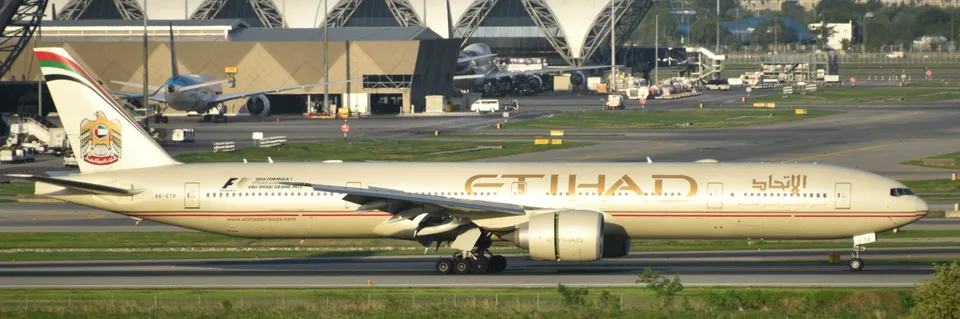
A damaged brake piston released hydraulic fluid into the heat sink after landing at Abu Dhabi. The brief fire went out, and all 366 people disembarked at a stand.
Original photograph. Responsive WebP copies resized without cropping.
Geographic context
Sydney Kingsford Smith Airport, departure
Abu Dhabi International Airport, landing and brake fire
EY455 flew from Sydney to Abu Dhabi. The Abu Dhabi marker uses the report's runway midpoint coordinates. The Sydney marker is approximate. The fire occurred on taxiway Foxtrot after landing on runway 13R. Basemap: Natural Earth, public domain.Read supporting evidence
After landing on runway 13R at Abu Dhabi, the crew saw flames at the left main landing gear on the ground maneuver camera display. They stopped on taxiway Foxtrot and called MAYDAY. The flame extinguished itself, but smoke continued. Investigators traced the fire to hydraulic fluid released by a damaged piston in brake number 2.
Read the full incident Follow what happened, from the flight to the investigation findings.
What investigators concluded
The AAIS found that unrestricted pressure plate rotation damaged a piston, allowing hydraulic oil into the heat sink, where it heated to its flashpoint. The brake defect was concealed during routine exterior inspections and transit checks. The investigation found that the landing roll and taxi operations did not contribute to the brake assembly damage.
1,512 words / about 7 minutes to read. Based on the investigation records cited below.
The arrival from Sydney
Etihad Airways flight EY455 departed Sydney Kingsford Smith Airport at 10:54 UTC on 18 May 2023 for Abu Dhabi International Airport. The Boeing B777-3FXER, registered A6-ETP, carried 348 passengers, four flight crewmembers and 14 cabin crewmembers, a total of 366 people. Two sets of pilots were assigned to the long range flight. For the landing, the commander was pilot monitoring and the copilot was pilot flying. All four pilots held the required licences, medical certificates and Boeing 777 type ratings.
The aircraft approached runway 13R on the instrument landing system. At 01:39:07 UTC on 19 May, the autopilot was disengaged as the aircraft descended through an indicated altitude of 650 feet, equivalent to a radio height of 530 feet. Its airspeed was 148 knots. Touchdown followed at 01:39:48, about 701 metres beyond the runway threshold, within the normal touchdown zone. The recorded indicated airspeed was 142 knots, the descent rate was about 200 feet per minute, and lateral acceleration was close to zero. The landing weight was approximately 225,950 kilograms.
The crew selected reverse thrust at 01:39:52 and stowed it at 01:40:15. At 01:40:13, with ground speed down to 43 knots, the aircraft began turning right to leave the runway. It passed through taxiway Echo 10 at about 30 knots, continued through Echo 13 and turned onto Foxtrot. The AAIS found that the landing and taxi speeds were normal and that the braking showed no indication of excessive heat. The landing roll and taxi operations did not contribute to the damage to brake number 2.
At 01:43:56, while taxiing along Foxtrot at 18 knots, the crew shut down the right engine under Etihad's reduced engine taxi procedure. Sometime afterwards, they saw flames coming from the left main landing gear on the ground maneuver camera system display. The flame lasted briefly and extinguished itself. Smoke continued to come from the same area.
The crew stopped the aircraft on Foxtrot between Echo 6 and Echo 9. The recorded stop time was 01:44:23, when the parking brake was set. Suspecting a main landing gear fire, the crew made a precautionary MAYDAY call to air traffic control and requested airport rescue and firefighting assistance. They also made an alert call over the passenger address system. Etihad's procedures provided for this cabin alert when an abnormal ground event had occurred or an evacuation might soon be required.
At 01:45, air traffic control declared the ground incident and notified the emergency services. Fire trucks reached the aircraft at 01:46. Firefighters saw smoke and hydraulic oil leaking from the left main landing gear. The fire commander requested shutdown of the remaining engine, and the left engine was shut down at 01:47:50. Firefighters continued watching the gear while the aircraft remained on the taxiway.
The airport began checking the route behind the aircraft. At 01:47, a ground operations team started inspecting the taxiways used after the runway exit. Small fragments of broken metal were found on Echo 13 and reported to air traffic control. At 01:58, the team leader was directed to inspect runway 13R. More metal fragments and pieces of carbon fibre lay on the runway centreline abeam Echo 10.
At 02:04, the inspection team advised that the south runway, 13R/31L, was unsuitable for safe operations. A separate team inspected the north runway, 13L/31R, to prepare it for departures and arrivals while the south runway was restored. The runway and taxiway searches followed the aircraft's route from landing to its stopping place.
An Etihad maintenance engineer reached the aircraft at 02:07 and used convection fan cooling on the left main gear brakes. The engineer inspected the area and confirmed that the wheels could rotate. In consultation with Etihad's Engineering Department, the engineer decided to tow the aircraft to the nearest parking stand. Towing began at 03:00, with a fire truck accompanying the aircraft. It reached stand 301 at 03:05, where all passengers and crewmembers disembarked uneventfully. The airport emergency status ended at 03:23 after the inspections and movement to the stand.
At the stand, maintenance personnel carried out a high energy brake damage inspection. Brake assembly number 2 was damaged, with hydraulic fluid leaking from one piston. The brake assembly was replaced. A deeper inspection found overheating damage on the axle sleeve, which was also replaced, along with main landing gear wheels 1 and 2. An operational test of the replacement brake showed normal indications and no leakage.
The brake assembly had accumulated 1,188 cycles since installation and 9,250 cycles since new. Seventy eight cycles had elapsed since the most recent tyre change on its mating wheel assembly. The technical log contained no brake defect before departure, and the crew reported no technical anomaly before or during the flight until the taxi incident. The aircraft's alerting system recorded no post flight fault maintenance messages for the flight.
Etihad independently calculated the landing brake energy and brake temperatures and found them within their normal ranges. The brake temperature monitoring system reached a maximum indication of 3.1 units about nine minutes after landing. The report places that value within a normal cooling regime requiring 42 minutes. The temperature tables show brake number 2 at 110 degrees Celsius when the aircraft stopped and 200 degrees Celsius at left engine shutdown. The normal operating indications accompanied a mechanically damaged brake.
The damaged brake was sent to its manufacturer, Collins, for examination. The pressure plate and piston housing were particularly badly affected. Lugs on stators 1 and 2 had failed, allowing stator clips to become trapped between the heat sink and torque plate. The displaced clips contacted the inner diameters of the rotor assemblies and damaged them. That interference prevented the clamping force from being distributed evenly through the heat sink.
Continued use increased the damage. Uneven loading produced an abnormal wear pattern and wore completely through part of the outboard half of stator 2. The pressure plate lugs eventually sheared, allowing the plate to rotate with the wheel beneath the pistons. Contact between the pistons and rotating pressure plate cut a groove into the plate. The AAIS considered that the additional damage to the outboard part of stator 2 probably occurred on the last cycle after landing.
The combined damage and uneven wear caused the piston at the 7 o'clock position to fail. Hydraulic oil escaped into the heat sink, heated to its flashpoint and produced the brief flame followed by smoke. Other pistons retracted normally during the examination, indicating that they had not been dragging before the failure. Stator 3 remained intact when the fire started, so the brake could still generate some torque.
Collins concluded that the depth of wear and pressure plate damage showed prolonged operation after the original stator lug failure. It considered that the condition would already have existed at the wheel removal 78 cycles earlier. Continued operation destroyed evidence of the original failure. The AAIS could not determine the primary cause of the stator lug damage.
The investigation examined what flight crews and maintenance personnel could see during normal checks. Exterior inspections and transit checks included looking at the brakes, wear indicator pins and signs of leakage. The AAIS concluded that the wheel assembly concealed the stators and their lug indicators, so their failure could not be seen during these checks. Removing the wheel was necessary to inspect that damage.
The wear indicator pin normally attached securely to the pressure plate and aligned with its guide. The AAIS reasoned that sustained pressure plate rotation would have separated the pin, making its absence visible during an exterior check. It considered the pin most probably intact at Sydney if the checks had been performed properly, and its separation probably occurred after landing. The runway and taxiway searches did not locate it. The manufacturer had considered the pressure plate damage visible with the wheel installed; the AAIS assessed the visibility limitations of the assembled wheel during routine checks.
The wheel and tyre installation task in the aircraft maintenance manual provided a closer inspection opportunity. It required checking the exposed brake for cracks, broken parts, distortion, extensive wear and misaligned index marks on the pressure plate and stator discs. The AAIS found that these steps would have allowed maintenance personnel to examine the assembly in detail. No brake damage findings had been entered in the technical log at the last wheel and tyre replacement.
The AAIS identified the inability to notice the brake defect during exterior inspections and transit checks as a contributing factor. It issued no additional safety recommendation for those routine visual checks, concluding that they offered limited access to the relevant parts. It stated that diligent performance of the existing wheel and tyre installation task would allow such defects to be identified before wheel installation.
The GCAA published its completed investigation as Incident Summary Report AIFN/0007/2023 on 10 January 2024. Its evidence includes flight data from the quick access recorder, information from the ATC communications transcript, brake examination findings, a ground track illustration and brake assembly diagrams. The investigation scope was limited to events leading to the occurrence, with no detailed analysis of factors judged unrelated to it.
The crew stopped and called MAYDAY. Emergency services attended, maintenance cooled and inspected the gear, and a fire truck escorted the tow to stand 301.
A simplified reading of the investigation findings. The sequence does not replace the full report or imply that every contributing factor is shown.
Sequence of events
All event times are UTC. UAE local time was UTC plus four hours. The flight departed Sydney on 18 May and landed at Abu Dhabi on 19 May 2023. Expand an event to see its evidence.
18 May, 10:54Departure from Sydney
EY455 departed Sydney Kingsford Smith for Abu Dhabi with 366 people on board.
After seeing brief flames and continuing smoke from the left main gear, the crew stopped and set the parking brake. A precautionary MAYDAY and cabin alert followed.
ATC alerted rescue and firefighting services at 01:45. Fire trucks arrived at 01:46. The left engine was shut down at 01:47:50 after the fire commander requested it.
Etihad's analysis placed brake energy and temperatures within normal ranges. The AAIS found normal braking and excluded the landing roll and taxiing as contributors to brake number 2 damage.
The installed wheel obscured the stators. The AAIS found that routine exterior inspections and transit checks could not reveal their failure. The wheel installation task exposed the brake for detailed inspection.
The AAIS considered it probable that the wear indicator pin separated sometime after landing. The pin was not found during the runway and taxiway inspections.
The published summary presents selected recorder information and Collins examination findings. The complete engineering report, full recorder data, ATC transcript and a CVR transcript are absent. It gives no separate injury table.
Actions and recommendations are described at the dates of the cited records. A recommendation is not proof of implementation.
Repairs and operational test
The damaged brake assembly, overheated axle sleeve and wheels 1 and 2 were replaced. The replacement brake passed its operational test with no leak and normal indications.
The AAIS issued no additional recommendation for routine walkarounds or transit checks. It concluded that diligent use of the existing wheel and tyre installation inspection would identify such defects before the wheel was installed.
Matching dossiers for Piston failure and hydraulic fluid ignition: No other dossier in this collection.
Contributing factorLimited visibility during routine checks
The installed wheel concealed the stators from flight crew and maintenance personnel carrying out exterior inspections and transit checks. Wheel removal gave access for a detailed brake inspection.
Matching dossiers for Limited visibility during routine checks: No other dossier in this collection.
CircumstanceNormal landing and taxi operations
The aircraft landed in the touchdown zone with normal vertical and lateral loads. The AAIS excluded the landing roll and taxiing as contributors to the brake damage.
Matching dossiers for Normal landing and taxi operations: No other dossier in this collection.
Read alongside
These comparisons connect specific research topics. Shared circumstances do not establish identical causes. Evidence from both investigations is provided below.
Both investigations traced a fire sequence involving components near the landing gear and escaping flammable fluid. In A6-ETP, a damaged brake piston released hydraulic oil into the heat sink during taxiing after landing. In Air France 4590, a tyre struck a metal strip during takeoff, and tyre debris initiated tank damage and fuel leakage. The BEA identified an electric arc or hot engine parts as possible ignition sources for the leaking fuel.
Explore the records below for additional context. They open on the publisher's site and are not all included in our report search. Source reuse terms apply.
The GCAA Air Accident Investigation Sector completed its investigation and issued Incident Summary Report AIFN/0007/2023 on 10 January 2024.
Source limitations
The published document is a summary report. It omits the complete Collins engineering examination report, the full recorder data and ATC transcript, a cockpit voice recorder transcript, and a separate injury table. The investigation covered the events leading to the occurrence and did not analyse non-contributing factors in depth.
Brake Fire, Etihad Airways Boeing B777-3FXER A6-ETP, 19 May 2023
UAE GCAA Air Accident Investigation Sector Final investigation issued as Incident Summary Report AIFN/0007/2023, 10 January 2024
Kevin Murphy writes the incident accounts on AirlineIncidents.com, out of a long interest in aviation safety and the lessons each investigation leaves behind.
Prepared by
AirlineIncidents editorial desk
Report citation check
Independent expert review
Not completed
Citation checks compare supporting text with the indexed report pages. They do not constitute independent expert review. How these pages are prepared.
Revision history
: Completed GCAA investigation summary, including brake failure findings and the limits of routine visual inspection.