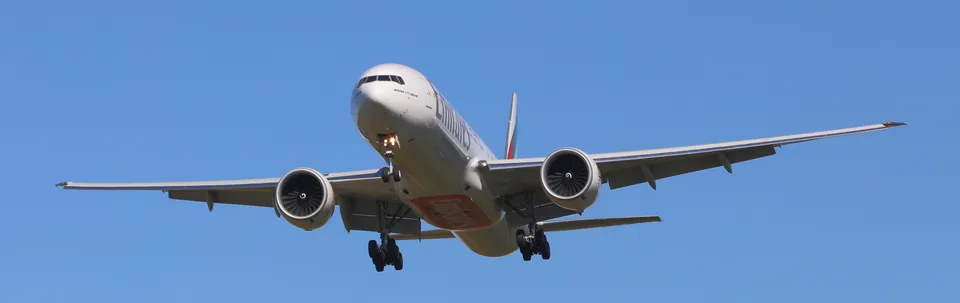
A Boeing 777 departed Dubai with ALT pitch mode engaged. Following its flight director guidance, the commander lowered the nose and the initial climb became dangerously shallow.
Original framing retained. Responsive WebP copies resized without cropping.
Geographic context
Dubai International Airport
Washington Dulles International Airport
Approximate airport markers show the departure and destination. The shallow climb occurred after departure from Dubai runway 30R. Basemap: Natural Earth, public domain.Read supporting evidence
Flight EK231 accelerated close to the ground as its pitch attitude decreased. The commander selected TO/GA, restoring climb guidance, and continued to Washington Dulles. All 372 occupants were uninjured.
Read the full incident Follow what happened, from the flight to the investigation findings.
What investigators concluded
The GCAA found that lowering the pitch below the attitude required for a safe climb caused the serious incident. Contributing factors included the AFDS design, missed mode and altitude checks, the copilot's unsuccessful reset and failure to communicate it, and missing explicit reset procedures.
1,540 words / about 7 minutes to read. Based on the investigation records cited below.
Four pilots preparing a long flight
Emirates flight EK231 was scheduled to fly from Dubai to Washington Dulles on 19 December 2021. Boeing 777-300ER A6-EQI carried 354 passengers, 14 cabin crew and four flight crew, giving 372 people aboard. The operating commander flew the aircraft and the operating copilot monitored it. A second commander and copilot occupied the observer seats for departure before providing relief during the long flight.
The departure was at night. Weather, navigation equipment, airport visual aids and communications with air traffic control were normal. The aircraft was heavy: the calculated actual takeoff weight was 350.1 tonnes, about 1.4 tonnes below its maximum. Investigators checked the performance calculations and found them correct. The planned speeds were 170 knots for V1, 177 knots for rotation and 183 knots for V2, with flaps 15 selected.
During preparation, the augmenting crew saw zero displayed in the mode control panel altitude window. The GCAA could not determine who had entered it. With the selected altitude within 20 feet of the displayed barometric altitude, switching on a flight director activated ALT pitch mode. That mode provided guidance to hold altitude, leaving the aircraft set up with inappropriate vertical guidance for takeoff.
The copilot noticed that his flight mode annunciator displayed TO/GA for roll and ALT for pitch. He continued his preparation tasks intending to address the indication later. He then switched his flight director off and on, but ALT remained displayed. He intended to tell the commander about the indication and failed reset. He told investigators that the busy cockpit distracted him and he forgot.
The reset required a different sequence. With both flight directors on, cycling one switch alone would leave the mode engaged. On the ground, the selected altitude had to differ by more than 20 feet from the displayed barometric altitude, both flight director switches had to be turned off, and either or both could then be switched on. The systems description contained this information, but the FCOM procedures gave no explicit reset instructions.
The required preflight checks included verification of the flight director modes by both operating pilots. The commander recognized the green indications but missed the ALT mode title. Calling the mode names aloud was not required. The before taxi checklist also contained no step ensuring the correct takeoff pitch mode. ALT remained active through taxi and the takeoff roll.
The aircraft had takeoff configuration warnings for conditions inconsistent with takeoff requirements. However, there was no warning for a flight director mode incompatible with the phase of flight. The ground proximity system also depended on its own alert conditions: its loss of altitude warning after takeoff was triggered by a height loss. The GCAA recorded no such warning during the incident. The displayed mode names and the flight path instruments provided the crew with the indications of the developing problem.
The crew changed the takeoff intersection from Mike 13A to Mike 14A to obtain a longer available distance. The aircraft began its takeoff roll at 23:09:43 UTC. Four seconds later the annunciator showed thrust reference, TO/GA roll and ALT pitch. At 23:10:30 the commander began rotating at 181 knots, about 2,280 metres along the runway from Mike 14A. Liftoff followed four seconds later.
About two seconds after liftoff, the pitch attitude reached 10.4 degrees nose up. Airspeed was 197 knots and radio altitude about 30 feet. The pitch then began decreasing. The copilot called a positive climb, and the commander ordered the landing gear up. At 23:10:41, when the gear lever moved up, radio altitude was 101 feet and the climb rate was 880 feet per minute.
The commander saw that the flight director guidance was inconsistent with the expected climb. She nevertheless lowered the nose toward the guidance. She told investigators that she had intended to pitch toward 15 degrees but held approximately 5 to 7.7 degrees nose up for about 15 seconds while trying to understand the indication. She also suspected that the aircraft weight calculation might be wrong.
Looking outside after selecting the gear up, the copilot saw increasing speed and an aircraft still close to the ground. He reported being startled for a couple of seconds before calling for a climb. The augmenting commander called for the pitch to be raised. At 23:10:50, the aircraft was at 160 feet radio altitude and 216 knots, with its climb rate reduced to about 255 feet per minute.
The commander advanced the thrust levers manually. Between 23:10:54 and 23:10:59 she reduced the pitch from 7.7 degrees to about 3 degrees nose up. Airspeed reached the 230 knot flap 15 limit at 23:10:56, triggering flap load relief. The flaps automatically retracted to position 5 while the flap lever stayed at 15. The protection reduced flap loading as the aircraft continued accelerating.
By 23:11:00 the climb rate was about 64 feet per minute. About a second later, the commander pressed TO/GA. At activation the recorded radio altitude was 211 feet and calibrated airspeed was 240 knots. The flight mode annunciator changed to thrust reference, TO/GA roll and TO/GA pitch. The flight director pitch bar moved from a nose down command to climb guidance, and the commander began raising the nose.
Increased thrust combined with the initially low pitch caused further acceleration. Airspeed exceeded the 245 knot flap 5 limit at 23:11:03 and reached 262 knots during the recovery. Pitch increased from 3 to 14 degrees between 23:11:00 and 23:11:16. The autopilot was engaged at 23:11:11 as the aircraft climbed through 459 feet radio altitude at about 2,610 feet per minute.
The recorder also showed several large roll control inputs during the shallow climb, although the bank angle stayed below about 2.5 degrees and heading remained about 300 degrees. There were brief speedbrake lever movements, but the speedbrakes did not deploy. No ground proximity warning occurred. At 23:11:20 the flap lever was moved from 15 to 5; subsequent retraction brought the flaps fully up at 23:13:01.
After top of climb, the augmenting commander offered the commander a short break. She said she had recovered from the surprise and continued as pilot flying. The augmenting commander later returned to the cockpit and stayed for an hour. He also asked her to contact the operations office through ACARS to check the load calculations and the aircraft condition after the overspeed. The flight landed uneventfully at Washington Dulles at 13:30:28 UTC. There were no injuries or aircraft damage.
The flight data recorder was downloaded successfully. The cockpit voice recording had been overwritten because more than two hours had elapsed since the event. Consequently, investigators could not precisely time the verbal interventions described by the pilots. The GCAA reconstructed the flight path from recorded parameters and used crew statements for the cockpit exchanges.
A simulator session reproduced the incident settings and control inputs. The simulation showed the inappropriate ALT guidance, flap load relief and the restoration of TO/GA pitch guidance after the switch was pressed. No ground proximity warning occurred during the simulation. The report describes a slight simulated descent when the incident control inputs were reproduced; the recorded incident sequence gives a climb rate of about 64 feet per minute near TO/GA activation.
The GCAA identified the cause as pitching below the attitude required for a positive, safe climb while following guidance from the wrong flight director pitch mode. Its contributing factors covered the AFDS design allowing takeoff in that mode, the commander missing the mode and altitude entry, the copilot failing to resolve or communicate the mode problem, and the absence of explicit reset procedures.
The investigation found that both operating pilots were qualified and fit for the flight. Fatigue was not a contributing factor. Neither pilot had received training in recognizing and handling indications from incorrect flight director settings. The GCAA found the copilot's intervention limited and his response to taking control insufficiently assertive. It also considered startle and the barriers to taking control in operational circumstances when assessing the delay.
The training manual used the attitude indicator as the primary pitch reference after liftoff and called for crosschecking pitch, airspeed and vertical speed. Investigators examined the commander's nose down control inputs against the aircraft's trim behavior. The primary flight computers had set a trim reference speed consistent with the normal initial climb, so pushing the nose down required increasing force against the pitch trim response. The report associated the large roll inputs and incomplete speedbrake lever movements with stress and confused control actions during the overspeed.
Emirates had removed an additional takeoff review procedure in July 2019. Investigators examined fleet data covering 31 takeoffs in ALT mode between January 2018 and December 2021. Statistical comparisons found no significant difference between the rates before and after removal, so the GCAA could not conclusively link the apparent increase to that procedural change.
The final report, issued on 22 July 2024, recorded a new Emirates FMA check requiring an announcement as well as verification, additional monitoring of AFDS errors and shallow climbs, and a recurrent training module on intervention. Boeing issued fleet information and began developing software changes to inhibit transitions from takeoff pitch mode to other modes on the ground. Recommendation SR10/2024 asked Emirates to tell pilots to avoid setting the MCP altitude at runway elevation, reducing the risk of that entry carrying into the next departure.
A simplified reading of the investigation findings. The sequence does not replace the full report or imply that every contributing factor is shown.
Sequence of events
Times are UTC, as used in the GCAA final report. Radio altitude measures height above the terrain beneath the aircraft. Expand an event to see its evidence.
Before departureALT mode remains engaged
The copilot saw ALT pitch mode, tried an unsuccessful reset and forgot to tell the commander.
With both flight directors on, cycling only one switch left ALT mode engaged. The reset required an altitude selection more than 20 feet from the displayed barometric altitude, both switches off, then either or both switches on.
What did the GCAA recommend about the altitude selector?
Recommendation SR10/2024 called for Emirates to issue a notice directing pilots to avoid setting the mode control panel altitude at runway elevation, reducing the risk of a subsequent crew departing with that setting.
The overwritten cockpit voice recording prevented investigators from determining the exact timing of the pilots' calls during the developing overspeed.
The GCAA considered knowledge, distraction and automation complacency as possible explanations for the copilot's response. The exact explanation remained uncertain.
Actions and recommendations are described at the dates of the cited records. A recommendation is not proof of implementation.
Mode checks and monitoring
The final report records that Emirates added an FMA check, introduced monitoring for AFDS errors and shallow takeoff climbs, reminded crews about procedure compliance and included intervention in recurrent training.
Boeing issued fleet digest articles and initiated software development for the 777 and 787 to inhibit transitions away from takeoff pitch mode on the ground. Alert service bulletins were also in development when the report was issued.
The GCAA recommended a notice directing Emirates pilots to avoid setting MCP altitude at runway elevation, to reduce the risk of the next crew departing with that entry.
Matching dossiers for Reset instructions absent from procedures: No other dossier in this collection.
Read alongside
These comparisons connect specific research topics. Shared circumstances do not establish identical causes. Evidence from both investigations is provided below.
Both GCAA investigations identified missed checks of automation behavior close to the runway. On A6-EQI, ALT guidance led the commander to lower the pitch during takeoff; TO/GA selection restored climb guidance. In the Emirates 521 accident, thrust remained at idle until the last three seconds before impact, and the crew omitted thrust verification after initiating a go-around. The reports identify different mode and thrust sequences.
Explore the records below for additional context. They open on the publisher's site and are not all included in our report search. Source reuse terms apply.
Flight history, recorded flight parameters, simulator work, findings and recommendation SR10/2024.
Sources and transparency
The GCAA issued final report AIFN/0016/2021 on 22 July 2024.
Source limitations
The GCAA could not determine who entered zero in the altitude window. The overwritten cockpit voice recording prevented precise timing of the crew's verbal interventions.
Shallow Initial Climb After Takeoff: Emirates Boeing 777-300ER A6-EQI
UAE GCAA Air Accident Investigation Sector Final report AIFN/0016/2021, issued 22 July 2024
Kevin Murphy writes the incident accounts on AirlineIncidents.com, out of a long interest in aviation safety and the lessons each investigation leaves behind.
Prepared by
AirlineIncidents editorial desk
Report citation check
Independent expert review
Not completed
Citation checks compare supporting text with the indexed report pages. They do not constitute independent expert review. How these pages are prepared.
Revision history
: Published sourced incident account, timeline, photographs and investigation findings.