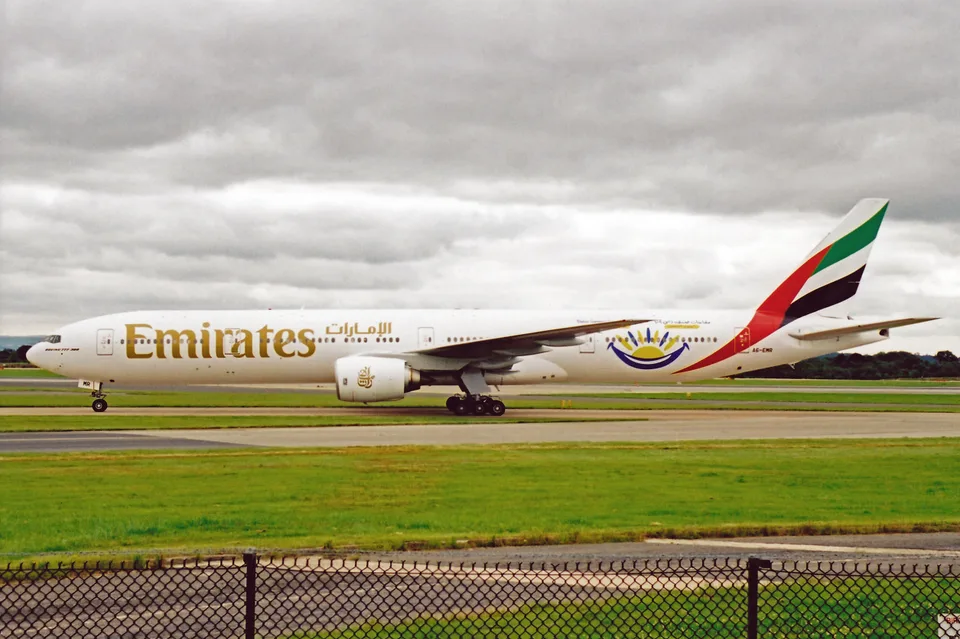
Standing water on the runway, Runway condition information, Junction box strap capability, Flat spotting and tyre failure, Landing within operator procedures
Original photograph unchanged. Responsive WebP copies resized without cropping.
Geographic context
Colombo departure airport
Male destination airport
Scheduled passenger service from Colombo to Male. Airport markers use approximate coordinates; Male's runway was aligned north to south. Basemap: Natural Earth, public domain.Read supporting evidence
A6-EMR landed on runway 36 at Male after ATC reported a wet runway. During the landing roll, the crew received autobrake and anti-skid warnings. The captain slowed manually and stopped after a runway turn. Three left main landing gear tyres burst and both junction boxes detached. All 249 occupants disembarked without injury.
Read the full incident Follow what happened, from the flight to the investigation findings.
What investigators concluded
GCAA identified standing water, the runway information provided by ATC, the lack of water reduction and the water-load capability of the junction box straps as causes and contributing factors. The landing followed Emirates' procedures, and tyre examination found that the tyres met specification.
1,553 words / about 8 minutes to read. Based on the investigation records cited below.
The approach from Colombo
On 2 December 2011, Emirates Boeing 777-300 A6-EMR flew a scheduled passenger service from Colombo, Sri Lanka, to Male in the Maldives. The aircraft carried 232 passengers, two flight crew and 15 cabin crew. The flight left Colombo at 16:27 GMT. No abnormalities were reported during the flight. As it descended through 6,000 feet towards Male, air traffic control told the crew that the runway was wet and that tailwinds were reaching eight knots.
The crew recalculated landing performance using autobrake setting 4. The calculation gave acceptable performance, and they continued the approach while monitoring the wind and checking it with ATC. Shortly before touchdown, ATC gave a wind from approximately 210 degrees at five knots. The quick access recorder later showed a wind from 195 degrees at 11 knots at touchdown. GCAA found that the reported tailwind did not present a hazard and that the landing followed Emirates' training and procedures.
The aircraft landed on runway 36 at Ibrahim Nasir International Airport at about 22:35 local time, equivalent to 17:35 UTC. Both pilots described the approach and touchdown as normal. Touchdown took place in the touchdown zone. The captain was flying and the first officer was monitoring. The captain selected full reverse thrust, but the crew felt less braking than they expected from autobrake setting 4. Initially, the rest of the landing roll seemed normal.
Approximately halfway along the runway, with the aircraft travelling at about 90 knots, the first officer called an autobrake warning from the engine indicating and crew alerting system. The captain began manual braking. About two seconds later, the first officer called an anti-skid warning, accompanied by an automatic speedbrake message. The captain continued slowing the aircraft manually until it reached a low taxi speed suitable for the required 180 degree turn on the runway.
Halfway through the turn, the crew felt the aircraft skid slightly. After completing it, they saw tyre debris on the runway. The aircraft felt abnormal, so they brought it to a complete stop near the runway 18 threshold. Another crew confirmed debris at the beginning of runway 36, and the tower controller was informed. A ground maintenance team approached the Boeing. The engines were shut down at the stopping position.
The ground engineer reported that the tyres at left main landing gear positions 1 and 2 had separated from their wheel hubs and that the landing gear had sustained further damage. The aircraft could no longer move under its own power. Passengers and crew disembarked and were taken to the terminal, and Male airport closed to traffic. All 249 occupants survived without injury. There was no emergency evacuation, and investigators found no evidence of fire during the flight or after the occurrence.
Inspection identified damage across the left main landing gear. Tyres 1 and 2 had left their hubs, and tyre 5 was damaged but remained on its wheel. Both the forward junction box, J501, and the aft junction box, J503, were missing. The missing components were subsequently recovered from the runway. Contact between wheel hubs and the runway had cut multiple grooves into the surface. The aircraft was recovered after the damaged parts were replaced.
Six tyres were sent to the manufacturer for examination under the supervision of the French investigation authority, BEA. Three had burst, at positions 1, 2 and 5. The tyres at positions 6, 9 and 10 retained pressure. Tyre 1 was recovered in three pieces, with about a quarter of its circumference missing. Its crown plies had torn, and a separate flat spot measured 280 millimetres. Heated rubber and rasped tread areas were visible around the damage.
Tyre 2 was recovered in four pieces. The tread package and carcass had separated, and investigators recorded major flat spotting, torn crown plies and broken bead cores. One flat spot measured 405 millimetres. Tyre 5 had ruptured through the centre of a 700 millimetre flat spot, with the rupture extending through the inner surface. These physical marks allowed the tyre examination to identify a common damage pattern across the three failures.
The tyre manufacturer reviewed manufacturing and retread records and found that they met specification. The partly detached crown packages and the damage to the three burst tyres were characteristic of abrasion from flat spotting. Examination found no tyre discrepancy against specification. The manufacturer attributed the damage to a cause external to the tyres. The three tyres that stayed inflated carried the additional load and met performance expectations without significant damage.
The junction boxes beneath the Boeing 777 landing gear contain equipment involved in wheel braking. Metal straps attach the boxes to the landing gear bogie. GCAA explained that loss or substantial damage to the boxes can cause braking to be lost or degraded, including anti-skid control. Losing anti-skid control can allow tyres to skid and heat through friction. The investigation connected the damaged braking equipment with the skidding and heat damage identified on the tyres.
The aircraft manufacturer examined all six band clamps from the two detached junction boxes. Each had failed through ductile overload. No fatigue was found. Their condition was consistent with excessive standing water on the runway splashing against the sides of the junction boxes and likely overloading the clamps, particularly those at the forward and aft ends. GCAA included the ability of the straps to resist the water loads among the causes and contributing factors.
Tests compared new clamps with clamps supplied by the operator. Ten new clamps were tightened to different torque values between 25 and 70 inch-pounds, then subjected to vertical loads increased in steps of 200 pounds until failure. The used clamps failed within the same applied load range as the new ones. Across the tested torque range, tightening torque did not affect the failure load. A separate examination also found no fatigue. The manufacturer reviewed the attachment design and introduced stronger securing straps.
Male's runway had a history of surface depressions that retained rainwater. Repairs in December 2010 addressed undulations and patches of standing water. Those repairs were intended to last more than 15 months, but undulations were identified again during 2011. Further repairs scheduled for November were delayed by prolonged rainfall. They were eventually carried out between 18 and 26 December 2011, after the Emirates incident.
Rain had begun before 15:00 UTC on the day of the landing and was still falling when the aircraft approached at 17:35 UTC. GCAA found that no runway water removal took place between the start of the rainfall and the landing. ATC told the crew that the runway was wet but gave no information about significant areas of standing water. The crew had no way of knowing the precise quantity or distribution of that water.
In its analysis, GCAA found that the crew expected an evenly wet runway, consistent with their training. Large, uneven amounts of water instead produced conditions that varied between wet and contaminated along the surface. The crew received no information that would have prompted a diversion. The aircraft had no minimum equipment list restrictions affecting its performance. The final report identified runway condition, the information supplied by ATC, the failure to reduce standing water to a safe depth and the junction box strap capability as causes and contributing factors.
The report described hydroplaning as a loss of wheel contact with the surface when a moving tyre cannot displace the water beneath it. That condition reduces braking effectiveness. GCAA called for monitoring runway condition, reducing standing water and communicating accurate surface reports to crews. At Male, the deteriorated surface allowed water to collect quickly during bursts of rain. The investigation identified those pooled areas as a hazard requiring both physical remedial work and operational information.
The UAE GCAA led the investigation at the Maldives' request, taking it over on 5 December 2011. Its final report, Case File 14/2011, is dated 17 March 2014. The airline supplied the cockpit voice recorder and digital flight data recorder. GCAA did not require further analysis of the voice recorder. Quick access recorder data supplied valid information for the investigation.
Investigators found that the aircraft had been equipped and maintained under the applicable regulations and approved procedures. No faults had been reported before landing. The pilots held the appropriate licences and qualifications for the flight. Both had valid medical certificates, were medically fit and showed no signs of fatigue. The findings placed the landing gear damage during the landing roll.
The report recorded several safety actions. GCAA's Airworthiness Sector was following up continued airworthiness measures, including junction box inspections at every transit and coordination over stronger attachment straps. The airport operator reported a runway repair programme, observations after rain to locate pooling and procedures for clearing water to allowable limits. It also reported standard procedures for communicating runway contamination under ICAO standards and recommendations. Emirates placed the condition of Male's runway on its Safety Board agenda, and airline and manufacturer personnel visited the airport to monitor it.
Two formal recommendations addressed operational awareness. SR 03/2014 called on GCAA to ensure that UAE operators using Male as a destination or alternate knew the investigation results. SR 04/2014 asked the Maldives Civil Aviation Authority to ensure that operators were fully aware of runway condition until the runway enhancements were finalised. The recommendations accompanied the physical measures to repair the runway, remove standing water and strengthen the landing gear attachments.
A simplified reading of the investigation findings. The sequence does not replace the full report or imply that every contributing factor is shown.
Sequence of events
Male local time was UTC plus five hours. The incident occurred at about 22:35 local, or 17:35 UTC. Landing roll events use the sequence and approximate speeds reported by the crew. Expand an event to see its evidence.
16:27 GMT, 2 December 2011Departure from Colombo
The Boeing 777 departed on the scheduled service to Male.
An autobrake warning prompted manual braking. About two seconds later the first officer called an anti-skid warning with an automatic speedbrake message.
The three burst tyres had damage characteristic of flat spotting. The manufacturer found that the tyres met specification and attributed the damage to an external cause. Loss of the landing gear junction boxes could degrade braking and anti-skid control, allowing skidding and frictional heating.
The clamp failures were consistent with excessive standing water striking the sides of the boxes and likely overloading their securing bands. Tests found ductile overload failures and no fatigue; the used clamps failed within the same load range as new clamps.
ATC described the runway as wet. The crew expected an evenly wet surface and had no information about the amount or location of standing water. GCAA found that the landing followed the operator's training and procedures.
Actions and recommendations are described at the dates of the cited records. A recommendation is not proof of implementation.
Runway repairs and water reporting
Repairs took place from 18 to 26 December 2011. The airport operator later reported observations after rain, water clearance procedures and procedures for reporting contamination.
The manufacturer reviewed the attachment design and strengthened securing straps. The report also recorded GCAA follow-up, transit inspections and coordination over strap strengthening.
GCAA was asked to ensure that UAE operators using Male knew the investigation results. The Maldives authority was asked to ensure that operators knew the runway condition until enhancements were finalised.
Matching dossiers for Landing within operator procedures: No other dossier in this collection.
Read alongside
These comparisons connect specific research topics. Shared circumstances do not establish identical causes. Evidence from both investigations is provided below.
Both investigations examined tyre damage and its effects on nearby aircraft equipment. At Male, water impact was consistent with junction box attachment failures, and three tyres showed flat spotting. For Air France 4590, BEA found that a tyre ran over debris from another aircraft during takeoff; tyre impact energy ruptured a fuel tank, followed by fuel ignition and loss of thrust.
Explore the records below for additional context. They open on the publisher's site and are not all included in our report search. Source reuse terms apply.
Final report dated 17 March 2014, with tyre examination, junction box tests, findings and recommendations.
Sources and transparency
GCAA final incident report, Case File 14/2011, dated 17 March 2014.
Source limitations
GCAA based its investigation on the operator's and tyre manufacturer's reports. The junction box clamp damage was consistent with water impact and likely overload.
Tire Burst during Landing, Boeing 777-300 A6-EMR, Emirates
UAE GCAA Air Accident Investigation Sector Final Incident Report, AAIS Case File 14/2011, dated 17 March 2014
Private evidence cache. Only short attributed quotations in original commentary; full report and third-party illustrations are not redistributed. Source terms.
Kevin Murphy writes the incident accounts on AirlineIncidents.com, out of a long interest in aviation safety and the lessons each investigation leaves behind.
Prepared by
AirlineIncidents editorial desk
Report citation check
Independent expert review
Not completed
Citation checks compare supporting text with the indexed report pages. They do not constitute independent expert review. How these pages are prepared.