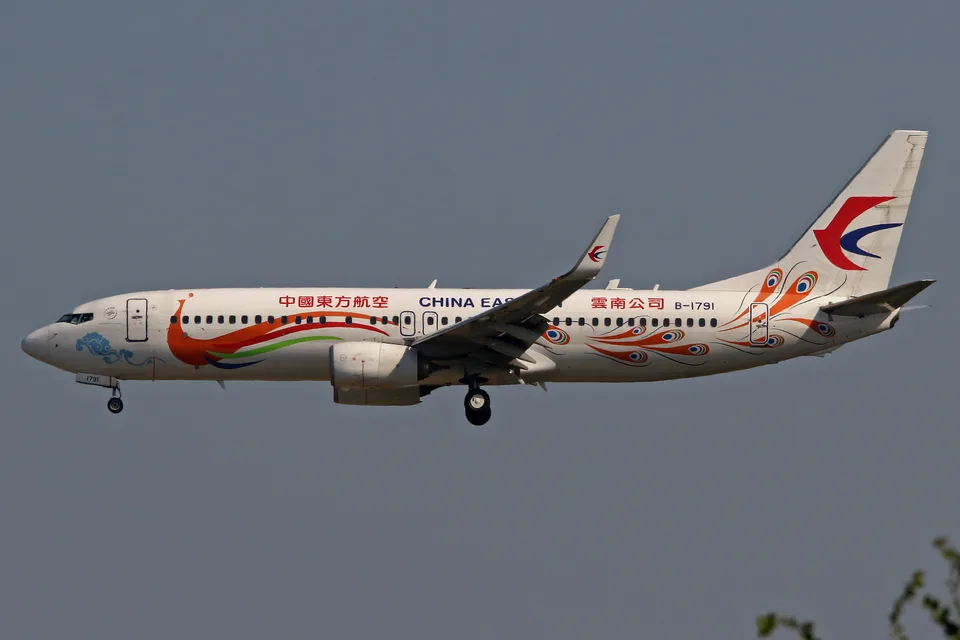
A Boeing 737-800 descended rapidly from 8,900 metres and crashed near Wuzhou, killing all 132 people aboard. CAAC published preliminary findings and later reported continuing cause analysis.
MU5735 left its cruising altitude after entering the Guangzhou control area. Controllers received no reply, the radar signal disappeared, and the aircraft crashed near Molang village.
Read the full incident Follow what happened, from the flight to the investigation findings.
What investigators concluded
CAAC reported a rapid descent from cruise, severe impact damage to the recorders and continuing investigation of the cause.
878 words / about 4 minutes to read. The official report for this event is short, so this account is shorter than most and covers only what the report documents.
Departure from Kunming
On 21 March 2022, China Eastern Yunnan Airlines operated flight MU5735 from Kunming to Guangzhou with Boeing 737-800 B-1791. The scheduled passenger flight carried 123 passengers and nine crew members. It departed from runway 21 at Kunming Changshui Airport at 13:16 Beijing time and climbed to a cruising altitude of 8,900 metres by 13:27. Its destination was Guangzhou Baiyun Airport.
The aircraft entered the Guangzhou control area along airway A599 at 14:17. The last normal radio exchange between the aircraft and air traffic control had taken place at 14:16. CAAC found no abnormality in radio communications or control instructions before the aircraft departed its cruising altitude. The initial checks also found no abnormality in the navigation and surveillance facilities along the route and no forecast of dangerous weather.
At 14:20:55, the Guangzhou area control radar generated an alert that the aircraft had deviated from its assigned altitude. B-1791 had left its cruising level and was descending rapidly. The controller immediately called the crew. No reply was received.
The last radar information was recorded at 14:21:40, 45 seconds after the altitude alert. It showed a standard pressure altitude of 3,380 metres, a ground speed of 1,010 kilometres per hour and a heading of 117 degrees. The radar signal then disappeared. The aircraft crashed near Molang village in Langnan township, Teng County, Wuzhou, in the Guangxi Zhuang Autonomous Region. It broke apart on impact. All 132 people aboard died.
The accident site lay in a valley running from southeast to northwest near Molang village. Investigators identified a water-filled crater as the main impact point. It covered about 45 square metres and was 2.7 metres deep. CAAC gave its position as 23 degrees 19 minutes 25.52 seconds north and 111 degrees 06 minutes 44.30 seconds east.
Most aircraft fragments were found on the surface and underground in the sector from 0 to 150 degrees relative to the main impact point. A trailing-edge piece of the right wingtip winglet was found about 12 kilometres away. The woodland vegetation showed signs of burning.
Recovered major components included the horizontal stabilizer, vertical tail, rudder, both engines, both wings, fuselage sections, landing gear and cockpit components. The collected wreckage was transported to a dedicated warehouse. Investigators cleaned and identified the components and arranged them in positions corresponding to the full-size aircraft for further examination and analysis.
CAAC completed a preliminary investigation report and issued a public notice on 20 April 2022. The notice covered the flight sequence, crew and maintenance personnel, airworthiness and maintenance, and wreckage distribution. Both flight recorders had suffered severe impact damage. Data restoration and analysis were continuing at that stage.
The flight crew, cabin crew and maintenance release personnel met the qualification requirements. The aircraft had valid airworthiness documents. Its most recent A check, identified as 31A, and C check, identified as 3C, were within the inspection intervals specified by the maintenance programme. The preflight and short-stop release on the day of the accident contained no fault reports or deferred defects. No cargo had been declared as dangerous goods.
On 20 March 2024, CAAC described further investigation of the wreckage, flight operation, aircraft airworthiness and ground support. Investigators photographed and marked major pieces of wreckage and mapped their discovery positions. Specialist examinations addressed the aircraft structure, flight controls and engines, including the aircraft attitude before impact and the possible operating state of key control components. Important engine and control-system components were sent to laboratories to determine the reasons for their damage.
The operational investigation examined crew technical and health information, the release plan, loading and balance, performance calculations, operational monitoring and crew preparation. It also examined the airline's safety, training, personnel qualification and maintenance management. Airworthiness work covered compliance with airworthiness directives and service bulletins, line and scheduled maintenance, deferred defects, fuel uplift and fuel quality. Investigators combined surveillance data and video recordings to analyse the last stage of flight and analysed data obtained from the repaired recorders.
The ground-support investigation covered airport staff qualifications, facilities and equipment, runway and taxiway inspections and maintenance, air traffic control personnel and equipment, weather, security checks and loading. It examined passenger, baggage, cargo and mail information and dangerous-goods training and carriage records.
CAAC reported that crew licences and certificates were valid, flight and duty periods and rest met the requirements, and the crew had passed their preflight health checks. Crew qualifications and staffing met the requirements. The aircraft airworthiness documents were valid and maintenance personnel were qualified. No fault or abnormality in the aircraft systems, structure or engines had been found before takeoff, and there were no deferred defects.
Airport support staff were qualified, facilities and equipment functioned normally, and operations followed the prescribed procedures. Air traffic control personnel were qualified and communication, navigation and surveillance equipment worked normally. Radio communications and control instructions showed no abnormality before the accident. No dangerous weather was reported in the relevant airspace and flight level. Loading met the requirements; no cargo or mail had been declared as dangerous goods, and investigators found no evidence of dangerous goods in cargo, mail or baggage.
The investigation remained ongoing in the March 2024 progress notice. CAAC said experimental verification and cause analysis would continue. The published preliminary notice and subsequent progress notice gave no determined cause for the rapid descent.
At 14:21:40 Beijing time, radar recorded a standard pressure altitude of 3,380 metres, a ground speed of 1,010 kilometres per hour and a heading of 117 degrees. The signal then disappeared.
Both recorders were severely damaged in the crash. Data restoration and analysis were continuing in April 2022. CAAC reported repair and analysis of obtained data in its March 2024 update.
Both recorders were severely damaged on impact. CAAC reported data restoration and analysis in April 2022, followed by repair and analysis of obtained data in its 2024 update.
Matching dossiers for Investigation ongoing: No other dossier in this collection.
Read alongside
These comparisons connect specific research topics. Shared circumstances do not establish identical causes. Evidence from both investigations is provided below.
Both investigations combined wreckage examination with flight-recorder evidence. MU5735's recorders suffered severe impact damage and required restoration. In Swissair 111, both recorders lost electrical power 5 minutes 37 seconds before impact; the TSB examined the loss of their shared power supply.
Explore the records below for additional context. They open on the publisher's site and are not all included in our report search. Source reuse terms apply.
No final report has been published yet. CAAC (China) is leading the investigation. It has been 55 months since the accident. Under ICAO Annex 13, a final report or an interim statement is due by each anniversary of the accident. The next anniversary is 21 March 2027.
Kevin Murphy writes the incident accounts on AirlineIncidents.com, out of a long interest in aviation safety and the lessons each investigation leaves behind.
Prepared by
AirlineIncidents editorial desk
Report citation check
Independent expert review
Not completed
Citation checks compare supporting text with the indexed report pages. They do not constitute independent expert review. How these pages are prepared.
Revision history
: Published sourced incident account, timeline, photographs and investigation findings.