A regional airliner and an Army helicopter met over the Potomac. The final investigation found failures in route design, visual separation, workload and safety oversight.
Potomac River, about 0.5 miles southeast of DCASources for this section
AIR-26-02: event and report editionNational Transportation Safety Board / final / PDF page 1, cover abstract and reissue note; PDF page 22, printed xxi
Operator
PSA Airlines, operating as American Airlines / American EagleSources for this section
AIR-26-02: event and report editionNational Transportation Safety Board / final / PDF page 1, cover abstract and reissue note; PDF page 22, printed xxi
AIR-26-02: event and report editionNational Transportation Safety Board / final / PDF page 1, cover abstract and reissue note; PDF page 22, printed xxi
Registration
N709PSSources for this section
AIR-26-02: event and report editionNational Transportation Safety Board / final / PDF page 1, cover abstract and reissue note; PDF page 22, printed xxi
Route
Wichita, Kansas, to Washington NationalSources for this section
AIR-26-02: event and report editionNational Transportation Safety Board / final / PDF page 1, cover abstract and reissue note; PDF page 22, printed xxi
People aboard
60 passengers, two pilots and two flight attendantsSources for this section
AIR-26-02: event and report editionNational Transportation Safety Board / final / PDF page 1, cover abstract and reissue note; PDF page 22, printed xxi
Fatalities
67: 64 on the airliner and 3 helicopter crewSources for this section
AIR-26-02: event and report editionNational Transportation Safety Board / final / PDF page 1, cover abstract and reissue note; PDF page 22, printed xxi
Survivors
None on either aircraftSources for this section
AIR-26-02: event and report editionNational Transportation Safety Board / final / PDF page 1, cover abstract and reissue note; PDF page 22, printed xxi
Investigating authority
NTSB DCA25MA108, completedSources for this section
NTSB investigation DCA25MA108National Transportation Safety Board / final / Completed status; What Happened, What We Found and What We Recommended
Topics
Midair collision
Photographic evidence
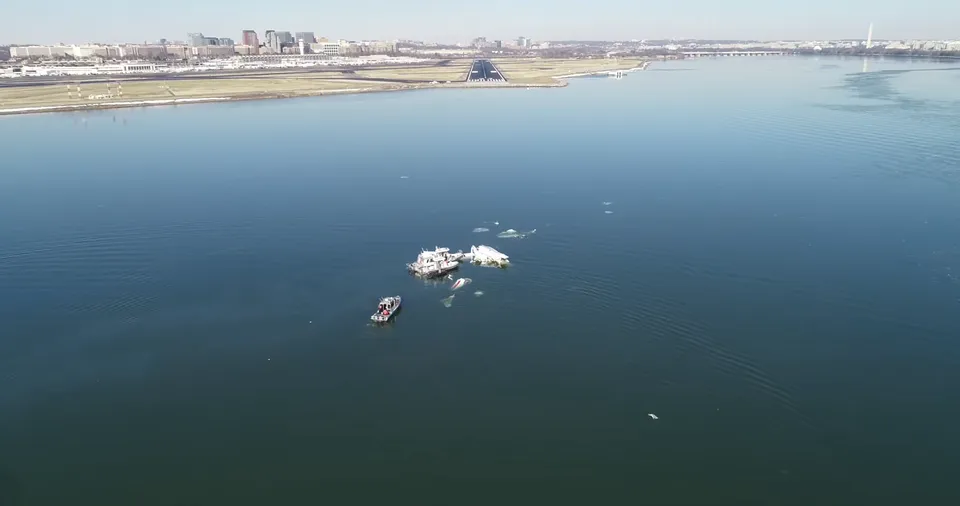
Recovery of Flight 5342 wreckage near Washington National, 3 February 2025.
Resized and WebP recompressed without cropping or content alteration. Banner and homepage use a display crop; the full photograph below is uncropped.
The banner uses a display crop. This photograph is shown uncropped here. It does not by itself establish the cause.
What happened
On the evening of 29 January 2025, PSA Airlines Flight 5342 was completing a flight from Wichita to Washington National. Its crew accepted a change from runway 1 to a circling approach to runway 33. Meanwhile, an Army Black Hawk was following helicopter routes along the Potomac during a training evaluation. Both aircraft converged over the river and collided shortly before 20:48. All 67 occupants died. The final NTSB report explains how an unsafe route arrangement, ineffective visual separation, communication problems, controller workload and inadequate safety management allowed the paths to intersect.
The NTSB attributed the accident to the FAA's placement and management of a helicopter route close to a runway approach and the air traffic system's excessive reliance on visual separation. It also identified ineffective helicopter visual separation, degraded tower performance under high workload and the Army's failure to explain altimeter error tolerances as causal factors. Equipment limitations, traffic pressure and failures to share and act on safety data contributed.
Sources for this section
NTSB investigation DCA25MA108National Transportation Safety Board / final / Completed status; What Happened, What We Found and What We Recommended
AIR-26-02: event and report editionNational Transportation Safety Board / final / PDF page 1, cover abstract and reissue note; PDF page 22, printed xxi
1,623 words / about 8 minutes to read. Based on final investigation findings.
Two routine flights share a constrained airspace
Flight 5342 left Wichita Dwight D. Eisenhower National Airport at 18:38 eastern standard time on 29 January 2025. The CRJ700 carried 60 passengers, two pilots and two flight attendants. PSA Airlines operated the scheduled passenger service for American Airlines. The journey's departure, cruise and initial descent gave investigators no indication of a developing aircraft problem. As the flight neared Washington, its task was the familiar one of joining the arrival flow and landing at Ronald Reagan Washington National Airport.
Seven minutes after the airliner departed Wichita, an Army UH-60L left Davison Army Airfield at Fort Belvoir. Its callsign was PAT25. The helicopter carried a pilot undergoing an annual standardization evaluation, an instructor pilot and a crew chief. The evaluation included the use of night vision goggles. Its route took it to landing sites in Virginia and Maryland before it turned south toward Washington and its home airfield. It was a training flight, rather than a passenger-carrying airline operation.
Night visual conditions prevailed. That description means the weather allowed visual flight; it does not mean that another aircraft was easy to identify. The NTSB later examined the effect of city lights, the aircraft's relative motion, cockpit sight lines and the crews' competing duties. These conditions became central to understanding why aircraft that were visible in principle were not recognized as a collision threat in time.
Sources for this section
AIR-26-02: event and report editionNational Transportation Safety Board / final / PDF page 1, cover abstract and reissue note; PDF page 22, printed xxi
At about 20:39, Flight 5342 received clearance for the Mount Vernon Visual Approach to runway 1. The captain was flying and the first officer was monitoring. A few minutes later, when the crew checked in with the airport tower, the controller asked whether they could use runway 33 instead. The change was intended to increase spacing between runway 1 arrivals and create time for departures. The pilots checked that they had the landing performance information for the shorter runway and accepted.
At 20:43:39, the controller told the crew to circle at the Wilson Bridge and cleared them to land on runway 33. The captain and first officer discussed the reference points and altitudes used for this approach. At 20:45:27, the autopilot was disconnected. The airliner turned away from the runway 1 localizer course and was flown manually for the remainder of the approach. It would turn onto a final approach that crossed the river southeast of the airport.
The final investigation did not treat accepting runway 33 as a complete explanation for the accident. The change placed the airliner on the path that intersected the helicopter route, but the broader question was why the system allowed these operations to coexist without dependable separation. The NTSB examined the route geometry and the assumptions made by operators and controllers about the protection supposedly provided by published helicopter altitudes.
Sources for this section
AIR-26-02: runway changeNational Transportation Safety Board / final / PDF page 35, printed page 4
PAT25 contacted the Washington National controller at about 20:32 and requested a return to Davison via helicopter Routes 1 and 4. The controller supplied an altimeter setting, which the helicopter crew read back correctly. The instructor transferred flying duties to the pilot and continued to monitor and handle the radio. Near Cabin John, the helicopter joined Route 1 and followed the Potomac south toward the airport.
The same tower controller was handling airplane and helicopter traffic, but the two groups used separate radio frequencies. Pilots could hear the controller's transmissions to other aircraft but could not hear all of the other crews' responses. The helicopter recording also captured poor reception and incomplete transmissions. These details matter because understanding another aircraft's intentions depends on more than hearing a callsign or seeing its lights.
The helicopter passed landmarks including the Memorial Bridge, the Tidal Basin and Hains Point as it moved toward Route 4. The crew discussed altitude, wind and nearby obstacles. The report later found that the Army had not adequately prepared pilots for the allowable error tolerances of their barometric altimeters. The accident helicopter was above the route's published maximum altitude. The NTSB's explanation distinguishes that finding from an unsupported claim that the crew deliberately ignored a known accurate altitude reading.
At 20:46:02, the controller advised PAT25 of a CRJ south of the Wilson Bridge and approaching runway 33. The helicopter's recording did not capture the word describing the airliner's circling maneuver. Its instructor reported having traffic in sight and requested visual separation, which the controller approved. At this point the airliner was approximately 6.5 nautical miles south of the helicopter, among several aircraft approaching the airport.
Visual separation transferred an important part of collision avoidance to the helicopter crew's ability to identify the correct airplane and remain clear of it. The final report concluded that the crew did not positively identify Flight 5342. Their expectation that the airliner would not conflict with their route influenced where they looked and how they interpreted the traffic. A statement that traffic was in sight therefore did not establish that safe separation actually existed.
The report describes a wider reliance on this procedure around Washington National. Helicopters and airliners repeatedly operated near each other, and visual separation helped controllers maintain traffic flow. The NTSB found that its limitations had not been given sufficient weight. A crew can sincerely believe it sees the relevant traffic while actually watching a different aircraft or misunderstanding the path of the one it has identified.
At 20:47:29, the CRJ was turning onto final approach for runway 33. Its crew received the normal 500-foot callout, and the first officer reported the runway's approach lights showing the expected glidepath. Four seconds later, a conflict alert began on the controller's radar display. The aircraft were drawing together rapidly, while the airliner crew was occupied with completing a demanding nighttime circling approach.
At approximately 20:47:39, the controller asked PAT25 whether the CRJ was in sight. The airliner also received a traffic advisory from its collision warning system. This was a warning about nearby traffic, not an instruction to climb or descend. Because of the system's low-altitude limitations, the crew did not receive the higher-level maneuver guidance that might have resolved the conflict.
At 20:47:42, the controller instructed the helicopter to pass behind the CRJ. During that transmission, one helicopter pilot pressed the radio transmit switch for 0.8 seconds. The resulting overlap blocked the relevant portion of the instruction from the helicopter's recording. The instructor again reported an aircraft in sight and requested visual separation. The controller approved. Neither exchange restored the separation that was missing.
In the final six seconds, the helicopter instructor asked the pilot to move left, referring to their position toward the middle of the river. The helicopter began a slight left bank. The airliner meanwhile rolled wings level on final approach. Its crew did not visually detect the helicopter until roughly one second before impact, according to the final investigation.
At 20:47:58, recorded movements of the airliner's control column and elevators showed a rapid nose-up command. Exclamations followed on the cockpit recording. At 20:47:59.3, a sharp deceleration marked the collision. The aircraft struck each other at an altitude of about 278 feet above mean sea level and fell into the Potomac. Both were destroyed.
The 64 people aboard Flight 5342 and all three helicopter crew members died. These totals refer to the two aircraft together and should not be confused with the airliner's passenger count. There were 60 passengers on the CRJ, alongside its four crew. There were no survivors from either aircraft.
AIR-26-02: event and report editionNational Transportation Safety Board / final / PDF page 1, cover abstract and reissue note; PDF page 22, printed xxi
The NTSB adopted its final report on 27 January 2026. It identified the FAA's placement of a helicopter route close to a runway approach, its failure to review the route and relevant data, and its failure to act on earlier concerns as probable-cause elements. The air traffic system's excessive dependence on visual separation was another. The accident was not explained simply as one crew failing to see the other.
The helicopter crew's ineffective visual separation, the tower team's degraded awareness and performance under high workload, and the Army's failure to explain altimeter tolerances were also causal. A combined helicopter and local control position increased the controller's burden. The absence of a structured way to assess operational risk contributed to inadequate traffic advisories and the failure to issue effective safety alerts.
Technology did not provide a reliable final barrier. The CRJ's TCAS operated as designed but its alerting was constrained at low altitude. The helicopter lacked integrated collision avoidance equipment. Its tablet could display traffic, but pilots did not normally monitor it during these low-level operations and its audible alerts were not available through their helmets. The helicopter's lack of ADS-B transmissions was investigated, but the NTSB expressly found that ADS-B Out alone would not have improved the information available to this airliner, which lacked ADS-B In.
Before completing the investigation, the NTSB issued urgent recommendations to prevent simultaneous use of the relevant helicopter route and runway approaches. The FAA removed the section of Route 4 between Hains Point and the Wilson Bridge from its charts and restricted runway use during certain limited helicopter operations. The final report records the first urgent recommendation as closed with acceptable action.
The completed investigation produced 50 new recommendations covering the FAA, Army, other federal bodies and collision avoidance standards. They addressed route reviews, traffic flow, controller workload and training, communications, altimeter awareness, equipment and the sharing of safety data. A recommendation is not proof that every proposed change has been implemented. The official recommendation record remains the source for individual responses and status.
The lasting lesson of Flight 5342 is specific: a hazardous meeting of flight paths was managed through layers that each depended on incomplete information or human detection. The final report follows that failure from the crews' last seconds back to the agencies and procedures that shaped the operation. Its findings support a full account of what went wrong, while the progress of the recommended changes remains a separate question.
After checking landing performance, the crew accepted a circling approach and received clearance to land.
Sources for this section
AIR-26-02: runway changeNational Transportation Safety Board / final / PDF page 35, printed page 4
20:46:02 ESTVisual separation approved
The controller issued a traffic advisory. The helicopter instructor reported traffic in sight, although the final investigation found the airliner had not been positively identified.
AIR-26-02: event and report editionNational Transportation Safety Board / final / PDF page 1, cover abstract and reissue note; PDF page 22, printed xxi
Sequence overview
Documented stages in reading order. This overview does not imply a settled chain of causes.
1
Flight 5342 departs Wichita
The departure, cruise and initial descent were uneventful.
The controller issued a traffic advisory. The helicopter instructor reported traffic in sight, although the final investigation found the airliner had not been positively identified.
AIR-26-02: event and report editionNational Transportation Safety Board / final / PDF page 1, cover abstract and reissue note; PDF page 22, printed xxi
Geographic context
Wichita (ICT), departure airport
Washington National (DCA), destination airport
Approximate airport reference positions, for geographic orientation only. Markers do not show the recorded flight track or exact impact position. Basemap: Natural Earth, public domain.Sources for this section
NTSB investigation DCA25MA108National Transportation Safety Board / final / Completed status; What Happened, What We Found and What We Recommended
AIR-26-02: event and report editionNational Transportation Safety Board / final / PDF page 1, cover abstract and reissue note; PDF page 22, printed xxi
Yes. NTSB AIR-26-02 was adopted on 27 January 2026. The downloaded edition was reissued on 25 February 2026 to correct a Board member concurrence.
Sources for this section
AIR-26-02: event and report editionNational Transportation Safety Board / final / PDF page 1, cover abstract and reissue note; PDF page 22, printed xxi
NTSB investigation DCA25MA108National Transportation Safety Board / final / Completed status; What Happened, What We Found and What We Recommended
Did the airliner receive a collision warning?
It received a TCAS traffic advisory, but not a resolution advisory telling the pilots how to maneuver. Low-altitude limitations prevented that higher-level alert.
The CRJ carried 60 passengers and four crew, all of whom died. Three crew aboard the Army helicopter also died.
Sources for this section
AIR-26-02: event and report editionNational Transportation Safety Board / final / PDF page 1, cover abstract and reissue note; PDF page 22, printed xxi
Classifications, with reasons
Accident outcomeMidair collision
The NTSB attributed the accident to the FAA's placement and management of a helicopter route close to a runway approach and the air traffic system's excessive reliance on visual separation. It also identified ineffective helicopter visual separation, degraded tower performance under high workload and the Army's failure to explain altimeter error tolerances as causal factors. Equipment limitations, traffic pressure and failures to share and act on safety data contributed.
Sources for this section
AIR-26-02: event and report editionNational Transportation Safety Board / final / PDF page 1, cover abstract and reissue note; PDF page 22, printed xxi
What the evidence can and cannot establish
Recommendation completion
The final report establishes the accident findings. It does not establish that all 50 new recommendations have since been implemented; individual status needs separate checking.
NTSB investigation DCA25MA108National Transportation Safety Board / final / Completed status; What Happened, What We Found and What We Recommended
Limits of reconstructed perception
The report combines recordings, simulation and analysis to explain what crews could see and hear. An animation should not be treated as a literal cockpit recording.
Search the indexed investigation documents. Their preliminary or final status is shown with the results. Other statements linked below may not be indexed.
Sources and transparency
Source status checked on 5 October 2026. This account has not undergone independent expert review. Official statements, interim documents and final findings are labelled separately.
NTSB investigation DCA25MA108
National Transportation Safety Board / final
Open original source. Specific page references appear with the supporting sections above.
AIR-26-02: safety recommendations and early FAA action
National Transportation Safety Board / final
Open original source. Specific page references appear with the supporting sections above.
Links open the publisher's original records. Source copyright and reuse terms apply.
Kevin Murphy writes the incident accounts on AirlineIncidents.com, out of a long interest in aviation safety and the lessons each investigation leaves behind.
Prepared by AirlineIncidents editorial desk. Published 5 October 2026 from the sources linked above. Later documents may revise earlier factual accounts.