LEVEL 2 Preliminary findings

Based on the investigation authority's preliminary or interim information. Causes not yet determined.

Date
Occurrence
Runway collision
Operator
Jazz Aviation, operating as Air Canada Express
Sources for this section

DCA26MA161 preliminary report: Event and occupantsNational Transportation Safety Board / preliminary / PDF and printed page 1

Flight
Air Canada 8646 / Jazz 646
Sources for this section

DCA26MA161 preliminary report: Event and occupantsNational Transportation Safety Board / preliminary / PDF and printed page 1

Aircraft
CRJ900 (CL-600-2D24) (Bombardier)
Sources for this section

DCA26MA161 preliminary report: Event and occupantsNational Transportation Safety Board / preliminary / PDF and printed page 1

Registration
C-GNJZ
Sources for this section

DCA26MA161 preliminary report: Event and occupantsNational Transportation Safety Board / preliminary / PDF and printed page 1

Route
Montreal-Trudeau to New York LaGuardia
Sources for this section

DCA26MA161 preliminary report: Event and occupantsNational Transportation Safety Board / preliminary / PDF and printed page 1

People aboard
72 passengers, two flight attendants and two pilots
Sources for this section

DCA26MA161 preliminary report: Event and occupantsNational Transportation Safety Board / preliminary / PDF and printed page 1

Fatalities
2, both pilots
Sources for this section

DCA26MA161 preliminary report: Event and occupantsNational Transportation Safety Board / preliminary / PDF and printed page 1

Serious injuries
6: one aircraft crew member, three passengers and two truck crew
Sources for this section

DCA26MA161 preliminary report: Injury classificationNational Transportation Safety Board / preliminary / PDF and printed page 15

Survivors
74: 72 passengers and 2 flight attendants
Sources for this section

DCA26MA161 preliminary report: Event and occupantsNational Transportation Safety Board / preliminary / PDF and printed page 1

Topics
Evacuation and rescue

Photographic evidence

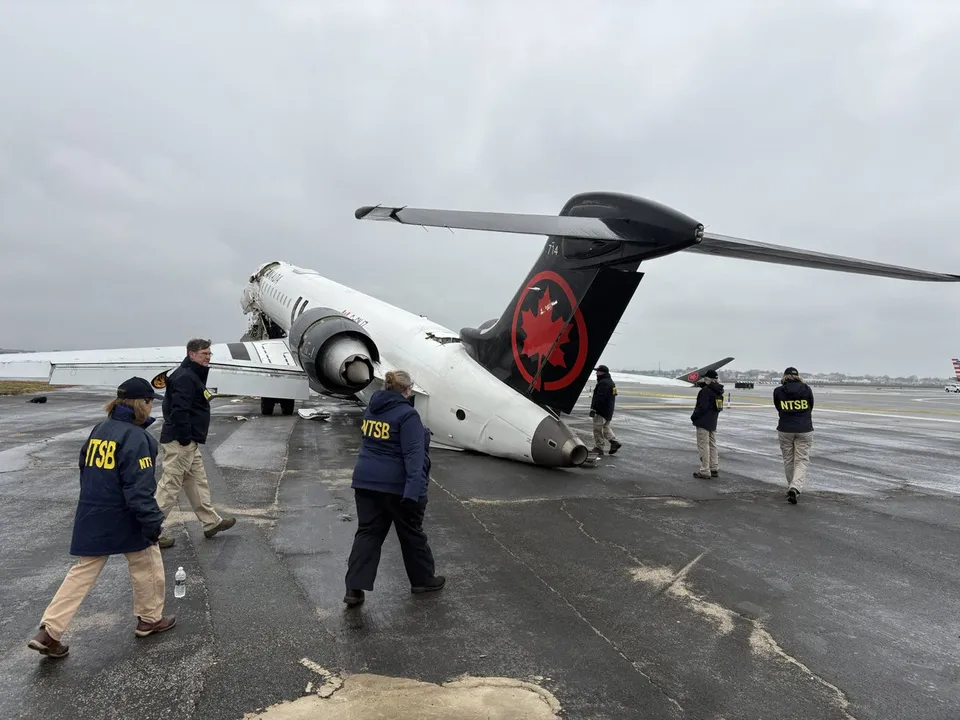
NTSB investigators walking beside damaged aircraft and firefighting vehicle at LaGuardia.

The Flight 8646 collision scene at LaGuardia, 23 March 2026.

Photo: National Transportation Safety Board, Public domain, NTSB staff work

Image info

Courtesy: National Transportation Safety Board.

Actual collision scene. Commons explicitly identifies NTSB staff authorship and PD-USGov; no third-party credit.

Image source / Original agency release

Resized and WebP recompressed without cropping or content alteration. Banner and homepage use a display crop; the full photograph below is uncropped.

The banner uses a display crop. This photograph is shown uncropped here. It does not by itself establish the cause.

What happened

A Jazz Aviation CRJ900 arriving from Montreal collided with an airport rescue truck on LaGuardia's runway 4 at approximately 23:37 on 22 March 2026. The truck was responding with other vehicles to an emergency near a terminal. It received clearance to cross while the airliner was on short final. The controller subsequently told it to stop, but it continued onto the runway. The aircraft struck the truck after landing. Both pilots died; the 72 passengers and two flight attendants survived. The preliminary investigation documents the conflicting clearances, warning-light timing, controller duties and limitations of the airport surveillance system, without issuing a probable-cause finding.

Read the full incident

Investigation status

The preliminary record establishes that the truck was cleared to cross an active landing runway, stop instructions followed, and the surface surveillance system did not issue a conflict alert. The NTSB has not yet determined probable cause or the complete role of individual actions and system limitations.

Sources for this section

NTSB DCA26MA161 investigation overviewNational Transportation Safety Board / preliminary / Updated 23 April 2026; Status Ongoing

DCA26MA161 preliminary report: Event and occupantsNational Transportation Safety Board / preliminary / PDF and printed page 1

DCA26MA161 preliminary report: Recorders and initial sequenceNational Transportation Safety Board / preliminary / PDF and printed page 2

DCA26MA161 preliminary report: Rescue communicationsNational Transportation Safety Board / preliminary / PDF and printed page 3

DCA26MA161 preliminary report: Crossing clearanceNational Transportation Safety Board / preliminary / PDF and printed page 4

DCA26MA161 preliminary report: Landing, collision and evacuationNational Transportation Safety Board / preliminary / PDF and printed page 5

DCA26MA161 preliminary report: Crew interviewsNational Transportation Safety Board / preliminary / PDF and printed page 6

DCA26MA161 preliminary report: Aircraft examinationNational Transportation Safety Board / preliminary / PDF and printed page 7

DCA26MA161 preliminary report: Truck examinationNational Transportation Safety Board / preliminary / PDF and printed page 8

DCA26MA161 preliminary report: Flight crewNational Transportation Safety Board / preliminary / PDF and printed page 9

DCA26MA161 preliminary report: Controllers and surveillanceNational Transportation Safety Board / preliminary / PDF and printed page 10

DCA26MA161 preliminary report: ASDE-X tracking limitationsNational Transportation Safety Board / preliminary / PDF and printed page 11

DCA26MA161 preliminary report: Runway status light systemNational Transportation Safety Board / preliminary / PDF and printed page 12

DCA26MA161 preliminary report: Warning light timingNational Transportation Safety Board / preliminary / PDF and printed page 13

DCA26MA161 preliminary report: Vehicle display and weatherNational Transportation Safety Board / preliminary / PDF and printed page 14

DCA26MA161 preliminary report: Injury classificationNational Transportation Safety Board / preliminary / PDF and printed page 15

When is the Air Canada Express Flight 8646 final report due?

No final report has been published yet. NTSB (United States) is leading the investigation. It has been 6 months since the accident. Under ICAO Annex 13, a final report or an interim statement is due by each anniversary of the accident. The next anniversary is 22 March 2027.

Published so far: preliminary report.

See all pending air accident final reports

The full incident

1,525 words / about 7 minutes to read. The account is limited to the detail supported by the published evidence; missing sequences are not reconstructed.

The last flight of the day

Air Canada Express Flight 8646 was a scheduled service from Montreal-Trudeau to New York LaGuardia, operated by Jazz Aviation. For air traffic purposes it was Jazz Flight 646. The aircraft, registration C-GNJZ, was a CRJ900, formally designated CL-600-2 D 24. On board were 72 passengers, two flight attendants and two pilots.

The cockpit crew were beginning a four-day trip. They had already flown from Montreal to Quebec City and back, making the LaGuardia arrival their third and final scheduled flight that day. The captain had accumulated 3,560 total flight hours, including 1,600 at Jazz. The first officer had 718 total hours, including 435 at the airline. They had flown together on one previous occasion.

LaGuardia was operating at night in visual meteorological conditions. Light rain had been reported, and the runway was considered wet or contaminated for landing purposes. The latest available airport information reported good braking action throughout runway 4. These conditions describe the setting; the preliminary report does not yet identify weather or runway condition as a cause of the collision.

Sources for this section

DCA26MA161 preliminary report: Event and occupantsNational Transportation Safety Board / preliminary / PDF and printed page 1

DCA26MA161 preliminary report: Flight crewNational Transportation Safety Board / preliminary / PDF and printed page 9

DCA26MA161 preliminary report: Vehicle display and weatherNational Transportation Safety Board / preliminary / PDF and printed page 14

An emergency elsewhere on the airport

At 23:31:42, an emergency was declared near terminal B. Seven vehicles began responding: four aircraft rescue and firefighting trucks, a tool truck, an airstair truck and a Port Authority police vehicle. Their intended route took them along taxiway D, across runway 4 and toward the terminal. They initially gathered near the intersection of taxiways BB and D.

Rescue 35, an Oshkosh Striker 1500 fire truck, was part of this group. Its radio callsign was Truck 1. The tool truck, Truck 7, was intended to lead the response. At 23:35:47 its crew attempted to contact the tower, but a simultaneous transmission obscured the call. It tried again at 23:36:21, then coordinated with Truck 1 to make contact.

The vehicles were responding to an emergency, but crossing a runway still required coordination with aircraft movements. The preliminary sequence shows the rescue response and the airline arrival developing at the same time. It is the interaction of these two operations, rather than either one in isolation, that explains how a truck came to be in the path of a landing aircraft.

Sources for this section

DCA26MA161 preliminary report: Recorders and initial sequenceNational Transportation Safety Board / preliminary / PDF and printed page 2

DCA26MA161 preliminary report: Rescue communicationsNational Transportation Safety Board / preliminary / PDF and printed page 3

Clearance while the CRJ approached

At 23:35:07, the local controller cleared Jazz 646 to land on runway 4. The CRJ was on a five-mile final at an altitude of about 1,900 feet. As it descended, the rescue vehicles assembled and sought clearance to cross the same runway. At 23:36:44, the controller asked which vehicle needed to cross. Truck 1 moved to the front of the waiting group.

At 23:36:51, the red runway entrance lights at taxiway D illuminated. The approaching aircraft was about 1.2 nautical miles from that intersection and at an altitude of 287 feet. Truck 1 was stationary on taxiway D, approximately 460 feet from the runway edge. The lights provided a separate visual warning about runway traffic approaching the intersection.

Truck 1 identified itself and the accompanying vehicles, then requested permission to cross. The controller instructed them to cross at 23:37:04. At that moment, the CRJ was about a quarter mile from the runway on final approach, approximately 130 feet above ground. It was around 4,400 feet from the taxiway D intersection where the vehicles intended to pass.

Sources for this section

DCA26MA161 preliminary report: Recorders and initial sequenceNational Transportation Safety Board / preliminary / PDF and printed page 2

DCA26MA161 preliminary report: Rescue communicationsNational Transportation Safety Board / preliminary / PDF and printed page 3

DCA26MA161 preliminary report: Crossing clearanceNational Transportation Safety Board / preliminary / PDF and printed page 4

Stop instructions and touchdown

Truck 1 read back the crossing clearance and began moving at 23:37:07. Four seconds later, the CRJ crossed the runway threshold. The truck was traveling at about 10 knots, or 11.5 miles per hour, and still approximately 410 feet from the runway edge. The two movements were closing on the same intersection from different directions.

At 23:37:12, after transmitting a taxi instruction to another airplane, the controller told Truck 1 to stop. The truck's speed continued to increase. Five seconds later, the CRJ's main landing gear touched down about 1,450 feet before taxiway D at a groundspeed of 128 knots. The first officer transferred control to the captain. The truck had crossed the hold-short line at about 24 miles per hour.

At 23:37:20, the controller again instructed Truck 1 to stop. The aircraft's braking began and its thrust reversers deployed. The truck was just over 100 feet from the runway and moving at about 29 miles per hour. The public report sets out this sequence in detail, but has not yet completed its assessment of why the stop instructions did not bring the truck to a halt.

Sources for this section

DCA26MA161 preliminary report: Crossing clearanceNational Transportation Safety Board / preliminary / PDF and printed page 4

DCA26MA161 preliminary report: Landing, collision and evacuationNational Transportation Safety Board / preliminary / PDF and printed page 5

The impact and evacuation

At 23:37:21, the runway entrance lights went out. About a second later, the aircraft's nose gear touched down. The CRJ was then approximately 400 feet from taxiway D and traveling at 106 knots, while Truck 1 was entering the runway at approximately 30 miles per hour. The collision followed roughly two seconds later.

The truck turned left just before impact, and the airplane's rudder moved about six degrees left. The last recorded aircraft groundspeed was 90 knots, equivalent to about 104 miles per hour. The collision occurred at the intersection of runway 4 and taxiway D. The CRJ stopped upright near taxiway B, initially with its nose down because of extensive forward-fuselage damage. The fire truck came to rest on its left side nearby.

Both pilots died. The 72 passengers and two flight attendants survived. Passengers evacuated through the four overwing exits, and the responding vehicles diverted from the terminal emergency to assist. The aft flight attendant described an orderly evacuation despite darkness and not knowing what had happened. He remained with four passengers until rescue personnel entered and helped them leave.

During evacuation, the airplane tilted until its tail contacted the ground. The NTSB recorded no aircraft fire. Six people sustained serious injuries: one aircraft crew member, three passengers and both truck occupants. Thirty-three passengers sustained minor injuries. The report's statement that 39 people went to hospitals includes the truck crew, so it should not be presented as 39 injured airliner passengers.

Sources for this section

DCA26MA161 preliminary report: Landing, collision and evacuationNational Transportation Safety Board / preliminary / PDF and printed page 5

DCA26MA161 preliminary report: Crew interviewsNational Transportation Safety Board / preliminary / PDF and printed page 6

DCA26MA161 preliminary report: Injury classificationNational Transportation Safety Board / preliminary / PDF and printed page 15

What the wreckage showed

The worst aircraft damage was ahead of the first passenger row. The cockpit and nose were crushed and partly separated. The pilot seats, unused flight-deck observer seat and forward flight attendant seat were found separated from the aircraft. In contrast, all passenger seats remained attached, with only limited deformation in the first two left-side seats and minor or no damage elsewhere.

Investigators found no anomalies in the pitch, roll or yaw control surfaces. The slats and flaps were fully extended. Although the spoilers were found retracted in the wreckage, the recorder showed that ground spoilers had activated about six seconds before the end of its data. The thrust reversers were found fully deployed. These differences illustrate why post-accident positions must be checked against recordings.

The truck's right-side structure and equipment compartments were badly damaged. Its water tank fragmented and its contents were released; the foam tank was breached. The operator cab remained largely intact. The preliminary examination documents how the impact affected the two vehicles, without yet completing the analysis of crash forces or occupant protection.

Sources for this section

DCA26MA161 preliminary report: Aircraft examinationNational Transportation Safety Board / preliminary / PDF and printed page 7

DCA26MA161 preliminary report: Truck examinationNational Transportation Safety Board / preliminary / PDF and printed page 8

Why the surface system did not warn

LaGuardia had Airport Surface Detection Equipment, Model X, known as ASDE-X. It combines radar and other inputs to show aircraft and vehicle movement and provide conflict alerts to controllers. FAA analysis found that it did not issue a visual or audible warning of this collision.

None of the seven responding vehicles had transponders. Their radar returns intermittently merged and separated as the vehicles waited close together. The system could not establish reliable individual tracks. Near the time of the accident, it displayed two radar targets for the group rather than seven distinct vehicles. It could not reliably associate Truck 1's movement with the approaching airplane to predict the conflict.

This does not mean that the entire airport surveillance system had simply stopped functioning. The report explains a tracking limitation involving the closely grouped, unequipped vehicles. It also notes that preventive maintenance had been performed the previous day. The presence of surveillance equipment alone therefore did not guarantee that every moving object would be identified well enough to trigger a warning.

Sources for this section

DCA26MA161 preliminary report: Controllers and surveillanceNational Transportation Safety Board / preliminary / PDF and printed page 10

DCA26MA161 preliminary report: ASDE-X tracking limitationsNational Transportation Safety Board / preliminary / PDF and printed page 11

DCA26MA161 preliminary report: Runway status light systemNational Transportation Safety Board / preliminary / PDF and printed page 12

Lights, radio and the continuing investigation

The runway entrance lights did operate. Surveillance video showed them red while the rescue vehicles waited and as Truck 1 advanced. The system is designed to extinguish the lights at an intersection about two to three seconds before a landing airplane reaches it. Their going out just before impact is therefore different from evidence that the runway had become safe to cross.

Truck 1 also had a situational awareness tablet. It could show positions and alert the crew when approaching a runway, but it was not designed to predict an impending collision. The preliminary report separates these functions rather than treating every airport display as a collision avoidance system.

Two controllers were on duty. The ground controller, also acting as controller-in-charge, was dealing with the other aircraft's rejected takeoffs and the subsequent terminal emergency. The local controller took over radio instructions on both ground and local frequencies. These duties and their timing remain part of the human-performance investigation.

As of 5 October 2026, the NTSB investigation remains ongoing and the available report is preliminary. Recorders from the airplane and truck, interviews, surveillance video and physical evidence support the sequence described here. They do not yet support a final finding about the relative responsibility of controllers, vehicle crews, airport procedures or equipment. The account will need revision when the NTSB completes that analysis.

Sources for this section

DCA26MA161 preliminary report: Controllers and surveillanceNational Transportation Safety Board / preliminary / PDF and printed page 10

DCA26MA161 preliminary report: Runway status light systemNational Transportation Safety Board / preliminary / PDF and printed page 12

DCA26MA161 preliminary report: Warning light timingNational Transportation Safety Board / preliminary / PDF and printed page 13

DCA26MA161 preliminary report: Vehicle display and weatherNational Transportation Safety Board / preliminary / PDF and printed page 14

NTSB DCA26MA161 investigation overviewNational Transportation Safety Board / preliminary / Updated 23 April 2026; Status Ongoing

Return to the short summary

Sequence of events

Times are shown only where the cited source establishes them. Untimed stages are ordered by the documented sequence.

  1. 23:31:42 EDTSeparate emergency declared

    Airport vehicles began responding to an emergency near terminal B.

    Sources for this section

    DCA26MA161 preliminary report: Recorders and initial sequenceNational Transportation Safety Board / preliminary / PDF and printed page 2

  2. 23:35:07 EDTAirliner cleared to land

    Jazz 646 was on a five-mile final for runway 4 at about 1,900 feet.

    Sources for this section

    DCA26MA161 preliminary report: Recorders and initial sequenceNational Transportation Safety Board / preliminary / PDF and printed page 2

  3. 23:36:51 EDTRunway entrance lights illuminate

    The red lights at taxiway D activated as the CRJ approached.

    Sources for this section

    DCA26MA161 preliminary report: Rescue communicationsNational Transportation Safety Board / preliminary / PDF and printed page 3

  4. 23:37:04 EDTTruck receives crossing clearance

    The airliner was about a quarter mile from the runway on final approach.

    Sources for this section

    DCA26MA161 preliminary report: Crossing clearanceNational Transportation Safety Board / preliminary / PDF and printed page 4

  5. 23:37:12 and 23:37:20 EDTController orders truck to stop

    The truck continued accelerating toward runway 4 as the CRJ landed.

    Sources for this section

    DCA26MA161 preliminary report: Landing, collision and evacuationNational Transportation Safety Board / preliminary / PDF and printed page 5

  6. About 23:37:24 EDTAircraft and truck collide

    The CRJ's last recorded groundspeed was 90 knots. Survivors evacuated through overwing exits.

    Sources for this section

    DCA26MA161 preliminary report: Landing, collision and evacuationNational Transportation Safety Board / preliminary / PDF and printed page 5

Sequence overview

Documented stages in reading order. This overview does not imply a settled chain of causes.

  1. Separate emergency declared

    Airport vehicles began responding to an emergency near terminal B.

    Sources for this section

    DCA26MA161 preliminary report: Recorders and initial sequenceNational Transportation Safety Board / preliminary / PDF and printed page 2

  2. Truck receives crossing clearance

    The airliner was about a quarter mile from the runway on final approach.

    Sources for this section

    DCA26MA161 preliminary report: Crossing clearanceNational Transportation Safety Board / preliminary / PDF and printed page 4

  3. Aircraft and truck collide

    The CRJ's last recorded groundspeed was 90 knots. Survivors evacuated through overwing exits.

    Sources for this section

    DCA26MA161 preliminary report: Landing, collision and evacuationNational Transportation Safety Board / preliminary / PDF and printed page 5

Geographic context

Geographical orientation for Air Canada Express Flight 8646Montreal-Trudeau (YUL), departure airport; LaGuardia (LGA), destination airport. Approximate airport reference positions, for geographic orientation only. Markers do not show the recorded flight track or exact impact position.12NORTH UP / SCHEMATIC / NOT A RECORDED FLIGHT TRACK
  1. Montreal-Trudeau (YUL), departure airport
  2. LaGuardia (LGA), destination airport
Approximate airport reference positions, for geographic orientation only. Markers do not show the recorded flight track or exact impact position. Basemap: Natural Earth, public domain.
Sources for this section

NTSB DCA26MA161 investigation overviewNational Transportation Safety Board / preliminary / Updated 23 April 2026; Status Ongoing

DCA26MA161 preliminary report: Event and occupantsNational Transportation Safety Board / preliminary / PDF and printed page 1

DCA26MA161 preliminary report: Recorders and initial sequenceNational Transportation Safety Board / preliminary / PDF and printed page 2

DCA26MA161 preliminary report: Rescue communicationsNational Transportation Safety Board / preliminary / PDF and printed page 3

DCA26MA161 preliminary report: Crossing clearanceNational Transportation Safety Board / preliminary / PDF and printed page 4

DCA26MA161 preliminary report: Landing, collision and evacuationNational Transportation Safety Board / preliminary / PDF and printed page 5

DCA26MA161 preliminary report: Crew interviewsNational Transportation Safety Board / preliminary / PDF and printed page 6

DCA26MA161 preliminary report: Aircraft examinationNational Transportation Safety Board / preliminary / PDF and printed page 7

DCA26MA161 preliminary report: Truck examinationNational Transportation Safety Board / preliminary / PDF and printed page 8

DCA26MA161 preliminary report: Flight crewNational Transportation Safety Board / preliminary / PDF and printed page 9

DCA26MA161 preliminary report: Controllers and surveillanceNational Transportation Safety Board / preliminary / PDF and printed page 10

DCA26MA161 preliminary report: ASDE-X tracking limitationsNational Transportation Safety Board / preliminary / PDF and printed page 11

DCA26MA161 preliminary report: Runway status light systemNational Transportation Safety Board / preliminary / PDF and printed page 12

DCA26MA161 preliminary report: Warning light timingNational Transportation Safety Board / preliminary / PDF and printed page 13

DCA26MA161 preliminary report: Vehicle display and weatherNational Transportation Safety Board / preliminary / PDF and printed page 14

DCA26MA161 preliminary report: Injury classificationNational Transportation Safety Board / preliminary / PDF and printed page 15

Questions readers ask

How many people survived on the aircraft?

All 72 passengers and both flight attendants survived. The captain and first officer died.

Sources for this section

DCA26MA161 preliminary report: Event and occupantsNational Transportation Safety Board / preliminary / PDF and printed page 1

Was the fire truck cleared to cross?

Yes. The preliminary report documents a crossing clearance at 23:37:04, followed by controller stop instructions at 23:37:12 and 23:37:20.

Sources for this section

DCA26MA161 preliminary report: Crossing clearanceNational Transportation Safety Board / preliminary / PDF and printed page 4

DCA26MA161 preliminary report: Landing, collision and evacuationNational Transportation Safety Board / preliminary / PDF and printed page 5

Did the airport's surface warning system alert controllers?

No. The FAA review found no ASDE-X conflict alert. Unequipped vehicles grouped close together could not be tracked reliably as separate targets.

Sources for this section

DCA26MA161 preliminary report: ASDE-X tracking limitationsNational Transportation Safety Board / preliminary / PDF and printed page 11

Classifications, with reasons

Survival factorEvacuation and rescue

The CRJ's last recorded groundspeed was 90 knots. Survivors evacuated through overwing exits.

Sources for this section

DCA26MA161 preliminary report: Landing, collision and evacuationNational Transportation Safety Board / preliminary / PDF and printed page 5

What the evidence can and cannot establish

Probable cause not issued

The report establishes a detailed sequence but does not yet determine the complete causes or responsibilities.

Sources for this section

NTSB DCA26MA161 investigation overviewNational Transportation Safety Board / preliminary / Updated 23 April 2026; Status Ongoing

Interview evidence

Reported recollections of stop calls are interview evidence. Inter-ARFF radio communications were not recorded.

Sources for this section

DCA26MA161 preliminary report: Crew interviewsNational Transportation Safety Board / preliminary / PDF and printed page 6

Safety follow-up

A recommendation does not establish implementation. Actions are described at the dates of the linked records.

International investigation support

The TSB of Canada appointed an accredited representative, with Canadian operator, manufacturer, regulator and crew representatives assisting.

Sources for this section

DCA26MA161 preliminary report: Event and occupantsNational Transportation Safety Board / preliminary / PDF and printed page 1

Recorder and systems analysis

Aircraft recorders were recovered and downloaded. Truck recorders, its display and additional aircraft equipment were retained for further laboratory work.

Sources for this section

DCA26MA161 preliminary report: Recorders and initial sequenceNational Transportation Safety Board / preliminary / PDF and printed page 2

Read alongside

Related subjects for further reading. These links do not imply identical causes.

American Eagle Flight 5342: Midair collision

Search the investigation evidence

Search the indexed investigation documents. Their preliminary or final status is shown with the results. Other statements linked below may not be indexed.

Sources and transparency

Source status checked on 5 October 2026. This account has not undergone independent expert review. Official statements, interim documents and final findings are labelled separately.

NTSB DCA26MA161 investigation overview

National Transportation Safety Board / preliminary

Open original source. Specific page references appear with the supporting sections above.

DCA26MA161 preliminary report: Injury classification

National Transportation Safety Board / preliminary

Open original source. Specific page references appear with the supporting sections above.

Links open the publisher's original records. Source copyright and reuse terms apply.

Sources and methodology

Editorial record

Kevin Murphy writes the incident accounts on AirlineIncidents.com, out of a long interest in aviation safety and the lessons each investigation leaves behind.

Prepared by AirlineIncidents editorial desk. Published 5 October 2026 from the sources linked above. Later documents may revise earlier factual accounts.
Suggest a source-based correction

Indexed source versions

DCA26MA161, Jazz Aviation / Air Canada Flight 8646 preliminary report

preliminary investigation report. Retrieved 5 October 2026. 15 PDF pages; 18,753,367 bytes.

File fingerprint (SHA-256). It identifies the exact version of the report this page was checked against.

f26af696fabe198e72aa63637bf564614c5a13db3a9393a653741e645425957f