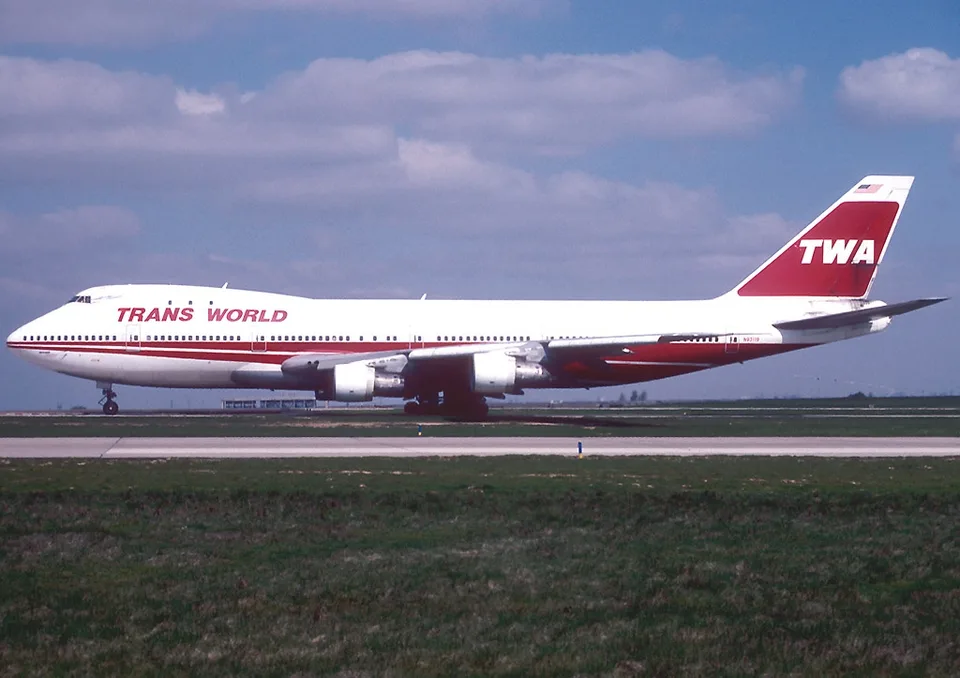
The accident aircraft photographed earlier. This is not an image of the explosion or the recovered wreckage. A full GFDL 1.2 copy accompanies the private media.
Commons contributor cropped 12 bottom pixels in 2013. Responsive versions resized and recompressed; derivatives retain GFDL 1.2 only. Responsive WebP copies resized without cropping.
Geographic context
New York JFK
Paris Charles de Gaulle
Approximate airport markers for the intended route, not an accident flight track or navigation chart. Basemap: Natural Earth, public domain.Read supporting evidence
The Boeing 747 broke up during climb after departure from New York. NTSB attributed the breakup to an explosion of flammable fuel-air vapor in its center wing tank.
Read the full incident Follow what happened, from the flight to the investigation findings.
What investigators concluded
NTSB determined that ignition of the flammable tank mixture caused the explosion. It could not establish the ignition source with certainty and identified an external short circuit feeding excessive voltage into fuel quantity indication wiring as most likely.
An established tank explosion and an uncertain ignition source
1,606 words / about 8 minutes to read. Based on the investigation records cited below.
A delayed departure from New York
Trans World Airlines flight 800 was a scheduled international passenger service from John F. Kennedy International Airport to Paris Charles de Gaulle on 17 July 1996. The aircraft was a Boeing 747-131, registered N93119. It carried 212 passengers, two pilots, two flight engineers and fourteen flight attendants. All 230 occupants died when the aircraft broke up and crashed into the Atlantic Ocean near East Moriches, New York. This account follows NTSB's final aircraft accident report, adopted on 23 August 2000. Recorded flight times are eastern daylight time rather than UTC.
The aircraft arrived from Athens earlier that afternoon. The arriving flight crew reported no operational abnormalities during that journey. At JFK it was refueled and remained at the gate with the auxiliary power unit and two air-conditioning packs operating for about two and a half hours. The scheduled crew change placed a captain in the left seat, a captain/check airman in the right seat and two flight engineers in the cockpit. One flight engineer was receiving initial operating experience. The investigation documented those roles without attributing the accident to the training arrangement.
Departure had been planned for approximately 19:00, but a disabled ground-service vehicle and concerns over a possible passenger-baggage mismatch delayed it. Gate personnel subsequently confirmed that the passenger associated with the bag had been aboard. The cockpit door closed at 19:59:59 and departure preparation continued. These details belong to the official chronology, but the final report did not identify that baggage concern as an explosion cause. A narrative must not convert an ordinary resolved departure issue into evidence of sabotage merely because the later event involved an explosion.
The aircraft pushed back at approximately 20:02. Engines 1, 2 and 4 were started before taxi, while engine 3 was started later during the taxi sequence. The crew completed the relevant checklists and taxied to runway 22R. Control issued takeoff clearance at 20:18:21, and recorder data indicated that the aircraft became airborne at approximately 20:19. Visual meteorological conditions prevailed, although the flight operated on an instrument flight rules plan. NTSB's final findings identified no significant weather condition capable of disrupting the flight at the accident time.
During departure the crew received altitude assignments and heading changes from New York terminal controllers and Boston en-route control. An instruction to climb towards 19,000 feet was subsequently amended to maintain 13,000 feet. The aircraft reached that assigned level. At 20:30:15, Boston control cleared flight 800 to climb and maintain 15,000 feet. The cockpit recording documented the crew calling for climb thrust and the flight engineer confirming power was set. This established a continuing climb sequence immediately before the catastrophic event, not an extended recorded recovery from an identified fuel-tank emergency.
The recording also included a captain's observation about the engine 4 fuel-flow indication. That indication and the tank fuel-quantity indication system are different functions. This draft does not treat the comment as proof of the final report's proposed ignition pathway. The investigation examined system details and electrical evidence to assess possible sources. A cockpit remark may be relevant evidence for analysis, but it is not itself a located short circuit or confirmation of where ignition occurred. The report's qualified conclusion remains the appropriate basis for describing the pathway.
At 20:31:12 the cockpit voice recording ended. The flight data recorder lost power at the same time, and the last recorded radar transponder return also occurred then. A sound-spectrum study identified changes in electrical background information near the end of the captain's channel. A very loud sound was recorded for a fraction of a second immediately before the recording stopped. NTSB examined these features as part of its reconstruction. They do not provide a recorded account of every event after power and recording were lost.
At 20:31:50, the captain of an Eastwind Airlines Boeing 737 reported an explosion ahead. Further reports reached controllers from other aircraft. Witnesses near the coast described explosions, a large fireball and burning debris falling towards the water. Some described an upward-moving streak of light. The investigation did not ignore those observations; it assessed them against radar, wreckage and the reconstructed breakup. An eyewitness description of light direction is presented as an observation requiring interpretation, rather than automatically identifying a projectile or the source of the first explosion.
NTSB's final findings concluded that the streaks were not related to a missile. It attributed the streak reported by most witnesses to burning fuel from the damaged aircraft in crippled flight during part of the post-explosion breakup, and fireballs to burning wreckage falling towards the ocean. The report also expressly found that a bomb or missile strike did not initiate the breakup. Those are attributed investigation findings. This account does not create a competing narrative from isolated witness wording while omitting the technical analysis and formal conclusions that address it.
NTSB concluded that the center wing tank contained flammable fuel-air vapor at the time of the accident. An explosion of that mixture could generate sufficient internal pressure to break the tank apart. The final findings identified this fuel-air explosion as the initiating event in the structural breakup. The probable-cause statement similarly describes an explosion resulting from ignition of the flammable mixture. That conclusion is more specific than saying that the aircraft simply exploded, because it identifies the compartment and physical hazard which the investigation found initiated the loss.
The report excluded a preexisting structural condition as the initiator of a failure and decompression. It also found no evidence that preexisting fatigue or corrosion contributed to the accident. Small fatigue cracks were found, but NTSB assessed their significance and concluded they would not have degraded the relevant structural capability or changed the breakup pattern. Their presence therefore does not establish that an old aircraft failed through fatigue. A condition discovered in wreckage can be real without being causal, and the final analysis is necessary to distinguish the two.
The fuel-tank explosion finding does not mean the exact ignition point was recovered. NTSB stated that the source of ignition energy could not be determined with certainty. Among the evaluated sources, it considered an external short circuit allowing excess voltage into the tank through fuel quantity indication system wiring most likely. That wording is preserved throughout this draft. The established explosion, the preferred energy pathway and the unlocated ignition mechanism have different levels of evidential resolution. Combining them into a single claim of a proved wire and spark would misstate the investigation.
The final findings assessed numerous possible ignition sources. NTSB considered several alternatives very unlikely and found that interference from personal electronic devices played no role in ignition. It concluded that an excess-voltage short circuit feeding fuel-quantity indication wiring was the most likely source of ignition energy. It also identified silver-sulfide deposits on components within tanks as an ignition risk. However, the possibility that deposits facilitated release of energy was not converted into a finding that a specific deposit had caused the initiating spark on this aircraft.
The report expressly states that neither the energy-release mechanism nor the location of ignition inside the tank could be determined from available evidence. Wiring examinations found deterioration, contamination, damage and repairs that did not comply with manufacturer guidance. Comparable conditions were observed across other transport aircraft examined in connection with the investigation. NTSB concluded that N93119's wiring condition was not atypical for its age and that maintenance followed prevailing industry practices. That is not a declaration that every identified wiring condition was safe; it places the findings within a wider industry problem.
The investigation was concerned that inaccessible bundles and general visual inspection criteria could leave unsafe wiring undetected. It found that insufficient attention had been paid to electrical wiring condition. This distinction matters to the safety response: the report did not merely propose locating one bad wire on one aircraft. It considered maintenance training, documentation, inspection limitations and protective technology. Those broader hazards supported recommendations even where the evidence could not identify the precise initiating short circuit. A recommendation can address a demonstrated risk without proving that every example of that risk caused the accident.
NTSB identified a contributing design and certification concept: attempting to prevent tank explosions solely by excluding all ignition sources while allowing fuel-tank flammability. It described that philosophy as fundamentally flawed because experience showed that every possible ignition source could not be predicted and reliably eliminated. A second contributing factor concerned heat sources located beneath the center wing tank without means to reduce heat transfer or make vapor nonflammable. These findings explain why the investigation focused on the tank atmosphere as well as electrical integrity.
The report recounts earlier recommendations for design or operational changes that would preclude explosive tank mixtures. They included significant consideration of inerting systems, insulation and operational measures pending design changes. New recommendations addressed electrical bonding, separation of critical wiring, ignition risks from sulfide deposits and the aging non-structural systems programme. The recommended maintenance response included training, better documentation and technologies such as arc-fault circuit breakers and automated wire testing. These are described in their report-era setting; no present implementation status has been inferred from a report adopted in 2000.
The resulting account is firm about the center wing tank explosion while precise about the unresolved ignition details. It gives the departure and recorded climb sequence, distinguishes witness observations from NTSB's interpretation and reports the fatalities without invented final dialogue or cabin scenes. It also preserves the distinction between identified wiring hazards and a proved initiating component. The safety response described by the investigation sought two complementary protections: reducing the chance that ignition energy could enter a tank and reducing the chance that the tank contained a flammable mixture when an unanticipated ignition source appeared.
Matching dossiers for Heat beneath the tank: No other dossier in this collection.
Read alongside
These comparisons connect specific research topics. Shared circumstances do not establish identical causes. Evidence from both investigations is provided below.
TWA 800 and Air France 447 both required recorder evidence and detailed analysis of aircraft systems. TWA 800 involved a fuel-tank explosion and structural breakup; AF447 involved airspeed unreliability followed by loss of control. The shared investigative need does not imply a shared accident mechanism.
Explore the records below for additional context. They open on the publisher's site and are not all included in our report search. Source reuse terms apply.
Final aircraft accident report adopted 23 August 2000
Sources and transparency
Checked against cached official report pages and specified official comments. No independent expert review.
Source limitations
The tank explosion is the NTSB finding. Excess voltage entering through fuel quantity indication wiring is its most likely ignition pathway, not a proven exact spark location.
NTSB AAR-00/03: In-flight breakup, TWA flight 800
NTSB Final aircraft accident report adopted 23 August 2000
Private evidence cache. Only short attributed quotations in original commentary; full report and third-party illustrations are not redistributed. Source terms / provenance.
Final Report: Accident on 1st June 2009 to the Airbus A330-203 registered F-GZCP operated by Air France flight AF 447
Bureau d'Enquetes et d'Analyses (BEA) English final report, 5 July 2012
Limited quotations for source-based commentary. Full report and illustrations are not republished. Wider reuse requires checking BEA terms. Source terms / provenance.
Kevin Murphy writes the incident accounts on AirlineIncidents.com, out of a long interest in aviation safety and the lessons each investigation leaves behind.
Prepared by
AirlineIncidents editorial desk
Report citation check
Independent expert review
Not completed
Citation checks compare supporting text with the indexed report pages. They do not constitute independent expert review. How these pages are prepared.
Revision history
: Private landmark Wave 1 original account; final report and specified comments cited.