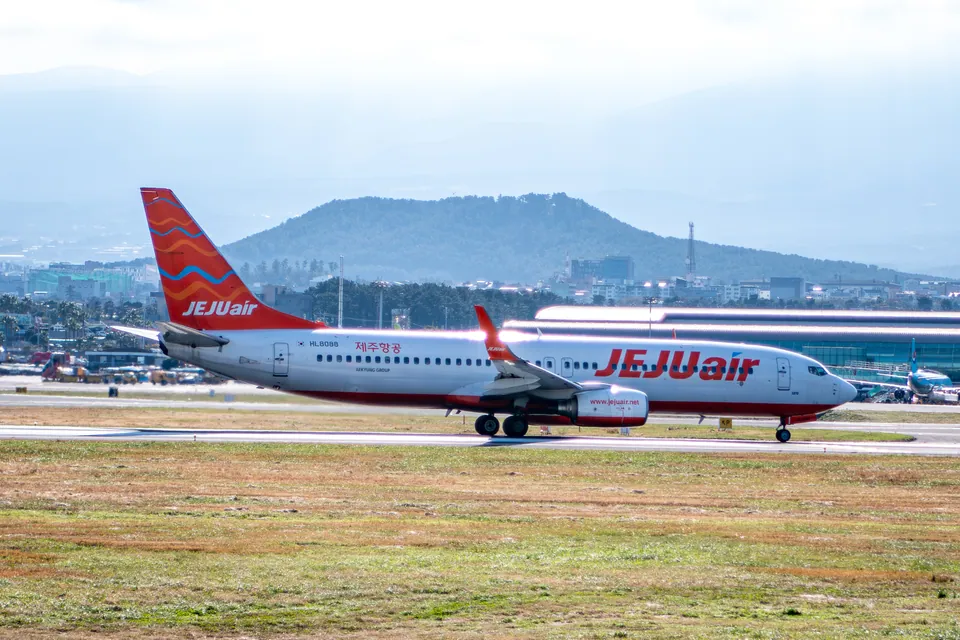
Resized and WebP recompressed; no content changes.
The banner uses a display crop. This photograph is shown uncropped here. It does not by itself establish the cause.
What happened
On 29 December 2024, Jeju Air Flight 2216 from Bangkok landed at Muan with its landing gear retracted. The Boeing 737-800 overran runway 19, struck an obstacle beyond the runway and caught fire.179 of the 181 people aboard died, and two survived with serious injuries. The official material used here is preliminary and does not establish the complete accident sequence or final cause.
The official preliminary notification establishes the gear-retracted landing, runway overrun, collision and fire. It should not be treated as a final explanation of why the emergency developed or why the aircraft landed in that configuration.
Preliminary report: Jeju AirHL 8088ARAIB, Republic of Korea / preliminary report listing / Publication 27 January 2025; verified listing, original attachment not independently page-checked.
When is the Jeju Air Flight 2216 final report due?
No final report has been published yet. ARAIB (South Korea) is leading the investigation. It has been 21 months since the accident. Under ICAO Annex 13, a final report or an interim statement is due by each anniversary of the accident. The next anniversary is 29 December 2026.
587 words / about 3 minutes to read. The account is limited to the detail supported by the published evidence; missing sequences are not reconstructed.
A scheduled flight to Muan
Jeju Air Flight 2216 was a scheduled passenger flight from Bangkok Suvarnabhumi to Muan in the Republic of Korea. On 29 December 2024, the aircraft involved was a Boeing 737-800 registeredHL 8088. There were 181 people aboard. The official preliminary notification supplied to the French investigation authority, BEA, records a fatal landing accident at Muan rather than a completed finding about its underlying cause.
The outcome was catastrophic.179 people died and two survived with serious injuries. The casualty numbers describe occupants of the aircraft. They should be read separately from the developing explanations of the emergency, because the death toll can be confirmed even when investigators have not completed the technical and operational analysis.
The BEA's official event record describes the aircraft landing on runway 19 with its landing gear retracted, overrunning the runway and striking an obstacle beyond it. A fire followed. The BEA's 2024 annual report also records the landing with the gear retracted. Those sources support the central physical sequence: landing, overrun, collision and fire.
The aircraft's configuration is an observation about the event, not an explanation of why it occurred. The verified material used for this account does not establish the pilots' complete decision-making sequence, the availability of the relevant aircraft systems, or a final causal chain connecting the emergency to the landing. It would be misleading to fill those gaps with a confident reconstruction based on general knowledge of the 737.
The distinction also applies to the structure beyond the runway. The later official government material on localizer improvements provides relevant safety followup. It does not, on its own, establish how every feature of the structure affected the crash or what the outcome would have been with a different arrangement. Such questions require the accident investigation's evidence and analysis.
The Ministry of Land, Infrastructure and Transport's 6 January 2025 update said all 179 deceased had been identified and escorted to funeral homes, while the two survivors were in hospital. It described the investigation of the engines and other critical components moved to a hangar, together with work to bring debris into the secured area. These were recovery and evidence-preservation measures during an ongoing investigation.
The same update reported completion of the cockpit-voice-recorder transcript on 4 January and the transfer of the flight-data recorder to Washington for examination. These steps establish that specialist recorder work was being pursued. The existence of a recorder examination does not mean its result is a complete final report, or that all questions about the aircraft's last minutes can already be answered publicly.
ARAIB's official listing records a preliminary report for HL8088 published on 27 January 2025. The listing establishes the report's status and availability. The account here uses separately verified official notification and government updates; page-specific technical findings from the preliminary attachment are not presented.
Preliminary report: Jeju AirHL 8088ARAIB, Republic of Korea / preliminary report listing / Publication 27 January 2025; verified listing, original attachment not independently page-checked.
What remains open
The present account is deliberately limited to what the verified official material supports. It does not state that a particular crew action, engine problem or airport feature was the final cause. It also does not attach invented precise times to the landing sequence. A preliminary factual page is useful only if its boundaries remain as clear as its confirmed details.
The investigation status near the top of this page marks that boundary. The confirmed record covers the flight identity, aircraft, route, fatalities, survivors and basic landing accident sequence. A fuller account can replace or expand these sections when the original technical documents and subsequent official findings have been verified. The developing status should remain until a final report is identified and assessed.
Preliminary report: Jeju AirHL 8088ARAIB, Republic of Korea / preliminary report listing / Publication 27 January 2025; verified listing, original attachment not independently page-checked.
MOLIT reported completion of identification of all 179 deceased, two survivors hospitalised and ongoing investigation of aircraft components and recorders.
ARAIB's official report listing identifies the HL 8088 preliminary report published on 27 January 2025.
Sources for this section
Preliminary report: Jeju AirHL 8088ARAIB, Republic of Korea / preliminary report listing / Publication 27 January 2025; verified listing, original attachment not independently page-checked.
Sequence overview
Documented stages in reading order. This overview does not imply a settled chain of causes.
1
Bangkok to Muan
Flight 2216 was operating from Bangkok Suvarnabhumi to Muan with 181 people aboard.
ARAIB's official report listing identifies the HL 8088 preliminary report published on 27 January 2025.
Sources for this section
Preliminary report: Jeju AirHL 8088ARAIB, Republic of Korea / preliminary report listing / Publication 27 January 2025; verified listing, original attachment not independently page-checked.
Geographic context
Bangkok Suvarnabhumi, departure
Muan Airport, destination and accident location
Approximate airport reference positions, for geographic orientation only. Markers do not show the recorded flight track or exact impact position. Basemap: Natural Earth, public domain.Sources for this section
Preliminary report: Jeju AirHL 8088ARAIB, Republic of Korea / preliminary report listing / Publication 27 January 2025; verified listing, original attachment not independently page-checked.
This account uses the verified official report listing and separately verified authority material. It does not include page-specific technical claims from ARAIB's preliminary attachment.
Sources for this section
Preliminary report: Jeju AirHL 8088ARAIB, Republic of Korea / preliminary report listing / Publication 27 January 2025; verified listing, original attachment not independently page-checked.
Latest final status
No final report was verified in this research. This is a limitation of the checked record, not proof that every possible publication channel has been exhausted.
Sources for this section
Preliminary report: Jeju AirHL 8088ARAIB, Republic of Korea / preliminary report listing / Publication 27 January 2025; verified listing, original attachment not independently page-checked.
Safety follow-up
A recommendation does not establish implementation. Actions are described at the dates of the linked records.
Recorder and component work
MOLIT's 6 January 2025 update records engine and component investigation, transcript completion and transfer of the flight-data recorder for specialist work.
MOLIT published a subsequent official announcement concerning localizer safety improvements. This is followup action, not a substitute for final accident findings.
Source status checked on 5 October 2026. This account has not undergone independent expert review. Official statements, interim documents and final findings are labelled separately.
Accident to Boeing 737-800 HL 8088 operated by Jeju Air on 29 December 2024 at Muan
BEA, France / preliminary notification
Open original source. Specific page references appear with the supporting sections above.
BEA 2024 annual report
BEA, France / annual overview
Open original source. Specific page references appear with the supporting sections above.
Latest updates for the Jeju Air crash in Muan Airport,6 January 2025
Ministry of Land, Infrastructure and Transport, Republic of Korea / government update
Open original source. Specific page references appear with the supporting sections above.
Preliminary report: Jeju AirHL 8088
ARAIB, Republic of Korea / preliminary report listing
Open original source. Specific page references appear with the supporting sections above.
Official announcement on localizer safety improvements
MOLIT, Republic of Korea / safety followup
Open original source. Specific page references appear with the supporting sections above.
Links open the publisher's original records. Source copyright and reuse terms apply.
Kevin Murphy writes the incident accounts on AirlineIncidents.com, out of a long interest in aviation safety and the lessons each investigation leaves behind.
Prepared by AirlineIncidents editorial desk. Published 5 October 2026 from the sources linked above. Later documents may revise earlier factual accounts.