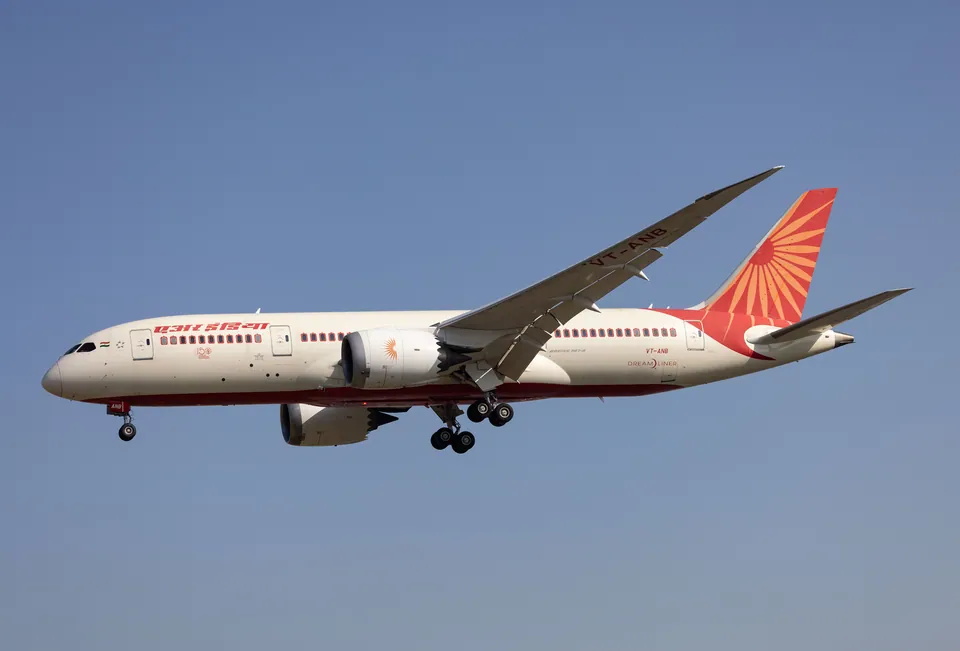
Resized and WebP recompressed; no content changes. This resized version is shared under the same licence.
The banner uses a display crop. This photograph is shown uncropped here. It does not by itself establish the cause.
What happened
Air India Flight AI171 crashed shortly after takeoff from Ahmedabad on 12 June 2025. AAIB's preliminary report records fuel-control-switch transitions to CUTOFF soon after liftoff, declining engine speeds and subsequent relight sequences. The Boeing 787 struck buildings outside the airport.241 people aboard and 19 on the ground died; one passenger survived. The reason for the recorded switch transitions has not been established in a final report.
The preliminary report establishes a timed sequence of fuel-control-switch position changes, loss of engine speed and attempted relight. It does not determine why those changes occurred or assign intent or blame.
When is the Air India Flight 171 final report due?
No final report has been published yet. AAIB India is leading the investigation. It has been 15 months since the accident. Under ICAO Annex 13, a final report or an interim statement is due by each anniversary of the accident. The next anniversary is 12 June 2027.
1,728 words / about 8 minutes to read. The account is limited to the detail supported by the published evidence; missing sequences are not reconstructed.
A departure from Ahmedabad
Air India Flight AI171 was preparing to leave Ahmedabad for London Gatwick on 12 June 2025. The Boeing 787-8, registered VT-ANB, carried 230 passengers, ten cabin crew and two pilots. It had arrived from Delhi earlier that morning as Flight AI423. The onward journey ended shortly after takeoff, when the aircraft descended outside the airport and struck buildings. The preliminary investigation records 241 deaths aboard, nineteen on the ground and one surviving passenger with serious injuries.
The aircraft touched down from Delhi at 05:47 UTC and parked at bay 34. The arriving crew had entered a stabiliser-position-transducer status message in the technical log. An engineer completed troubleshooting and released the aircraft at 06:40. That entry is part of the preliminary factual record; its existence does not establish a causal connection with the crash. It should not be converted into a claim that the aircraft departed with a known accident-causing fault.
The two pilots had arrived at Ahmedabad the previous day and the report records an adequate rest period. The first officer was the pilot flying and the captain was the pilot monitoring. Both underwent the required preflight breath-analyser test and were assessed fit to operate. The report gives extensive pilot-experience information, but experience alone cannot resolve what happened during the subsequent emergency. The investigation is examining the technical and human evidence together.
The flight carried 54,200 kilograms of fuel. Its takeoff weight was 213,401 kilograms, below the allowable 218,183 kilograms for the conditions. The load sheet recorded no dangerous goods. These details place the departure within its documented loading limits. They do not, by themselves, explain the later loss of thrust. They are useful boundaries around claims that excessive weight or a hazardous cargo has already been identified as the reason for the accident.
Ahmedabad's runway 05/23 is 3,505 metres long. AI171 requested the full length of runway 23 and taxied there through taxiwayR 4, backtracking before lining up. The recorded weather near departure included visibility of 6,000 metres, light wind and a temperature of about 37 C. The aircraft was cleared for takeoff at 08:07:33 UTC. Surface-surveillance replay placed the beginning of its roll four seconds later. This chronology comes from preserved airport and recorder evidence.
The calculated takeoff speeds were 153 knots for the takeoff decision speed,155 knots for rotation and 162 knots for the initial takeoff safety speed. The forward flight recorder captured 153 knots at 08:08:33 and 155 knots at 08:08:35. At 08:08:39 the aircraft's air-ground sensors changed to the airborne state, consistent with liftoff. The report therefore provides a tightly timed record of the transition from runway roll to initial climb, rather than relying solely on distant video.
By about 08:08:42 the aircraft had reached its maximum recorded indicated airspeed of 180 knots. Immediately afterwards, the recorded engine fuel-control-switch positions changed from RUN to CUTOFF, one after the other, separated by one second. Engine rotational speeds began to fall as fuel supply was cut. This is the crucial sequence established in the preliminary report. The publication describes the recorded changes; it does not establish why they occurred.
The cockpit recording contains one pilot asking the other why the fuel had been cut off, followed by a denial. The preliminary publication does not identify which pilot spoke each part of that exchange. It also does not conclude that either pilot intentionally caused the accident. Attributing the exchange to a named individual, inferring motive or presenting a criminal explanation would go beyond the authority's published evidence.
Airport CCTV showed the ram air turbine deploying during the initial climb. This emergency device can provide power when the aircraft's normal supply is disrupted. The report records its hydraulic pump beginning to supply hydraulic power at about 08:08:47. By then, both engines' core speeds had fallen below minimum idle. The aircraft began losing altitude before it crossed the airport perimeter wall. The footage did not show significant bird activity near the flight path.
At approximately 08:08:52 the recorded number-one fuel-control-switch position returned from CUTOFF to RUN. Two seconds later, the auxiliary power unit's inlet door began to open, consistent with its automatic-start logic. At 08:08:56 the number-two switch also returned to RUN. The engine controllers then managed their automatic relight and thrust-recovery sequences. The report describes this as a progression visible in the recorded parameters, not proof that normal thrust was fully restored.
Exhaust-gas temperatures rose in both engines, indicating relight. Number one's core-speed decrease stopped and began to reverse towards recovery. Number two relit but did not arrest its core-speed deceleration, with repeated fuel introduction recorded as the control system sought recovery. There was very little time and height available. The distinction between evidence of relight and evidence of recovered usable thrust is essential when describing these final seconds.
At about 08:09:05 a pilot transmitted a Mayday call. The controller asked for the callsign but received no reply. The recorder stopped at 08:09:11. The controller saw the aircraft crash outside the boundary and activated the emergency response. An airport crash-fire tender left the premises at 08:14:44 and local fire and rescue services also attended. The sequence gives a recorded framework for the emergency without inventing dialogue or actions that the preliminary report has not supplied.
The aircraft struck the BJ Medical College hostel area approximately 0.9 nautical miles beyond the departure end of runway 23. The preliminary wreckage survey describes first contact with trees and a chimney in the Army Medical Corps compound, followed by the northeast wall of a building. Marks on the aircraft and building were consistent with a roughly eight-degree nose-up attitude and wings approximately level. These are impact-reconstruction observations, not a complete aerodynamic analysis of the descent.
The wreckage spread through buildings and vegetation over an area approximately 1,000 by 400 feet. Five buildings sustained major structural and fire damage. Aircraft sections separated as the jet progressed through the site. Investigators mapped the location of the engines, landing gear, wing sections, tail and flight-deck wreckage. That mapping provides evidence about the aircraft's physical passage through the built environment and helps distinguish damage occurring during impact from conditions already present in flight.
The flap handle was found at the five-degree position, matching the takeoff setting recorded by the flight recorder. The landing-gear lever was found in the down position. Both thrust levers were found near idle in the damaged wreckage, but the recorder showed that they had remained forward at takeoff thrust until impact. This disagreement illustrates why the position of a burned or distorted component cannot be read as an unqualified record of its pre-impact operation.
Both fuel-control switches were found in RUN in the wreckage, consistent with the later recorded returns to RUN. The switches' recovered position does not erase the earlier CUTOFF transitions in the data. Nor does the preliminary publication establish the mechanism behind those transitions. The factual account must keep the recorded sequence, the physical examination and the remaining explanatory questions distinct. This prevents apparently simple photographs or component positions from becoming unsupported conclusions.
The 787 had two enhanced airborne flight recorders, one forward and one aft, each combining flight-data and cockpit-audio recording. The forward recorder also had an independent power supply. Investigators recovered the aft unit on 13 June and the forward unit on 16 June. Both had suffered impact and fire damage. They were taken to the AAIB facility in New Delhi on 24 June, with equipment supplied through the United States NTSB to assist data recovery.
The forward recorder's memory module was mounted in an identical recorder chassis for download. Its recovered data covered approximately 49 hours and six flights, including the accident flight, while the audio covered two hours and captured the event. The aft unit was too severely damaged for a conventional download, and examination found extensive memory-card damage. The report's detailed takeoff sequence was therefore based on successfully recovered forward-recorder evidence rather than an intact pair of recorders.
Investigators also preserved air-traffic recordings, obtained CCTV, interviewed witnesses and the surviving passenger, secured the engines and identified components for further examination. Fuel samples from the bowsers and tanks used to refuel the aircraft were tested and found satisfactory. Very small samples from aircraft components required further specialised examination. The distinction between tested ground fuel and pending tests of recovered aircraft samples should remain visible in any account of the fuel evidence.
The preliminary report was published on 12 July 2025. At that stage it recommended no actions to 787-8 or GEnx-1 B engine operators or manufacturers. That dated statement is not a guarantee that the aircraft or engine could play no role in the accident, and it does not establish that no later safety action will be needed. It describes the investigators' position when the preliminary information was released.
The preliminary report discusses a 2018 FAA advisory bulletin about fuel-control-switch locking features. It records that the suggested checks were advisory and that Air India had not performed them on that basis. It also records earlier throttle-control-module replacements whose reasons were not linked to the fuel switches, and no reported fuel-switch defect since 2023 onVT-ANB. These facts justify examination of the component history. They do not prove that a defective lock caused the recorded transitions.
On 12 June 2026, one year after the accident, AAIB issued an interim progress statement. It said work had advanced across aircraft systems, recorder data, engine components, maintenance and operating records, and technical, operational, organisational and human factors. The evidence and examination results were being analysed together, with additional specialist work where necessary. The statement did not publish a final probable cause or substitute a new completed technical analysis for the preliminary record.
AAIB said the final report would follow completion of investigative activities and the required international review and consultation. It urged the public and media to avoid speculation and premature conclusions. As checked for this account on 5 October 2026, the authority's public report material included the preliminary report and the anniversary statement, rather than a final report.
The confirmed story is already significant: a normally loaded long-haul passenger flight became airborne, recorded fuel-control positions changed, thrust fell, relight sequences began and the aircraft struck buildings before recovery could be completed. The reason behind the initial switch transitions remains unresolved in the published official investigation. A responsible account can narrate the sequence closely while leaving that question open, and can be updated when the investigators provide substantiated findings.
Approximate airport reference positions, for geographic orientation only. Markers do not show the recorded flight track or exact impact position. Basemap: Natural Earth, public domain.Sources for this section
The preliminary report records rising exhaust-gas temperatures indicating relight in both engines. It does not say both recovered normal takeoff thrust before impact.
Airport CCTV showed the ram air turbine deploying during the initial climb. This emergency device can provide power when the aircraft's normal supply is disrupted. The report records its hydraulic pump beginning to supply hydraulic power at about 08:08:47. By then, both engines' core speeds had fallen below minimum idle. The aircraft began losing altitude before it crossed the airport perimeter wall. The footage did not show significant bird activity near the flight path.
At publication of the July 2025 preliminary report, AAIB recommended no actions to 787-8/GEnx operators or manufacturers. That statement should not be treated as a final safety conclusion.
Search the indexed investigation documents. Their preliminary or final status is shown with the results. Other statements linked below may not be indexed.
Sources and transparency
Source status checked on 5 October 2026. This account has not undergone independent expert review. Official statements, interim documents and final findings are labelled separately.
AI171 preliminary report, page 15
Aircraft Accident Investigation Bureau, India / preliminary
Open original source. Specific page references appear with the supporting sections above.
Interim statement on progress: Air India Flight AI171,12 June 2026
AAIB India / interim
Open original source. Specific page references appear with the supporting sections above.
Links open the publisher's original records. Source copyright and reuse terms apply.
Kevin Murphy writes the incident accounts on AirlineIncidents.com, out of a long interest in aviation safety and the lessons each investigation leaves behind.
Prepared by AirlineIncidents editorial desk. Published 5 October 2026 from the sources linked above. Later documents may revise earlier factual accounts.