LEVEL 2 Preliminary findings

Based on the investigation authority's preliminary or interim information. Causes not yet determined.

Date
Occurrence
Runway overrun
Location
Runway 30 and airport boundary, Miami International
Sources for this section

DCA26MA352 preliminary report: History of flight, impacts and evacuationNational Transportation Safety Board / preliminary / PDF and printed page 2

Operator
21 Air, operating cargo service for Amazon
Sources for this section

DCA26MA352 preliminary report: Event and investigationNational Transportation Safety Board / preliminary / PDF and printed page 1

Flight
7598
Sources for this section

DCA26MA352 preliminary report: Event and investigationNational Transportation Safety Board / preliminary / PDF and printed page 1

Aircraft
Boeing 767-33A freighter
Sources for this section

DCA26MA352 preliminary report: Event and investigationNational Transportation Safety Board / preliminary / PDF and printed page 1

Registration
N1997A
Sources for this section

DCA26MA352 preliminary report: Event and investigationNational Transportation Safety Board / preliminary / PDF and printed page 1

Route
San Juan, Puerto Rico, to Miami
Sources for this section

DCA26MA352 preliminary report: Event and investigationNational Transportation Safety Board / preliminary / PDF and printed page 1

Fatalities
5, all in a ground vehicle
Sources for this section

DCA26MA352 preliminary report: Event and investigationNational Transportation Safety Board / preliminary / PDF and printed page 1

DCA26MA352 preliminary report: History of flight, impacts and evacuationNational Transportation Safety Board / preliminary / PDF and printed page 2

Serious injuries
3 on the ground; both pilots sustained minor injuries
Sources for this section

DCA26MA352 preliminary report: Event and investigationNational Transportation Safety Board / preliminary / PDF and printed page 1

Investigating authority
NTSB DCA26MA352, ongoing
Sources for this section

NTSB DCA26MA352: Runway Overrun of 21 Air Flight 7598National Transportation Safety Board / preliminary / Updated 1 October 2026; ongoing status and September 9 recorder update

Topics
Late touchdown

Photographic evidence

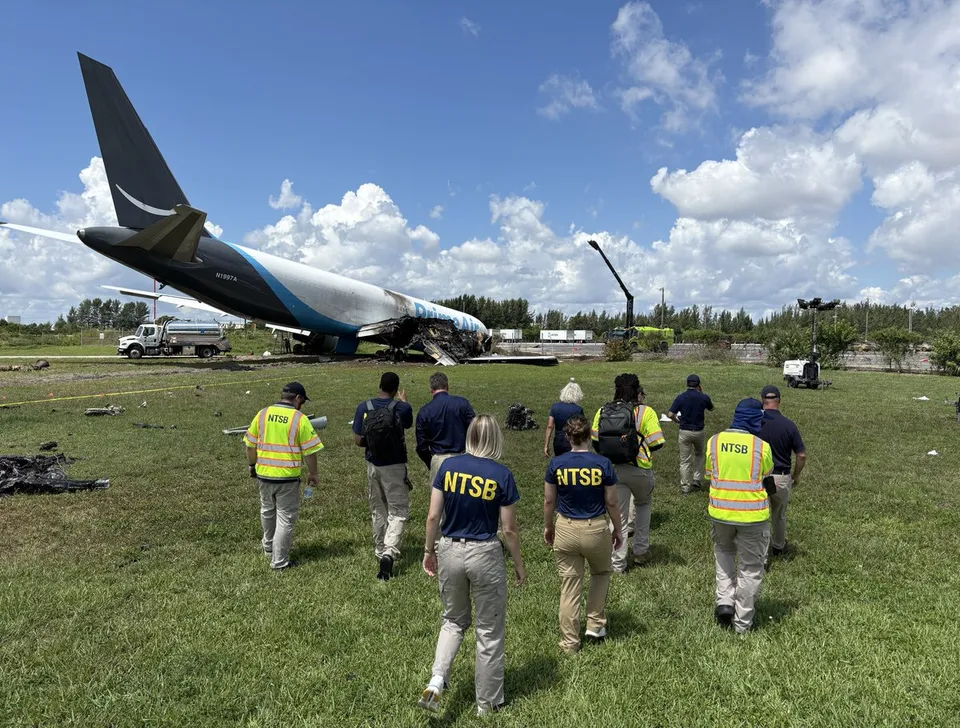
NTSB investigators examining the wreckage field of 21 Air Flight 7598 at Miami.

Investigators at the Flight 7598 accident scene in Miami, September 2026.

Photo: National Transportation Safety Board, Public domain, NTSB staff work

Image info

Courtesy: National Transportation Safety Board.

NTSB investigators at the actual Miami accident scene. This photograph records the aftermath, not the overrun itself, and does not establish the cause.

Image source / Original agency release

Resized and WebP recompressed without cropping or content alteration. Banner and homepage use a display crop; the full photograph below is uncropped.

The banner uses a display crop. This photograph is shown uncropped here. It does not by itself establish the cause.

What happened

On 6 September 2026, a 21 Air Boeing 767 carrying cargo for Amazon landed on Miami International Airport's runway 30. The latest preliminary report places its initial touchdown about 3,750 feet beyond the threshold, followed by an overrun at about 113 knots. The aircraft struck airport equipment, a passenger van and a separate sport utility vehicle before stopping beyond the airport boundary. Five van occupants died and three people on the ground suffered serious injuries. Both pilots survived with minor injuries. Recorder evidence documents speed concerns, warnings, an attempted go-around and no deployment of speed brakes or thrust reversers, but the NTSB has not yet determined probable cause.

Read the full incident

Investigation status

The preliminary evidence describes a late touchdown, continued high groundspeed, a brief increase to go-around thrust and an overrun. It does not yet establish the causes of the approach, crew decisions or lack of speed-brake and reverse-thrust deployment.

Sources for this section

NTSB DCA26MA352: Runway Overrun of 21 Air Flight 7598National Transportation Safety Board / preliminary / Updated 1 October 2026; ongoing status and September 9 recorder update

DCA26MA352 preliminary report: Event and investigationNational Transportation Safety Board / preliminary / PDF and printed page 1

DCA26MA352 preliminary report: History of flight, impacts and evacuationNational Transportation Safety Board / preliminary / PDF and printed page 2

DCA26MA352 preliminary report: Aircraft, operator and weatherNational Transportation Safety Board / preliminary / PDF and printed page 4

DCA26MA352 preliminary report: Runway and air traffic controlNational Transportation Safety Board / preliminary / PDF and printed page 5

DCA26MA352 preliminary report: Cockpit voice recorder sequenceNational Transportation Safety Board / preliminary / PDF and printed page 6

DCA26MA352 preliminary report: Flight data recorder and performanceNational Transportation Safety Board / preliminary / PDF and printed page 7

DCA26MA352 preliminary report: Wreckage examinationNational Transportation Safety Board / preliminary / PDF and printed page 10

DCA26MA352 preliminary report: Configuration and investigation statusNational Transportation Safety Board / preliminary / PDF and printed page 11

When is the 21 Air Flight 7598 final report due?

No final report has been published yet. NTSB (United States) is leading the investigation. It has been 1 month since the accident. Under ICAO Annex 13, a final report or an interim statement is due by each anniversary of the accident. The next anniversary is 6 September 2027.

Published so far: preliminary report.

See all pending air accident final reports

The full incident

1,668 words / about 8 minutes to read. The account is limited to the detail supported by the published evidence; missing sequences are not reconstructed.

A return cargo flight

Flight 7598 was the return leg of a day's flying between Miami and San Juan. The two pilots reported for duty at about 05:30 eastern daylight time on 6 September 2026 and flew the same Boeing 767 from Miami to Puerto Rico that morning. On that outward flight, the first officer flew while the captain monitored. It was the first time the two pilots had flown together. For the return service, those roles were reversed.

The cargo flight departed Luis Munoz Marin International Airport at approximately 11:24. Its destination was Miami International, and it was being operated by 21 Air on behalf of Amazon.com Services. The aircraft was N1997A, a Boeing 767-33 A originally manufactured as a passenger aircraft in 1994 and converted to a freighter in 2016. It had GE CF-6 engines and had accumulated about 110,077 flight hours and 24,505 cycles.

The distinction between Amazon's commercial service and the airline operating the airplane matters. The NTSB names 21 Air as the operator and Amazon as the company on whose behalf the cargo was being carried. The investigation examines the operator, crew, aircraft, airport and other relevant systems. A brand painted on an aircraft does not by itself describe responsibility for flight operations.

Sources for this section

DCA26MA352 preliminary report: Event and investigationNational Transportation Safety Board / preliminary / PDF and printed page 1

DCA26MA352 preliminary report: History of flight, impacts and evacuationNational Transportation Safety Board / preliminary / PDF and printed page 2

DCA26MA352 preliminary report: Aircraft, operator and weatherNational Transportation Safety Board / preliminary / PDF and printed page 4

Approaching runway 30

At about 13:49, the tower cleared Flight 7598 to land on runway 30. The aircraft was roughly 12 nautical miles from the runway's displaced threshold. Miami has four runways, and the airport diagram lists runway 12/30 as 9,360 feet long and 150 feet wide. That published length includes the displaced threshold. Blast pads beyond the runway are not part of the usable runway length, and there was no engineered materials arresting system at the runway 30 end.

Weather observations around the landing described thunderstorms, changing wind and gusts. At 13:50, the airport's automated data recorded wind from 190 degrees at 16 knots, gusting to 24. The 13:53 observation reported 17 knots from the same direction, gusting to 26, with visibility of at least ten statute miles. The preliminary report documents these conditions without yet assigning their role in the overrun.

The controller did not provide wind information with the landing clearance. The preliminary report notes that FAA procedures require wind direction and speed when authorizing runway use where a tailwind component exists. About four minutes earlier, the controller had passed wind information to another aircraft, but Flight 7598 was not then on that frequency. This is a documented element for investigation, rather than a completed finding that it caused the accident.

Sources for this section

DCA26MA352 preliminary report: History of flight, impacts and evacuationNational Transportation Safety Board / preliminary / PDF and printed page 2

DCA26MA352 preliminary report: Aircraft, operator and weatherNational Transportation Safety Board / preliminary / PDF and printed page 4

DCA26MA352 preliminary report: Runway and air traffic controlNational Transportation Safety Board / preliminary / PDF and printed page 5

Concerns on the cockpit recording

The voice recorder preserved the approach and landing. About six minutes before its recording ended, the captain called for flaps to be set to one degree. Further flap calls and landing-gear extension followed as the aircraft neared the airport. At approximately one minute and 42 seconds before the end, the captain called for 20 degrees of flap and the first officer cautioned that they were too fast.

The first officer continued to comment on excessive speed during the remaining recording. The preliminary report says there was not a consistent verbal response to those comments. It also lists automatic sink-rate and terrain warnings and a later call for more flap. These recorded observations establish what was heard in the cockpit. They do not establish the pilots' private reasoning or every action that occurred between the listed events.

The cockpit voice and flight data records provide different kinds of evidence. One records voices and sounds; the other records aircraft parameters. Their short timelines were initially published before the clocks had been precisely synchronized. The fuller preliminary report combines the available information with runway marks and other evidence, but still calls the resulting sequence preliminary. Relative seconds from an earlier update should therefore not be presented as perfectly synchronized absolute times.

The September 9 update separately reported nose and right main gear contact at 158 knots groundspeed, with left main gear contact later at 134 knots. These were preliminary FDR observations. The fuller October report gives about 160 knots for initial touchdown. The figures should retain their source dates rather than be treated as interchangeable measurements.

Sources for this section

DCA26MA352 preliminary report: Cockpit voice recorder sequenceNational Transportation Safety Board / preliminary / PDF and printed page 6

DCA26MA352 preliminary report: Flight data recorder and performanceNational Transportation Safety Board / preliminary / PDF and printed page 7

NTSB DCA26MA352: Runway Overrun of 21 Air Flight 7598National Transportation Safety Board / preliminary / Updated 1 October 2026; ongoing status and September 9 recorder update

A touchdown far along the runway

ADS-B and flight data placed the aircraft about 105 feet above ground and at a groundspeed of 177 knots as it crossed the runway threshold. Initial touchdown followed approximately 13 seconds later. The NTSB's preliminary reconstruction puts it around 3,750 feet beyond the threshold at about 160 knots groundspeed. Investigators also found tire contact marks approximately 3,750 and 3,820 feet from the approach threshold.

Groundspeed is the speed of the aircraft over the ground. It should not be casually substituted for airspeed or compared with a landing reference speed without accounting for the wind and aircraft configuration. The preliminary data demonstrate how quickly the aircraft was using the available runway; the detailed performance study remains part of the investigation.

The recorded weight-on-wheels indication changed between air and ground for about seven seconds. It then indicated ground for the rest of the recording, when approximately 2,730 feet of runway remained. Wheel braking began at about 146 knots groundspeed. Neither the speed brakes nor the thrust reversers deployed during the landing and subsequent rollout, according to the flight data. Those are significant observations, but the report does not yet explain why those systems were not used.

Sources for this section

DCA26MA352 preliminary report: History of flight, impacts and evacuationNational Transportation Safety Board / preliminary / PDF and printed page 2

DCA26MA352 preliminary report: Flight data recorder and performanceNational Transportation Safety Board / preliminary / PDF and printed page 7

A brief go-around command

About eight seconds after braking began, the brake pedals were released at a groundspeed of approximately 120 knots. Both engines' recorded throttle resolver angles increased to values corresponding to go-around thrust. Only about 930 feet of runway remained. The voice recorder also captured the captain calling for a go-around late in the rollout.

Approximately four seconds later, the engine commands returned to idle and wheel braking was applied again. The aircraft was traveling at about 117 knots and had roughly 415 feet of runway remaining. It continued beyond the runway end at about 113 knots. These measurements show that the airplane did not become established in another climb before leaving the available paved runway.

The NTSB has not yet issued a performance finding about the feasibility of stopping or becoming airborne at each point in this sequence. It would be misleading to add a definite statement that a particular decision guaranteed a particular outcome. The recorded changes establish what the aircraft did and when; the performance analysis will help explain the remaining margins and the effects of configuration, wind, braking and thrust.

Sources for this section

DCA26MA352 preliminary report: Cockpit voice recorder sequenceNational Transportation Safety Board / preliminary / PDF and printed page 6

DCA26MA352 preliminary report: Flight data recorder and performanceNational Transportation Safety Board / preliminary / PDF and printed page 7

Beyond the airport boundary

The aircraft struck the localizer and approach-light equipment at the northwest end of the runway at approximately 100 knots. It continued from the paved surface onto grass. Before reaching the airport perimeter fence, it hit a Ford Econoline passenger van traveling on a perimeter road. The van carried seven people. Five died and two suffered serious injuries.

Flight 7598 then struck the perimeter fence and crossed NW 67 th Avenue, a public road. There it hit a Toyota Corolla Cross carrying one person, who was seriously injured. The last recorded groundspeed was 65 knots shortly after the aircraft struck the fence and crossed the road. It continued through another fence and stopped near a parking lot approximately 1,200 feet beyond the paved surface.

The two ground vehicles explain the casualty total. This was not an overrun whose consequences were confined to the aircraft. The pilots survived with minor injuries, while five people on the ground died and three others on the ground were seriously injured. Describing only the survival of the crew would omit the people who bore the worst consequences.

Sources for this section

DCA26MA352 preliminary report: Event and investigationNational Transportation Safety Board / preliminary / PDF and printed page 1

DCA26MA352 preliminary report: History of flight, impacts and evacuationNational Transportation Safety Board / preliminary / PDF and printed page 2

Escape, fire and physical evidence

The captain left through door 1L and the first officer escaped through the right cockpit window. The tower activated the airport alert system at about 13:53. Miami-Dade Fire Rescue responded with five aircraft rescue and firefighting units, and further mutual-aid resources were dispatched. The airplane sustained substantial damage, including a postcrash fire involving the right wing.

Investigators found the main landing gear extended and locked, while the nose gear had been displaced beneath the aircraft. All eight main-wheel brake wear pins indicated remaining service life. The right wing showed major thermal damage, and the right engine was partly separated and damaged by heat. These observations help document the wreckage but should not be turned into a complete conclusion about pre-impact system condition.

The flap lever was found at the 25-degree detent, and physical measurements of the flap and slat mechanisms were consistent with that setting. This differs from the voice-recorded call for 30 degrees. The distinction is worth preserving: a recorded instruction is not proof that the requested configuration was reached. Likewise, the position of a lever found after an accident needs to be interpreted with the rest of the evidence.

Sources for this section

DCA26MA352 preliminary report: History of flight, impacts and evacuationNational Transportation Safety Board / preliminary / PDF and printed page 2

DCA26MA352 preliminary report: Wreckage examinationNational Transportation Safety Board / preliminary / PDF and printed page 10

DCA26MA352 preliminary report: Configuration and investigation statusNational Transportation Safety Board / preliminary / PDF and printed page 11

What remains under investigation

The NTSB recovered both flight recorders and assembled specialist groups covering the aircraft structure and systems, engines, flight operations, human performance, air traffic control, the airport and survival factors. The voice recorder contained about two hours and four minutes of audio, while the flight recorder held approximately 54 hours spanning 16 flights and more than 400 parameters.

The September 9 update identifies an Acron Aviation FA2100 voice recorder and an Ontic SSFDR flight data recorder. Both were successfully read out at the NTSB's Vehicle Recorder Laboratory in Washington, DC. The voice recording had four channels of good-quality audio.

The public preliminary report provides an unusually detailed sequence for a recent accident, but it is not a probable-cause report. The crew's approach management, the wind information, aircraft performance and the reasons for the recorded actions require further analysis. Its facts support a chronological account without supporting a final allocation of fault.

The investigation parties include the FAA, Boeing, GE Aerospace, 21 Air, Miami-Dade Aviation Department, National Air Traffic Controllers Association and 21 Air Pilots Association. Their participation does not constitute a finding about responsibility for the accident.

As of 5 October 2026, the official investigation page still describes the case as ongoing. This account follows the preliminary report linked by the NTSB on 1 October and distinguishes the observed sequence from explanations that have not yet been adopted. A later factual update or final report may refine both the measurements and the interpretation.

Sources for this section

DCA26MA352 preliminary report: Event and investigationNational Transportation Safety Board / preliminary / PDF and printed page 1

DCA26MA352 preliminary report: Flight data recorder and performanceNational Transportation Safety Board / preliminary / PDF and printed page 7

DCA26MA352 preliminary report: Configuration and investigation statusNational Transportation Safety Board / preliminary / PDF and printed page 11

NTSB DCA26MA352: Runway Overrun of 21 Air Flight 7598National Transportation Safety Board / preliminary / Updated 1 October 2026; ongoing status and September 9 recorder update

Return to the short summary

Sequence of events

Times are shown only where the cited source establishes them. Untimed stages are ordered by the documented sequence.

  1. 11:24 EDTDeparture from San Juan

    The return cargo flight departed SJU with the captain flying and first officer monitoring.

    Sources for this section

    DCA26MA352 preliminary report: History of flight, impacts and evacuationNational Transportation Safety Board / preliminary / PDF and printed page 2

  2. 13:49 EDTClearance to runway 30

    The aircraft was cleared to land while about 12 nautical miles from the displaced threshold.

    Sources for this section

    DCA26MA352 preliminary report: History of flight, impacts and evacuationNational Transportation Safety Board / preliminary / PDF and printed page 2

  3. Final approachSpeed concerns recorded

    The first officer repeatedly commented on excessive speed; the recorder also captured sink-rate and terrain warnings.

    Sources for this section

    DCA26MA352 preliminary report: Cockpit voice recorder sequenceNational Transportation Safety Board / preliminary / PDF and printed page 6

  4. TouchdownAbout 3,750 feet beyond threshold

    The preliminary reconstruction places initial contact at about 160 knots groundspeed.

    Sources for this section

    DCA26MA352 preliminary report: History of flight, impacts and evacuationNational Transportation Safety Board / preliminary / PDF and printed page 2

    DCA26MA352 preliminary report: Flight data recorder and performanceNational Transportation Safety Board / preliminary / PDF and printed page 7

  5. Late in rolloutGo-around thrust then renewed braking

    The brakes were released and engine commands increased with about 930 feet remaining, then thrust returned to idle and braking resumed.

    Sources for this section

    DCA26MA352 preliminary report: Flight data recorder and performanceNational Transportation Safety Board / preliminary / PDF and printed page 7

  6. About 13:53 EDTOverrun and ground impacts

    The aircraft crossed the runway end at about 113 knots, hit two vehicles and stopped about 1,200 feet beyond the paved surface.

    Sources for this section

    DCA26MA352 preliminary report: History of flight, impacts and evacuationNational Transportation Safety Board / preliminary / PDF and printed page 2

    DCA26MA352 preliminary report: Flight data recorder and performanceNational Transportation Safety Board / preliminary / PDF and printed page 7

Sequence overview

Documented stages in reading order. This overview does not imply a settled chain of causes.

  1. Departure from San Juan

    The return cargo flight departed SJU with the captain flying and first officer monitoring.

    Sources for this section

    DCA26MA352 preliminary report: History of flight, impacts and evacuationNational Transportation Safety Board / preliminary / PDF and printed page 2

  2. About 3,750 feet beyond threshold

    The preliminary reconstruction places initial contact at about 160 knots groundspeed.

    Sources for this section

    DCA26MA352 preliminary report: History of flight, impacts and evacuationNational Transportation Safety Board / preliminary / PDF and printed page 2

    DCA26MA352 preliminary report: Flight data recorder and performanceNational Transportation Safety Board / preliminary / PDF and printed page 7

  3. Overrun and ground impacts

    The aircraft crossed the runway end at about 113 knots, hit two vehicles and stopped about 1,200 feet beyond the paved surface.

    Sources for this section

    DCA26MA352 preliminary report: History of flight, impacts and evacuationNational Transportation Safety Board / preliminary / PDF and printed page 2

    DCA26MA352 preliminary report: Flight data recorder and performanceNational Transportation Safety Board / preliminary / PDF and printed page 7

Geographic context

Geographical orientation for 21 Air Flight 7598San Juan (SJU), departure airport; Miami (MIA), destination airport. Approximate airport reference positions, for geographic orientation only. Markers do not show the recorded flight track or exact impact position.12NORTH UP / SCHEMATIC / NOT A RECORDED FLIGHT TRACK
  1. San Juan (SJU), departure airport
  2. Miami (MIA), destination airport
Approximate airport reference positions, for geographic orientation only. Markers do not show the recorded flight track or exact impact position. Basemap: Natural Earth, public domain.
Sources for this section

NTSB DCA26MA352: Runway Overrun of 21 Air Flight 7598National Transportation Safety Board / preliminary / Updated 1 October 2026; ongoing status and September 9 recorder update

DCA26MA352 preliminary report: Event and investigationNational Transportation Safety Board / preliminary / PDF and printed page 1

DCA26MA352 preliminary report: History of flight, impacts and evacuationNational Transportation Safety Board / preliminary / PDF and printed page 2

DCA26MA352 preliminary report: Aircraft, operator and weatherNational Transportation Safety Board / preliminary / PDF and printed page 4

DCA26MA352 preliminary report: Runway and air traffic controlNational Transportation Safety Board / preliminary / PDF and printed page 5

DCA26MA352 preliminary report: Cockpit voice recorder sequenceNational Transportation Safety Board / preliminary / PDF and printed page 6

DCA26MA352 preliminary report: Flight data recorder and performanceNational Transportation Safety Board / preliminary / PDF and printed page 7

DCA26MA352 preliminary report: Wreckage examinationNational Transportation Safety Board / preliminary / PDF and printed page 10

DCA26MA352 preliminary report: Configuration and investigation statusNational Transportation Safety Board / preliminary / PDF and printed page 11

Questions readers ask

Were the deaths aboard the cargo aircraft?

No. Both pilots survived with minor injuries. Five occupants of a ground van died; two others in that van and the sole occupant of a separate SUV suffered serious injuries.

Sources for this section

DCA26MA352 preliminary report: Event and investigationNational Transportation Safety Board / preliminary / PDF and printed page 1

DCA26MA352 preliminary report: History of flight, impacts and evacuationNational Transportation Safety Board / preliminary / PDF and printed page 2

Did the aircraft use reverse thrust?

The preliminary flight-data review found that thrust reversers and speed brakes did not deploy during the landing and rollout. The NTSB has not yet explained why.

Sources for this section

DCA26MA352 preliminary report: Flight data recorder and performanceNational Transportation Safety Board / preliminary / PDF and printed page 7

Has the NTSB determined the cause?

No. The investigation remains ongoing. The published report is preliminary and its observations are subject to change.

Sources for this section

NTSB DCA26MA352: Runway Overrun of 21 Air Flight 7598National Transportation Safety Board / preliminary / Updated 1 October 2026; ongoing status and September 9 recorder update

DCA26MA352 preliminary report: Configuration and investigation statusNational Transportation Safety Board / preliminary / PDF and printed page 11

Classifications, with reasons

Initiating eventLate touchdown

The preliminary reconstruction places initial contact at about 160 knots groundspeed.

Sources for this section

DCA26MA352 preliminary report: History of flight, impacts and evacuationNational Transportation Safety Board / preliminary / PDF and printed page 2

DCA26MA352 preliminary report: Flight data recorder and performanceNational Transportation Safety Board / preliminary / PDF and printed page 7

What the evidence can and cannot establish

Recorder synchronization

The initial September update warned that the CVR and FDR relative timelines had not been precisely synchronized.

Sources for this section

NTSB DCA26MA352: Runway Overrun of 21 Air Flight 7598National Transportation Safety Board / preliminary / Updated 1 October 2026; ongoing status and September 9 recorder update

Safety follow-up

A recommendation does not establish implementation. Actions are described at the dates of the linked records.

Detailed preliminary report

The official overview was updated on 1 October 2026 with a 12-page preliminary report documenting the approach, runway marks, recorder data and vehicle impacts.

Sources for this section

NTSB DCA26MA352: Runway Overrun of 21 Air Flight 7598National Transportation Safety Board / preliminary / Updated 1 October 2026; ongoing status and September 9 recorder update

Aircraft performance study

The NTSB plans to combine recorder and engineering data to refine the sequence and analyze the aircraft's physical state during approach and landing.

Sources for this section

DCA26MA352 preliminary report: Flight data recorder and performanceNational Transportation Safety Board / preliminary / PDF and printed page 7

Read alongside

Related subjects for further reading. These links do not imply identical causes.

American Airlines Flight 1420: Runway overrun

Lufthansa Flight 2904: Runway overrun

Search the investigation evidence

Search the indexed investigation documents. Their preliminary or final status is shown with the results. Other statements linked below may not be indexed.

Sources and transparency

Source status checked on 5 October 2026. This account has not undergone independent expert review. Official statements, interim documents and final findings are labelled separately.

NTSB DCA26MA352: Runway Overrun of 21 Air Flight 7598

National Transportation Safety Board / preliminary

Open original source. Specific page references appear with the supporting sections above.

DCA26MA352 preliminary report: Configuration and investigation status

National Transportation Safety Board / preliminary

Open original source. Specific page references appear with the supporting sections above.

Links open the publisher's original records. Source copyright and reuse terms apply.

Sources and methodology

Editorial record

Kevin Murphy writes the incident accounts on AirlineIncidents.com, out of a long interest in aviation safety and the lessons each investigation leaves behind.

Prepared by AirlineIncidents editorial desk. Published 5 October 2026 from the sources linked above. Later documents may revise earlier factual accounts.
Suggest a source-based correction

Indexed source versions

DCA26MA352, 21 Air Flight 7598 preliminary report

preliminary investigation report. Retrieved 5 October 2026. 12 PDF pages; 11,492,241 bytes.

File fingerprint (SHA-256). It identifies the exact version of the report this page was checked against.

bf68aea8007604c55b0603d15bb6db9c689c17c2ad40a291a0c57de422162993