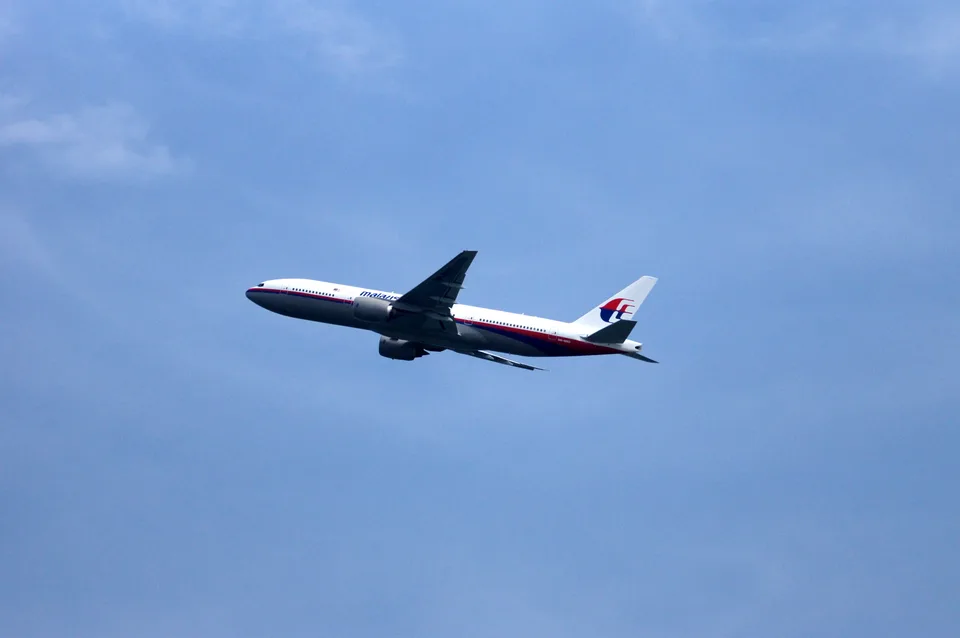
Original photograph retained. Responsive derivatives use the same CC BY-SA 3.0 licence. Responsive WebP copies resized without cropping.
Geographic context
Kuala Lumpur departure
Beijing intended destination
Approximate airport markers for the planned route, not the aircraft's actual track or a crash location. Basemap: Natural Earth, public domain.Read supporting evidence
MH370 lost routine communications near the transfer from Malaysian to Vietnamese air traffic control. Radar reconstruction showed a return across Malaysia; satellite exchanges supported a later flight towards the southern Indian Ocean. Confirmed debris did not resolve the cause.
Read the full incident Follow what happened, from the flight to the investigation findings.
What investigators concluded
The Malaysian investigation team was unable to determine the real cause of the disappearance. Manual inputs were considered likely, but the operator of those inputs, motive and final sequence were not established.
A disappearance reconstructed from incomplete evidence
1,561 words / about 8 minutes to read. Based on the investigation records cited below.
A scheduled departure and a routine handover
Malaysia Airlines flight MH370 departed Kuala Lumpur for Beijing during the early hours of 8 March 2014 in Malaysia. In the UTC convention used by the report, departure occurred on 7 March at about 16:42. This distinction matters because the flight crossed midnight in local time before it disappeared. The Boeing 777-200ER, registered 9M-MRO, carried 227 passengers and twelve crew members. The 2018 safety investigation begins with a scheduled international passenger service whose dispatch and initial radio contacts followed an ordinary sequence.
The captain had ordered 49,100 kilograms of fuel. The computerised flight plan gave an endurance of seven hours and 31 minutes, including reserves, against a planned flight duration of five hours and 34 minutes. The first officer was completing the last phase of line training on the Boeing 777 after transitioning from the Airbus A330. The report states that he was assigned as pilot flying and had already been certified functional, so an additional safety pilot was not required. Those details describe preparation and crew roles without supplying an explanation for what followed.
After takeoff clearance, the aircraft received instructions to climb and track directly to IGARI. Successive clearances took it to flight level 350, which it reported maintaining. At 17:19:26 UTC, Kuala Lumpur instructed the flight to contact Ho Chi Minh control. Four seconds later, MH370 acknowledged the instruction. That acknowledgement was the last recorded radio transmission from the aircraft. The report did not detect evidence of anxiety or stress in the routine communications. Nothing in these exchanges establishes what later happened inside the flight deck.
The surveillance picture separates from the planned flight
The secondary surveillance picture disappeared shortly after the handover instruction. The last secondary radar position was recorded at 17:21:13 UTC. The final ACARS transmission had occurred earlier, at 17:07:29 UTC, through the satellite communications system. These are separate observations from different systems. Their cessation did not provide a recorded reason for the communications loss. A disappeared transponder return also did not mean that every radar could no longer detect the aircraft, because primary radar could still record reflected energy without an identifying reply.
Military radar and civilian primary radar supplied evidence of a return towards Malaysia. The reconstructed track initially turned slightly right, then left, crossed the peninsula and later headed northwest. The military tracking ended at 18:22:12 UTC, beyond waypoint MEKAR. The investigation used continuity, track behaviour and other characteristics to associate the return with MH370. It also examined the turn in simulator trials. The team's conclusion was that the turn back was likely made under manual control rather than by the autopilot. That inference did not identify the person controlling the aircraft or establish intent.
The report gives a substantial warning about the military radar record. Some displayed speed and altitude changes were beyond the aircraft's capabilities, and the extracted values were subject to inherent error. Latitude and longitude were considered reasonably accurate. It is therefore inappropriate to turn every listed radar height into a dramatic descent or climb in the narrative. The useful result was a broad geographical reconstruction of the diversion. It was not a complete, reliable recording of the aircraft's attitude, altitude, cockpit inputs or the conditions experienced by its occupants.
At 17:39:06 UTC, Ho Chi Minh control asked Kuala Lumpur about MH370's whereabouts. Kuala Lumpur contacted the airline's operations centre. Other control centres were also approached, but these enquiries did not establish radio contact with the flight. The Kuala Lumpur Aeronautical Rescue Coordination Centre was activated at 21:30 UTC. The investigation found no evidence that Ho Chi Minh control activated its own rescue coordination centre. These documented delays form an important part of the safety investigation even though they do not explain the original diversion.
The report concluded that the accepting control centre had not notified Kuala Lumpur when two-way communication failed to develop within the specified handover interval. Kuala Lumpur, in turn, should have acted to contact Ho Chi Minh control rather than relying on aircraft position information supplied by the airline's flight operations. Both centres failed to initiate the required emergency phases, delaying alerting and search and rescue activation. The distinction is essential: these are findings about the response to a missing aircraft, not proof that the delay caused the aircraft to disappear.
The military had recognised the primary radar return as MH370 and regarded it as friendly, so it did not pursue an interception. Civil and military observations subsequently helped reconstruct the event, but they did not restore communication with the crew. The investigation's account shows how pieces of information could exist in different organisations without producing a timely, shared operational picture. Its recommendations on coordination, flight following and tracking address that safety problem. They cannot retrospectively establish whether any particular intervention would have changed the aircraft's final outcome.
Satellite exchanges extend the evidence beyond radar
Satellite communications evidence indicated that the aircraft remained airborne for more than seven hours. The report used the final seven satellite handshakes to help establish an approximate path over the Indian Ocean. A handshake was an exchange between the aircraft communications equipment and the satellite system, not a cockpit voice message or a position report containing a complete flight track. The resulting reconstruction supplied constraints on where the aircraft could have been. It did not reveal who was flying, what the passengers experienced or why the aircraft had left its route.
The team recorded that a satellite link was available from 18:25 UTC on 7 March until 00:11 UTC on 8 March, although it was not used for voice, ACARS or other data services apart from two unanswered ground-to-air telephone calls. The aircraft initiated log-ons at 18:25 and 00:19 UTC. The report considered interruptions of electrical power to the satellite avionics the most likely explanation. For the earlier interruption, it suggested power-bus cycling while leaving the reason unknown. Those carefully qualified statements should remain qualified when translated into a reader's account.
For the final log-on, the team considered low fuel, loss of the engines and their electrical generators, and a temporary supply from the auxiliary power unit a probable sequence. This was an inference from available communications and aircraft-system evidence. It was not a recovered recorder trace showing both engines stopping. The long duration also suggested that the autopilot, at least in basic modes, and substantial parts of the electrical system probably remained functional. The evidence supported a prolonged flight, while leaving major questions about its management and end unresolved.
Debris establishes damage but leaves the final sequence open
By the report's 2018 edition, the main wreckage had not been located despite an extended search in the southern Indian Ocean. Debris had washed ashore along parts of eastern and southern Africa and on islands in the region. The report identified a flaperon, part of the right outboard flap and a section of the left outboard flap as confirmed MH370 components. Other items received different levels of identification confidence. These distinctions prevent a loose reference to all recovered material as if every object had equally secure provenance.
Examination suggested that the right outboard flap was most likely retracted and that the flaperon was probably near its neutral position when they separated from the wing. Cabin interior debris suggested likely breakup. However, the available damage did not establish whether the aircraft broke up in flight or during impact with the ocean. Beyond those limited deductions, the team could not infer additional in-flight emergencies, configuration or impact details from the debris. A component condition is therefore not a complete reconstruction of the final moments.
The injuries section stated that no survivors or bodies had been found and that injuries could not be established. It recorded 239 people still missing. This account preserves that report-era formulation instead of presenting an independently verified fatality count. The missing main wreckage also prevented examination of damage elsewhere on the aircraft. Without the recorders and the remaining structure, investigators lacked the evidence that ordinarily connects a flight's final trajectory to aircraft systems, crew actions and the sequence of destruction.
The team found that the aircraft had been released as airworthy and that the crew held valid licences and medical certification. It identified no recorded aircraft defect that could explain the event, while also saying that the absence of physical evidence prevented a conclusive exclusion of aircraft or system malfunction. The report considered manual inputs a likely explanation for the route changes. It did not establish whether anyone other than the pilots flew the aircraft. Nor did the possibility of third-party intervention amount to a finding that such intervention occurred.
Its safety recommendations covered surveillance, coordination, flight following, medical and training records, cargo security and emergency location. Malaysia Airlines was asked to ensure suitably trained flight-following staff and upgrade towards global real-time tracking. ICAO was asked to review emergency locator effectiveness and ways of determining the location of an aircraft entering water. These recommendations were directed at identified vulnerabilities in the aviation system. Their presence should not be used to infer that cargo, medical factors or any other recommendation subject was established as the cause.
The report's central conclusion remained that the real cause of MH370's disappearance could not be determined. The documented route changes, prolonged flight and recovered debris narrowed the factual picture without resolving the explanation. That is the appropriate endpoint for a report-based account. This draft describes the evidence available to the 2018 team and its stated uncertainties. It does not claim a present search outcome, assign responsibility to an individual or complete the missing final sequence through speculation.
No. It could not establish whether anyone other than the pilots flew the aircraft. A possibility that cannot be excluded is not an identified perpetrator.
ICAO was asked to review emergency locator effectiveness and ways to locate aircraft entering water. This is a recommendation, not proof of present implementation.
Matching dossiers for Surveillance and alerting: No other dossier in this collection.
Read alongside
These comparisons connect specific research topics. Shared circumstances do not establish identical causes. Evidence from both investigations is provided below.
Both MH370 and Air France 447 raised questions about evidence from remote oceanic accidents. MH370's report lacked the recorders and could not determine a cause; the BEA's recovered recordings supported specific AF447 training and operational findings. A shared difficulty in obtaining evidence does not make their mechanisms the same.
Explore the records below for additional context. They open on the publisher's site and are not all included in our report search. Source reuse terms apply.
2018 investigation report, chronology, analysis, conclusions and recommendations.
Sources and transparency
Checked against cached official report pages and specified official comments. No independent expert review.
Source limitations
The 2018 report could not determine the cause, locate the main wreckage or establish injuries. This account reflects that edition, not present search status.
Safety Investigation Report MH370/01/2018
Malaysian ICAO Annex 13 Safety Investigation Team for MH370 Issued 2 July 2018, released 30 July 2018
Private evidence cache. Only short attributed quotations in original commentary; full report and third-party illustrations are not redistributed. Source terms / provenance.
Final Report: Accident on 1st June 2009 to the Airbus A330-203 registered F-GZCP operated by Air France flight AF 447
Bureau d'Enquetes et d'Analyses (BEA) English final report, 5 July 2012
Limited quotations for source-based commentary. Full report and illustrations are not republished. Wider reuse requires checking BEA terms. Source terms / provenance.
Kevin Murphy writes the incident accounts on AirlineIncidents.com, out of a long interest in aviation safety and the lessons each investigation leaves behind.
Prepared by
AirlineIncidents editorial desk
Report citation check
Independent expert review
Not completed
Citation checks compare supporting text with the indexed report pages. They do not constitute independent expert review. How these pages are prepared.
Revision history
: Private landmark Wave 1 original account; final report and specified comments cited.