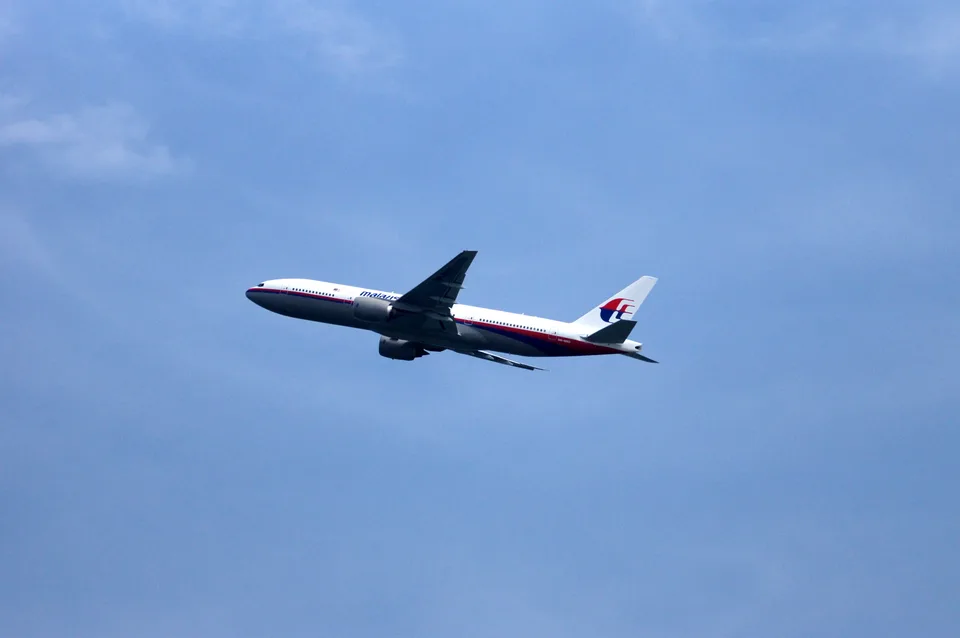
This is 9M-MRO, a different aircraft from MH17's 9M-MRD. The earlier photograph illustrates the operator and aircraft type; it is unrelated to the MH17 accident and depicts no aftermath.
Original photograph retained. Responsive derivatives use the same CC BY-SA 3.0 licence. Responsive WebP copies resized without cropping.
Geographic context
Amsterdam departure
Kuala Lumpur intended destination
Approximate airport markers for the intended route, not an accident flight track or navigation chart. Basemap: Natural Earth, public domain.Read supporting evidence
MH17 was cruising at flight level 330 over eastern Ukraine when a warhead detonated above and to the left of its cockpit. High-energy fragments and blast damaged the forward structure, initiating in-flight breakup. All 298 occupants died.
Read the full incident Follow what happened, from the flight to the investigation findings.
What investigators concluded
The Dutch Safety Board identified a 9N314M warhead carried by a 9M38-series missile as installed on the Buk system. It also found systemic weaknesses in assessing and restricting conflict-zone airspace.
1,557 words / about 8 minutes to read. Based on the investigation records cited below.
Departure and the route towards Ukraine
Malaysia Airlines flight MH17 departed Amsterdam Schiphol on 17 July 2014 for Kuala Lumpur. The Boeing 777-200, registered 9M-MRD, had arrived from Malaysia earlier that morning and was serviced and prepared for its return journey. It left the gate at 10:13 UTC, thirteen minutes later than planned, and took off from runway 36C at 10:31. There were 283 passengers and fifteen crew members aboard, including four flight crew members and eleven cabin crew. The Dutch Safety Board found the aircraft airworthy and its crew competent and qualified.
Before departure, the crew received an operational flight plan, air traffic control flight plan information, notices to airmen, loading data and weather information. The route crossed Germany and Poland before entering Ukraine, then was intended to continue across the Russian Federation and onward towards Malaysia. The planned cruise involved stepped climbs. The aircraft reached flight level 330 before the part of the route where the accident occurred. These details establish a scheduled passenger operation whose initial progress followed the filed route and ordinary control procedures.
The investigation later separated two questions that are easily confused: how the aircraft was destroyed, and why an airline flight was operating over an armed conflict. Its first part examined the flight, wreckage, recorders and physical mechanism. Its second part examined decisions about airspace and routes. Neither task was a determination of criminal responsibility. The report expressly excluded questions of blame and liability from its purpose. This account follows that boundary and attributes the weapon finding to the Board without adding a perpetrator or a later legal conclusion.
At about 12:53 UTC, MH17 entered Dnipropetrovsk control airspace at flight level 330. The controller asked whether the aircraft could climb to flight level 350. The crew replied that it wished to remain at its present level, without giving a specific reason in the exchange. A second Boeing 777 was approaching from behind at the same level, creating a potential separation conflict. The controller resolved that situation by clearing the other aircraft to climb. The Board regarded MH17's decision to remain at its altitude as a normal operational consideration.
At 13:00, the crew requested a deviation to the north to avoid weather associated with cumulonimbus clouds. Control approved the track deviation but retained flight level 330 because of other civilian traffic. Recorded data showed that the aircraft moved about 6.5 nautical miles to the left of the original route centreline and then turned back. The crew received weather information before departure, and the actual weather was consistent with the forecast. The Board ultimately concluded that weather did not influence the crash.
After a sector transfer and a further small heading change, MH17 was almost back on its original course. At 13:19:56, the crew acknowledged clearance to fly directly to waypoint RND. It was the final radio transmission. The controller immediately supplied information about a subsequent expected direct clearance, but no acknowledgement followed. There had been no recorded system warning, failure or cockpit conversation indicating an emergency before the occurrence. The final normal communications therefore provide a clear boundary between routine operation and the abrupt destructive event.
At 13:20:03 UTC, a warhead detonated outside and above the left side of the cockpit. The Dutch Safety Board identified it as a 9N314M warhead carried on a 9M38-series missile as installed on the Buk surface-to-air missile system. The finding did not rest on the mere fact that an aircraft had fallen in a conflict zone. It arose from the pattern of fragment impacts, recovered objects, damage to the forward structure and analysis of how a detonation in that position would affect the aircraft.
The cockpit voice recorder captured a brief sound peak. Analysis located its origin outside the aircraft, above the left side of the cockpit, with the disturbance propagating rearwards. Both cockpit voice and flight data recordings ended abruptly. The recorders and radar supported straight and level flight until the destructive event. Damage and injuries showed impacts by numerous high-energy fragments from a common external direction. The Board found no known aircraft-system or engine failure pattern that could account for the observed forward fuselage and cockpit damage.
The fragment impacts killed the three people in the cockpit and damaged the aircraft's forward structure. That damage initiated in-flight breakup. The wreckage was dispersed over several sites near Hrabove, Rozsypne and Petropavlivka, covering about fifty square kilometres. Most of it lay in three sites southwest of Hrabove, while post-impact fires occurred at two sites. The report established that all 298 occupants died. It did not establish an exact ground-impact time for the whole disintegrating aircraft, which was no longer descending as a single intact structure.
Recovered foreign objects included fragments with cubic and bow-tie forms. The shapes, material and distribution were important because they could be compared with warhead fragmentation patterns. Investigators also examined suspected missile components, paint samples and explosive traces. Simulations tested whether the blast and fragment spray could reproduce the damage found on the aircraft. The Board brought these different lines of evidence together to identify the weapon mechanism rather than treating any single fragment as sufficient on its own.
Other possible explanations were examined and excluded on the available evidence. These included an onboard fire, a fuel tank explosion, an explosive device inside the aircraft, lightning and impact by space debris or a meteor. Air-to-air gunfire did not fit the number and forms of the perforations. The relevant air-to-air missiles did not contain the distinctive bow-tie fragments. The Board also found no evidence of another civil or military aircraft in MH17's direct vicinity. These exclusions belong to the investigation's physical analysis, not to speculation about competing stories.
Modelling identified an area of about 320 square kilometres from which a compatible missile flight could have produced the observed damage. That geographical constraint was not an identification of a launcher, firing team or individual. The report also treated survival evidence carefully. It established immediate fatal injuries to the cockpit occupants but could not fully reconstruct the experiences of everyone elsewhere in the aircraft after breakup. A responsible narrative therefore stops at the documented physical sequence rather than imagining passengers' thoughts, conversations or a uniform period of awareness.
The armed conflict in eastern Ukraine had expanded from ground fighting into the airspace. The Board examined reports of military aircraft being shot down and the implications of weapons capable of reaching civilian cruise levels. Restrictions were in place up to flight level 320, while MH17 was operating at flight level 330 in airspace that remained open. Compliance with that boundary did not provide protection against a weapon capable of engaging an aircraft at cruise altitude. The report found sufficient reason for a precautionary closure of the airspace over the conflict area.
The Board found that operators, states and other relevant parties did not identify the resulting risk adequately. Malaysia Airlines was among many airlines that continued using routes over the region. The report recorded 160 flights above eastern Ukraine on the day of the crash before the airspace was closed. This wider operational pattern mattered because the safety question was not limited to one captain's route choice. Open airspace had been treated as an indication of safety while the conflict and its weapon capabilities created a risk beyond the published lower-altitude restrictions.
The crew's decision to remain at flight level 330 instead of climbing to 350 did not change the missile system's ability to engage the aircraft, according to the Board. The weather deviation likewise did not cause the crash. These findings keep ordinary flight decisions separate from the larger airspace risk. The investigation did not turn hindsight into a claim that the crew could see or diagnose the impending attack. It examined how states and operators obtained, shared and assessed information before an airline aircraft entered a conflict zone.
The recommendations and the limits of this account
The Board organised its recommendations around three connected subjects: management of airspace in conflict zones, assessment of risk, and operator accountability. It sought clearer state responsibilities, earlier publication of specific threat information and a more active role for ICAO when a state faced difficulty fulfilling its airspace safety obligations. The proposals recognised that the sovereign state responsible for airspace might itself be involved in the conflict and that the international aviation system needed mechanisms to address the resulting vulnerability.
Operators were expected to make their own assessments rather than assume that unrestricted airspace was safe. The recommendations called for threat information to be shared in a timely, structured way and for uncertain or worsening factors to be included in risk analysis. They also sought clearer requirements through national regulations and industry audit standards. Public accountability for route choices was proposed as a way to improve transparency. These are report-era recommendations. Their inclusion here does not certify that every recommended measure has since been implemented or that current conflict-zone risks are adequately controlled.
The 2015 safety report establishes a specific destructive mechanism: an external Buk missile warhead detonation, fragment impacts and blast, forward structural damage and breakup. It also identifies weaknesses in the system that allowed civilian overflight of the conflict area. Those conclusions can be presented firmly while retaining their limits. This account does not determine who launched the weapon, import later criminal findings into the safety report or invent the final experiences of the occupants. It rests on the official report's physical evidence, operational record and clearly attributed safety conclusions.
Matching dossiers for Conflict-zone airspace: No other dossier in this collection.
Read alongside
These comparisons connect specific research topics. Shared circumstances do not establish identical causes. Evidence from both investigations is provided below.
MH17 and Air France 447 both required reconstruction from recorder data and recovered wreckage. MH17 involved external weapon damage and breakup; AF447 involved airspeed inconsistency and loss of control with training and operational findings. Their evidence methods can be compared, but their initiating mechanisms are different.
Explore the records below for additional context. They open on the publisher's site and are not all included in our report search. Source reuse terms apply.
Final report, October 2015, published 13 October 2015
Sources and transparency
Checked against cached official report pages and specified official comments. No independent expert review.
Source limitations
A safety investigation, not a criminal determination. The report identifies the weapon mechanism but does not assign blame or liability. Exact final experiences of the occupants are unresolved.
Crash of Malaysia Airlines flight MH17
Dutch Safety Board Final report, October 2015, published 13 October 2015
Private evidence cache. Only short attributed quotations in original commentary; full report and third-party illustrations are not redistributed. Source terms / provenance.
Final Report: Accident on 1st June 2009 to the Airbus A330-203 registered F-GZCP operated by Air France flight AF 447
Bureau d'Enquetes et d'Analyses (BEA) English final report, 5 July 2012
Limited quotations for source-based commentary. Full report and illustrations are not republished. Wider reuse requires checking BEA terms. Source terms / provenance.
Kevin Murphy writes the incident accounts on AirlineIncidents.com, out of a long interest in aviation safety and the lessons each investigation leaves behind.
Prepared by
AirlineIncidents editorial desk
Report citation check
Independent expert review
Not completed
Citation checks compare supporting text with the indexed report pages. They do not constitute independent expert review. How these pages are prepared.
Revision history
: Private landmark Wave 1 original account; final report and specified comments cited.