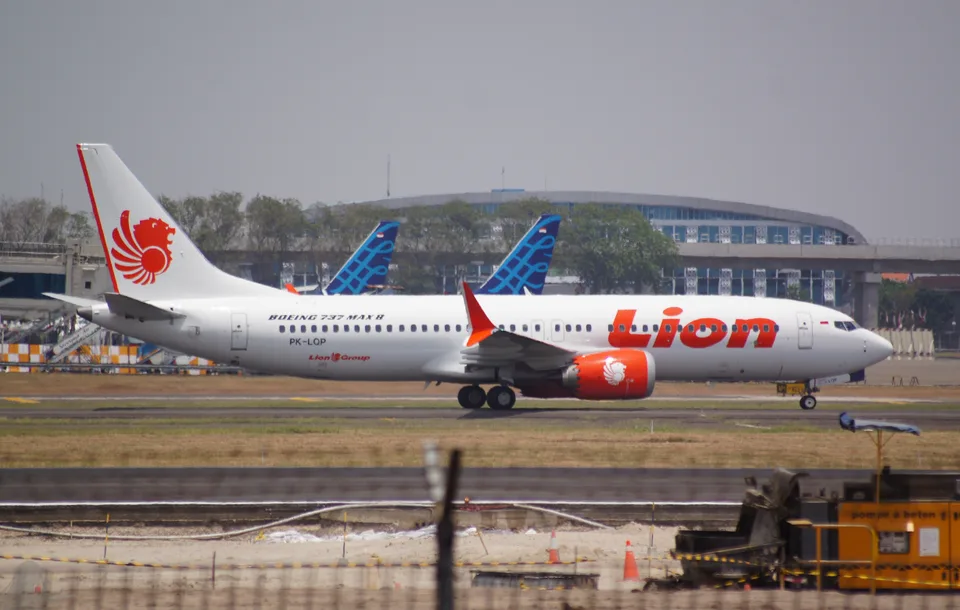
Earlier photograph of the accident aircraft, not evidence of cockpit indications or the sensor calibration. The Commons version was previously cropped vertically; this draft makes no further crop.
Downloaded Commons derivative, previously cropped by its contributor. Responsive copies retain CC BY-SA 2.0. Responsive WebP copies resized without cropping.
Geographic context
Jakarta departure
Pangkal Pinang destination
Approximate airport markers for the intended route, not an accident flight track or navigation chart. Basemap: Natural Earth, public domain.Read supporting evidence
Lion Air 610 departed Jakarta with 189 people. Erroneous angle-of-attack input generated warnings and MCAS nose-down trim commands. The crew repeatedly countered trim but did not identify and stop the runaway stabilizer sequence. The aircraft struck the sea.
Read the full incident Follow what happened, from the flight to the investigation findings.
What investigators concluded
KNKT identified interacting design, certification, maintenance, documentation and operational factors. It found MCAS vulnerable to one erroneous sensor and crew response assumptions inadequate.
1,589 words / about 8 minutes to read. Based on the investigation records cited below.
A fault passed from maintenance into service
The sequence behind Lion Air flight 610 began before its departure on 29 October 2018. On 26 October, speed and altitude flags had appeared on the captain's primary flight display during a flight from Tianjin to Manado. After recurring problems, maintenance replaced the left angle-of-attack sensor in Denpasar on 28 October. The new sensor carried a bias of about 21 degrees. The replacement therefore changed a component without removing the source of erroneous information. KNKT later identified both the sensor repair history and the failure to detect its miscalibration as contributing factors.
Angle of attack describes the relationship between the wing and the relative airflow. On this aircraft, an incorrect signal affected more than one cockpit indication. It also supplied the input used by the Maneuvering Characteristics Augmentation System, or MCAS. This feature had been introduced on the 737 MAX to adjust pitch characteristics in manual flight with flaps up at elevated angles of attack. Its reliance on a single sensor made an erroneous input capable of producing automatic stabilizer commands. The problem was therefore connected to the way aircraft information and automation used the sensor signal.
KNKT found that the sensor had been miscalibrated during an earlier repair and that the error had not been detected there. It could not determine that the later installation test was performed properly, and the error again remained undetected. That wording matters: the investigation established that the installed sensor was wrong, but did not establish every detail of the installation testing. The final report connected the resulting vulnerability with design and certification assumptions about how pilots would respond to malfunctions, rather than assigning the whole accident to a single maintenance task.
During the preceding flight from Denpasar to Jakarta, the erroneous left sensor generated conflicting airspeed and altitude indications, a feel-pressure warning, a continuous left stick shaker and MCAS activation. The stick shaker is a warning felt through the control column. Repeated automatic stabilizer movement made aircraft handling more difficult, but that crew stopped the repetitive MCAS activity by selecting stabilizer trim cutout. The flight continued to a landing in Jakarta. It provided an important opportunity for the emerging problem to be recognised before the aircraft flew again.
The crew reported some malfunctions after landing. However, its maintenance log entry did not include the continuous stick shaker or the use of the stabilizer cutout switches. KNKT concluded that this absence of documentation deprived both the maintenance crew in Jakarta and the accident crew of significant information. The missing details were operationally different from a generic disagreement between instruments: they described a continuing stall warning and a response to repeated uncommanded trim. Without them, the next people handling the aircraft lacked a fuller account of what had occurred.
The AOA DISAGREE alert was not available because it had not been correctly enabled during development. That missing alert could not be documented by the pilots and was unavailable to help maintenance identify the miscalibrated sensor. The report consequently treated information loss as a chain across design, flight reporting and troubleshooting. Successful landing on the earlier flight did not mean the aircraft's problem had been adequately resolved. Nor did it guarantee that another crew, confronting incomplete records and multiple warnings, would reproduce the same mitigation.
Flight 610 was a scheduled service from Jakarta Soekarno-Hatta to Depati Amir Airport at Pangkal Pinang. There were 189 people aboard: two pilots, six cabin crew and 181 passengers, including an engineer. KNKT noted a discrepancy in the weight-and-balance document, which listed 188 people, but the established onboard total was 189. The captain was pilot flying and the first officer pilot monitoring. The recorded preflight briefing covered the route, runway, weather and an unrelated deferred maintenance item. It did not record discussion of the earlier aircraft problem entered in the maintenance log.
The recorded takeoff sequence began at 23:20 UTC on 28 October, corresponding to the morning of 29 October locally. During the roll, the flight data recorder showed the difference between the two angle-of-attack signals. The left stick shaker activated as the nose lifted and continued for most of the flight. Soon after the aircraft became airborne, the first officer reported an airspeed disagreement. An altitude disagreement followed. These alerts did not represent separate confirmed aerodynamic emergencies; they were part of the cockpit effects produced by the erroneous sensor information.
The crew sought altitude information from air traffic control and began addressing the unreliable indications. The captain directed memory actions for unreliable airspeed, while the exchanges show difficulty developing a clear response. The first officer asked about returning and later requested a holding point, reporting a flight-control problem. The aircraft was still being flown manually amid warnings, instrument differences and control communications. This is the operational setting in which MCAS began adding nose-down trim, rather than a simple situation involving one clearly announced system failure.
Repeated automatic trim and repeated counteraction
At 23:22:33 UTC, after the flaps reached the fully retracted position, automatic aircraft-nose-down trim operated for about ten seconds. The stabilizer position moved from 6.1 to 3.8 units. The captain then selected nose-up electric trim, while the crew also changed flap settings. The record shows that automatic nose-down commands and pilot nose-up inputs continued to alternate. Those movements changed the aircraft's longitudinal trim, altering the forces and inputs needed to control pitch. They were not simply repeated changes in a displayed number.
The investigation found that the accident crew did not identify the runaway stabilizer condition. The crew began the indicated-airspeed-disagree checklist, but the combination of multiple alerts, repeated MCAS activity and numerous control communications made the situation difficult to manage. The report also identified weaknesses in manual handling, checklist execution and communication between the pilots. KNKT described these as interacting workload and crew-resource-management factors, with related performance issues previously identified during training. The finding does not remove the design and information problems that created the demanding cockpit environment.
The automatic commands could be interrupted by the pilots' electric trim inputs, but interruption was not a permanent removal of the erroneous input or of MCAS availability. The preceding flight had used the cutout switches to stop the recurring movement. The accident flight continued with repeated opposing commands instead. The absence of MCAS information in manuals and training, together with incomplete knowledge of the earlier flight, made understanding and responding to the behaviour more difficult. The aircraft remained controllable for portions of the recorded flight, while the repeated sequence continued to consume attention and control effort.
By 23:30 UTC, the crew was communicating with the arrival controller about the continuing flight-control problem and preparation for a return. The flight data record still showed alternating MCAS activity and pilot trim. At 23:30:48, the captain asked the first officer to take over control. The first officer acknowledged the transfer shortly afterwards. Meanwhile, the captain continued radio coordination. The transfer changed the distribution of tasks but did not remove the conflicting indications or the recurring automatic trim that had dominated the flight.
During the final minute, several nose-up inputs were brief and the stabilizer moved progressively towards nose-down under further automatic commands. The report records increasing control-column forces and a rapidly developing descent. At 23:31:46, the two primary displays still showed different altitudes, while the descent rate exceeded 10,000 feet per minute. Terrain and sink-rate alerts were recorded, followed by the end of the flight data recording at 23:31:54. The cockpit voice recording ended one second later. These are recorder observations, not an invented description of crew or passenger experience.
The radar target disappeared and controllers attempted further calls without receiving a reply. Other aircraft were asked to hold over the last known position and conduct a visual search. A tugboat crew subsequently found floating debris that was identified as belonging to Flight 610. The aircraft had struck the water off Tanjung Karawang in West Java and was destroyed. All 189 occupants died. The report's casualty findings and the recorded loss of control establish the catastrophic outcome without requiring speculation about the precise experiences of people in the cabin.
KNKT listed nine contributing factors in chronological order and explicitly said the order did not show their degree of contribution. The list included incorrect assumptions about crew response, incomplete review of combined cockpit effects, MCAS reliance on one sensor, insufficient manual and training guidance, the missing disagreement alert, sensor miscalibration, uncertainty about installation testing, incomplete earlier-flight reporting and ineffective management of the accident flight's alerts and workload. The final report therefore presents an interconnected sequence rather than a single explanation that replaces every other finding.
The report recorded safety actions by Lion Air and other organisations. Lion Air issued reminders about unreliable airspeed and runaway stabilizer procedures, fuller review and recording of defects, and effective crew coordination. It reinforced relevant simulator exercises and directed pilots to use the fault-reporting guidance. KNKT acknowledged these actions but also issued further recommendations, including timely manual updates and improved hazard-identification training. These statements describe what was reported at publication; they are not a present-day audit of the airline, maintenance organisation or aircraft fleet.
The central lesson supported by the report is how a wrong sensor signal could propagate through automation and indications while organisational information failed to make the response straightforward. Design assumptions, maintenance checks, pilot documentation and flight-deck preparation were connected barriers. Several proved inadequate in this sequence. The resulting account must preserve both the technical initiation and the operational difficulty, including the successful mitigation on the earlier flight. It should not substitute a simple claim about one component or one crew for the broader set of contributing factors KNKT actually identified.
A simplified reading of the investigation findings. The sequence does not replace the full report or imply that every contributing factor is shown.
Sequence of events
UTC in the recorder chronology; local Jakarta time is UTC plus seven hours. The accident flight was on 28 October UTC and 29 October locally. Expand an event to see its evidence.
28 OctoberSensor replacement
The replacement left angle-of-attack sensor had an undetected 21-degree bias.
Matching dossiers for Warnings and information: No other dossier in this collection.
Read alongside
These comparisons connect specific research topics. Shared circumstances do not establish identical causes. Evidence from both investigations is provided below.
Lion Air 610 and Air France 447 both involved misleading aircraft indications, demanding crew responses and findings about training. Lion Air involved repeated MCAS stabilizer commands from a biased sensor; AF447 involved airspeed inconsistency followed by a sustained stall. The common question concerns preparation for multiple cues, not an identical automation failure.
Explore the records below for additional context. They open on the publisher's site and are not all included in our report search. Source reuse terms apply.
Checked against cached official report pages and specified official comments. No independent expert review.
Source limitations
KNKT listed nine contributing factors without ranking their contribution. Some maintenance testing details could not be established. Report-era corrective actions are not current compliance claims.
Private evidence cache. Only short attributed quotations in original commentary; full report and third-party illustrations are not redistributed. Source terms / provenance.
Final Report: Accident on 1st June 2009 to the Airbus A330-203 registered F-GZCP operated by Air France flight AF 447
Bureau d'Enquetes et d'Analyses (BEA) English final report, 5 July 2012
Limited quotations for source-based commentary. Full report and illustrations are not republished. Wider reuse requires checking BEA terms. Source terms / provenance.
Kevin Murphy writes the incident accounts on AirlineIncidents.com, out of a long interest in aviation safety and the lessons each investigation leaves behind.
Prepared by
AirlineIncidents editorial desk
Report citation check
Independent expert review
Not completed
Citation checks compare supporting text with the indexed report pages. They do not constitute independent expert review. How these pages are prepared.
Revision history
: Private landmark Wave 1 original account; final report and specified comments cited.