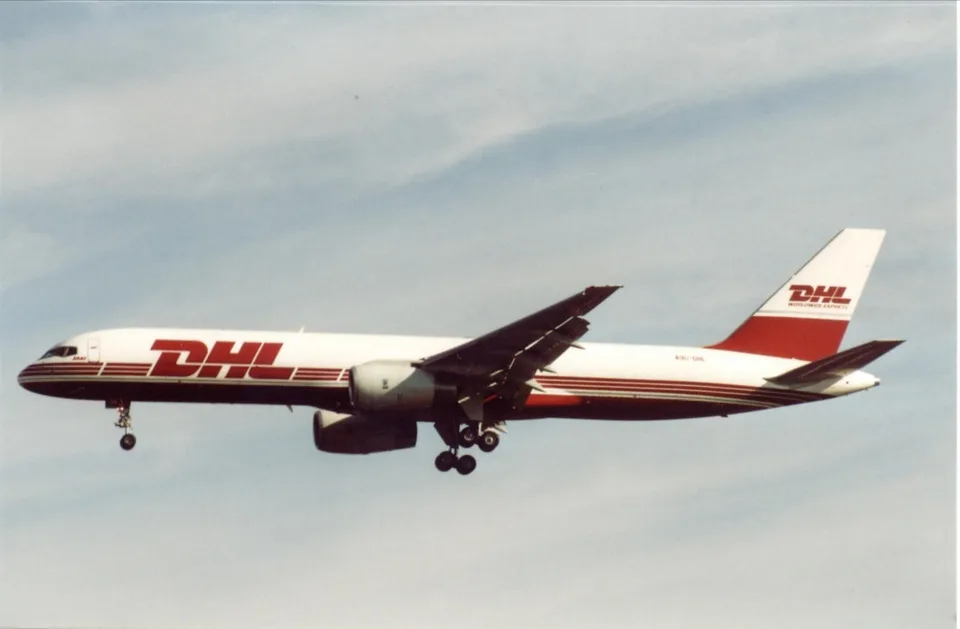
Licensed pre-accident operator and aircraft-type illustration. The BFU report does not supply the registration in its identification sections; the photo identity comes from the media provenance. This does not depict the collision.
No cropping or colour changes. Derivatives retain the stated source licence. Responsive WebP copies resized without cropping.
Geographic context
Moscow Domodedovo
Barcelona
Bergamo
Brussels
Approximate airport markers for the intended route, not an accident flight track or navigation chart. Basemap: Natural Earth, public domain.Read supporting evidence
A passenger Tupolev and a cargo Boeing 757 collided north of Uberlingen while both were descending. All 71 occupants died.
Read the full incident Follow what happened, from the flight to the investigation findings.
What investigators concluded
BFU identified late ATC recognition and the Tupolev descent contrary to its TCAS climb advisory as immediate causes, with incomplete collision-avoidance integration and tolerated single-controller night operation as systemic causes.
Two descents and the failure of separation safeguards
1,533 words / about 7 minutes to read. Based on the investigation records cited below.
Two flights enter the same controlled airspace
On 1 July 2002 a Tupolev TU154M carrying passengers from Moscow Domodedovo to Barcelona and a Boeing B757-200 carrying cargo from Bergamo to Brussels collided north of Uberlingen, near Lake Constance. The collision occurred at 21:35:32 UTC. There were 60 passengers and nine crew members on the Tupolev, and two pilots on the Boeing. All 71 died. Both aircraft were destroyed. This account follows Germany's BFU final report and its official English appendices, including the participating states' differing assessments. The report identifies the aircraft principally by type rather than registration.
The Boeing's journey had begun in Bahrain, with Bergamo as an intermediate stop. It landed there at 19:10 after a flight lasting five hours and forty minutes. The aircraft was refuelled, unloaded and reloaded before departing for Brussels at 21:06. Only the two pilots were aboard. The copilot initially flew the aircraft. Both pilots had flown together through the preceding month and had been off duty for 75 hours before this flight cycle. These are the circumstances recorded by the investigation, rather than an inferred explanation for the later conflict.
The Tupolev departed Moscow Domodedovo at 18:48 on a charter flight. Five flight crew members were in the cockpit, including an instructor and a commander under supervision. The instructor occupied the right seat, handled radio communications and was regarded by BFU as pilot in command. The aircraft entered German airspace after receiving routing instructions from Vienna. Both flights operated under instrument flight rules and subsequently came under Zurich control. The night was dark, but the report describes flight visibility at the relevant level of at least ten kilometres.
At 21:21:50 the Boeing crew contacted Zurich while climbing through flight level 260. Zurich initially cleared it to flight level 320 and later approved its request for flight level 360. The aircraft reached that level at 21:29:50 without a separate crew report. At 21:30:11 the Tupolev crew also contacted Zurich at flight level 360, having been transferred from Munich. The aircraft were approaching one another through the controlled airspace. Their presence at a shared flight level required ground separation to keep their paths safely apart.
The controller's working environment had lost important support. Sectorisation maintenance required the radar system to operate in fallback mode, and the optical short-term conflict alert was unavailable. Direct telephone connections with adjacent units were also unavailable for part of the period before the collision. BFU found that the controller did not know the optical alert was unavailable and that the system provided no automatic indication of that condition. The report addresses those technical losses as part of the operational setting, alongside the allocation of work and the preparation for maintenance.
Although two controllers were scheduled, one had retired to rest when traffic diminished. The remaining controller worked two adjacent positions and handled the two high-level aircraft as well as a delayed Airbus approaching Friedrichshafen. The Airbus used a different frequency. BFU found that the controller devoted more attention to the approach during the last five minutes before the collision. Low aircraft count therefore did not equate to low task demand. The report's conclusions extend beyond the number of radar targets to the simultaneous duties and weakened safety support.
The maintenance setting also affected coordination with neighbouring control units. The direct telephone connections were unavailable between 21:23 and 21:34:37, and there was no automatic changeover of incoming calls to the bypass system. Four incoming calls were registered shortly afterwards but went unanswered. BFU found that the written maintenance directives did not explain the effects on available equipment and that the work had not been coordinated with adjacent units. Its findings also record that colleagues present in the control room did not have tasks clearly understood by the operating controller. These facts show why the presence of other staff in the room did not automatically provide another person monitoring the developing aircraft conflict.
Ground instructions and airborne advisories conflict
At 21:34:42 the aircraft collision-avoidance systems generated traffic advisories. Seven seconds later Zurich instructed the Tupolev to expedite descent to flight level 350 because of crossing traffic. While that transmission was in progress, the instructor requested descent and the aircraft began responding. At 21:34:56 its TCAS generated a climb resolution advisory. This placed the crew in a conflict between the controller's instruction and its airborne system. The report records the subsequent cockpit discussion but does not require invented thoughts or emotions to establish what the aircraft did.
At the same time the Boeing received a descent resolution advisory. Its pilot disconnected the autopilot, pushed the control column forward and reduced thrust. The aircraft developed a descent rate of approximately 1,500 feet per minute. Fourteen seconds after the first resolution advisory, TCAS called for an increased descent. The copilot had returned to his workstation after briefly leaving it and the crew increased the descent. At 21:35:19 they reported the TCAS descent to Zurich. BFU found that the controller did not notice that message amid the communications at his positions.
The Tupolev continued down despite its climb advisory. Zurich repeated the instruction to expedite descent and supplied traffic information which was inconsistent with the other aircraft's actual relative position. The copilot questioned the descent, but the crew did not establish that TCAS should take precedence. At 21:35:24 the Tupolev received an instruction to increase its climb. It remained in descent. These details distinguish the equipment's coordinated guidance from the actions taken in response: the airborne systems had not instructed both crews to descend into the same space.
In the last seconds the crews made further control inputs. The Boeing's column was pushed fully forward about two seconds before collision. The Tupolev's column was pulled back, with thrust increased near the end, but it was still descending when the aircraft met at about 34,890 feet. The Boeing lost most of its vertical tail. The Tupolev broke into several pieces in flight. Wreckage fell north of Uberlingen, damaging fields and forest. Recorder, radar and communications evidence allowed the investigators to reconstruct a much more precise sequence than observations from the ground alone could supply.
BFU identified two immediate causes. First, air traffic control failed to notice the impending separation infringement in time, and its descent instruction came too late to ensure the required separation. Second, the Tupolev crew followed that instruction and continued descending even after TCAS advised a climb. The latter manoeuvre contradicted the generated resolution advisory. These findings explain the last operational failures without implying that the investigation considered the wider environment irrelevant. The report deliberately presents immediate causes and systemic causes as different but connected parts of the accident.
The final report's appended statements preserve disagreement. Bahrain argued that important human-factors and organisational findings were insufficiently carried into the conclusions. Russia highlighted misleading traffic information and disputed aspects of the assessment of the Boeing crew's opportunities. Switzerland sought an additional cause concerning the Tupolev's descent below the assigned flight level 350. These positions are attributed to the states that submitted them. They do not replace BFU's adopted cause statement, and their presence means the reader should not be told that every participant agreed on every causal emphasis.
The systemic conclusions addressed the integration of ACAS and TCAS into aviation operations. BFU found that international rules, national requirements and instructions from manufacturers and operators were not sufficiently standardised. They were incomplete and partly contradictory. The system's coordinated resolution advisories depended on crews responding consistently, yet the surrounding guidance did not fully reflect that philosophy. BFU also identified management and quality-assurance failures which permitted night workstations to go unstaffed and tolerated one controller working while the other rested. Those were adopted systemic causes, rather than incidental criticisms.
The recommendations addressed both airborne and ground protections. BFU called for clear international requirements that pilots follow TCAS resolution advisories even when air traffic control issues contrary instructions, unless compliance would itself jeopardise safety. It sought stronger training and uniform procedures, and recommended development of transmission of advisory information to controllers. For Zurich, it recommended minimum active staffing, additional coverage for approach duties and planned break relief. Maintenance procedures were to explain operational consequences, available redundancies and responsibilities, so technical work would not remove safeguards without an adequate operational response.
Further recommendations sought effective conflict alerts, explicit indications when an alert system was unavailable, automatic telephone rerouting and improved radar recording. Those proposals are described at their report-era dates; this account does not assert their present implementation. The investigation's central lesson is supported by its actual sequence: ground separation was lost, and an airborne avoidance layer depended on consistent responses that were not achieved. The collision therefore cannot be explained solely by counting aircraft, quoting one controller instruction or blaming TCAS for issuing the complementary advice it was designed to provide.
The report additionally recommended training suited to emergencies and to the actual operating environment. Controller exercises were to address recognition of conflicts, restoration of minimum separation and effective concise phraseology. Russian crew training recommendations called for simulators or interactive computer-based exercises involving collision-avoidance manoeuvres, together with crew resource management scenarios. The proposed protections therefore included practice under abnormal conditions as well as clearer written requirements. This is a description of BFU's recommendations, and does not establish whether a particular later training programme met them.
Matching dossiers for TCAS procedural integration: No other dossier in this collection.
Read alongside
These comparisons connect specific research topics. Shared circumstances do not establish identical causes. Evidence from both investigations is provided below.
Uberlingen concerns traffic separation and conflicting guidance. AF447 concerns unreliable airspeed and loss of control, so it is not the same mechanism. Both reports examine how training and procedural understanding support safe responses to aircraft-system information.
Explore the records below for additional context. They open on the publisher's site and are not all included in our report search. Source reuse terms apply.
Official final-report appendices, including deviating statements, May 2004
Sources and transparency
Checked against cached official report pages and specified official comments. No independent expert review.
Source limitations
The report separates immediate and systemic causes. Its appendix includes differing assessments from Bahrain, Russia and Switzerland. Aircraft registrations are not supplied in the report aircraft-identification sections. The familiar airline names in the heading follow the approved batch identity; the fact table retains the BFU identification limits.
BFU AX001-1-2/02: collision near Ueberlingen
BFU Final report, 19 May 2004. Official English translation; German version is authentic.
Private evidence cache. Only short attributed quotations in original commentary; full report and third-party illustrations are not redistributed. Source terms / provenance.
Private evidence cache. Only short attributed quotations in original commentary; full report and third-party illustrations are not redistributed. Source terms / provenance.
BFU appendices 2 and 4 to 10
BFU Official final-report appendices, including deviating statements, May 2004
Private evidence cache. Only short attributed quotations in original commentary; full report and third-party illustrations are not redistributed. Source terms / provenance.
Final Report: Accident on 1st June 2009 to the Airbus A330-203 registered F-GZCP operated by Air France flight AF 447
Bureau d'Enquetes et d'Analyses (BEA) English final report, 5 July 2012
Limited quotations for source-based commentary. Full report and illustrations are not republished. Wider reuse requires checking BEA terms. Source terms / provenance.
Kevin Murphy writes the incident accounts on AirlineIncidents.com, out of a long interest in aviation safety and the lessons each investigation leaves behind.
Prepared by
AirlineIncidents editorial desk
Report citation check
Independent expert review
Not completed
Citation checks compare supporting text with the indexed report pages. They do not constitute independent expert review. How these pages are prepared.
Revision history
: Private landmark Wave 2 original account with source-level citations.